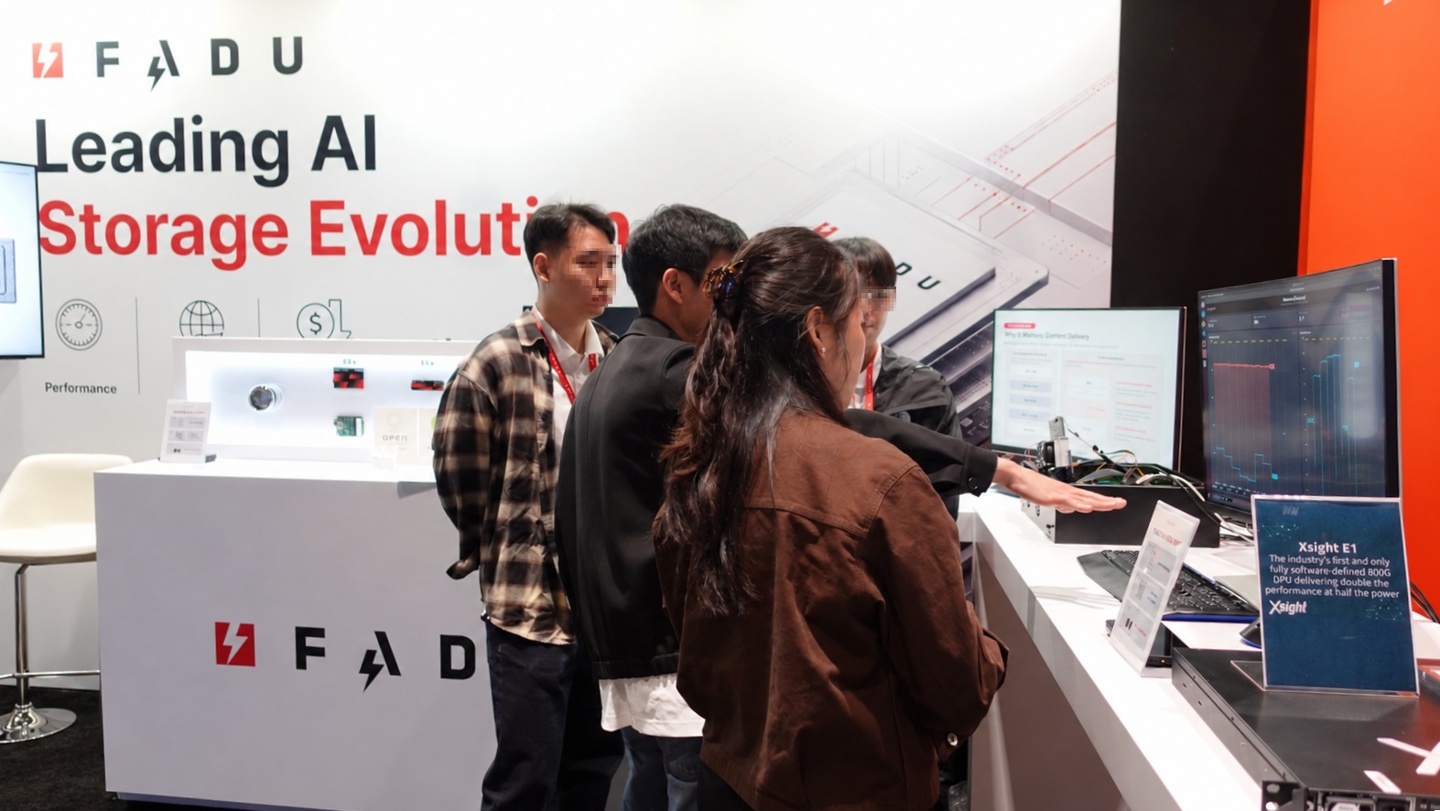
South Korean solid-state drive controller and solution provider FADU has announced a groundbreaking innovation at the 2026 OCP Global Summit: the world’s first File-Semantic SSD (FS-SSD).
Revolutionizing Data Access
Traditionally, the CPU and operating system have shouldered the responsibility for complex data management tasks such as file searching, permission control, and address translation. Solid-state drives, in this paradigm, primarily operate at the block level. This architecture necessitates that accelerators seeking to access stored files must go through the CPU as an intermediary, leading to increased latency and a heavier CPU workload.
The FS-SSD from FADU fundamentally changes this dynamic. By integrating file processing firmware directly onto the SSD and supporting NVMe commands that embed file requests, the drive gains the ability to understand and manage files independently. This allows accelerators to communicate directly with the FS-SSD, bypassing the CPU, system memory, and software layers entirely. FADU envisions this technology as the foundation for future hostless storage servers based on DPUs and scalable file storage solutions.
Introducing the ‘Sierra’ PCIe Gen6 SSD Controller
Alongside the revolutionary FS-SSD, FADU also showcased its new PCIe Gen6 SSD controller, the FC6161, codenamed ‘Sierra’. This new controller boasts impressive performance gains, delivering up to 2.5 times the performance of the previous generation. Furthermore, FADU has focused on power efficiency, with the entire drive exhibiting sequential write power consumption of less than 28W and idle power consumption below 5W. The controller itself is remarkably power-efficient, consuming less than 6W during reads and less than 7W during writes.
Implications for Accelerators and AI
The advent of File-Semantic SSDs holds significant promise for high-performance computing, particularly in areas like artificial intelligence and machine learning. By offloading file management tasks from the CPU to the storage device itself, accelerators can achieve faster data retrieval and processing. This direct data path reduces bottlenecks and allows these specialized processors to operate at their full potential. The potential reduction in latency and CPU overhead could lead to substantial improvements in training times for AI models and the overall efficiency of data-intensive workloads.
FADU’s move towards intelligent storage solutions aligns with broader industry trends focusing on disaggregation and specialized hardware acceleration. As data volumes continue to explode, innovations like the FS-SSD are crucial for building more efficient and scalable data infrastructures. The company’s commitment to pushing the boundaries of SSD technology with advancements in both architecture and controller performance signals a dynamic future for data storage and processing.