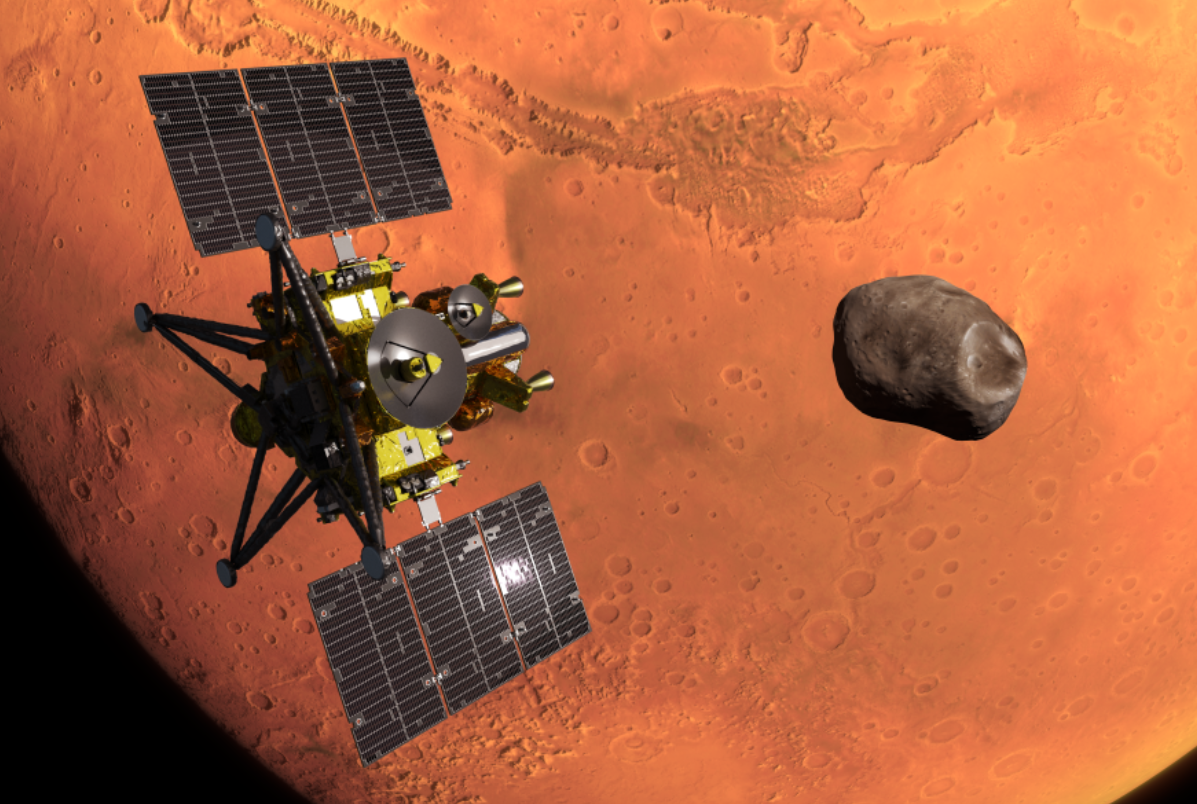
The Japanese Aerospace Exploration Agency (JAXA) is gearing up to launch its groundbreaking Mars Moon eXploration (MMX) mission on October 20, 2026. This ambitious endeavor marks humanity’s first attempt to collect samples from Phobos, one of Mars’s two moons, and return them to Earth.
A Collaborative Lunar Sample Return
The MMX mission is a collaborative effort led by JAXA, with significant contributions from NASA, the French National Centre for Space Studies (CNES), the German Aerospace Center (DLR), and the European Space Agency (ESA). This international partnership underscores the global scientific interest in understanding the Martian moons and the early solar system.
The MMX spacecraft is scheduled to depart from the Tanegashima Space Center in Japan aboard an H3 rocket. The launch is planned for 04:41 Japan Standard Time on October 20, 2026 (03:41 Beijing Time).
Mission Timeline and Objectives
Following its launch, MMX is expected to reach the Martian system in August 2027. Upon arrival, it will begin a detailed survey of both Martian moons, Phobos and Deimos, before entering orbit around Phobos in September 2027. The primary objective is to collect at least 10 grams of surface material from Phobos. This sample return is slated for 2031, with the return capsule scheduled to land in Australia before being transported to Japan for sample extraction and cataloging.
The mission also includes the deployment of a small rover named Idefix onto the surface of Phobos in early 2029. MMX itself will land on Phobos in 2030 to gather samples. During its return journey to Earth, the spacecraft will conduct flybys and further investigations of Deimos and Mars itself.
Scientific Instruments and NASA’s Role
A total of 11 scientific instruments will be carried aboard the MMX mission: seven on the main orbiter and four on the Idefix rover. The orbiter is equipped with a radiation monitor, two high-resolution cameras, and two distinct sampling devices.
NASA’s contributions are crucial, including the Mars-moon Exploration using Gamma-ray and Neutron Detector (MEGANE) and the Pneumatic Sampler (P-Sampler) technology demonstration. NASA will also provide communication and navigation support through its Deep Space Network and fund American scientists participating in the MMX science team.
Unraveling the Mystery of Martian Moons’ Origin
The origin of Phobos and Deimos has long been a subject of scientific debate. Scientists theorize they could be remnants of a massive impact on Mars that ejected material into orbit, or perhaps ancient asteroids captured by Martian gravity billions of years ago.
“Phobos and Deimos may be remnants of a giant impact on Mars that sent material into Martian orbit, or they could be ancient asteroids captured by Martian gravity billions of years ago,” said Tom Statler, MMX program executive and program scientist at NASA Headquarters. “Having answers will help reveal the early era when Earth and other planets may have acquired large amounts of water and organic compounds.”
The data and samples collected by the MMX mission are expected to provide invaluable insights into the formation of these moons and the broader history of the solar system, potentially shedding light on how planets acquire water and organic compounds.