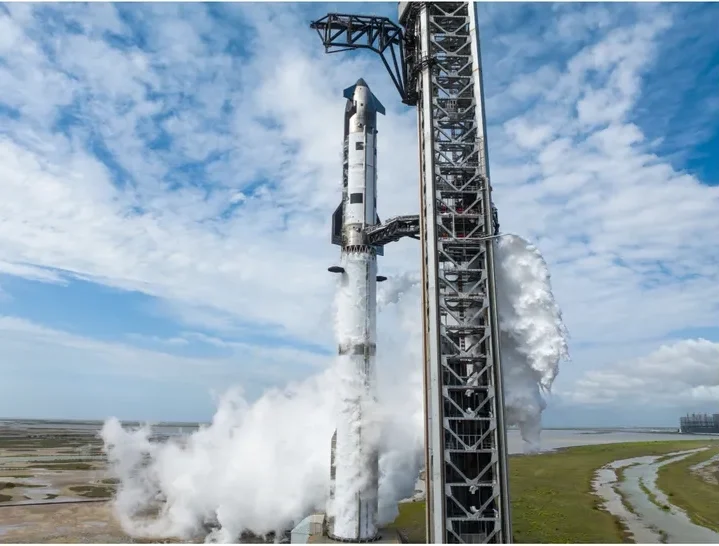
Ten years ago, Elon Musk unveiled an ambitious plan for a spacecraft designed to colonize Mars. Last month, its descendant, Starship, reached Earth orbit for the first time. But does this mark progress toward the Red Planet, or is it merely an intermediate step?
From Concept to Steel Giant
It all began in 2016 with the presentation of the Interplanetary Transport System (ITS) project, which was intended to be built from carbon fiber. The concept later evolved into the familiar stainless steel Starship. Initial prototype testing commenced in 2019, marked by both successes and dramatic failures, culminating in the successful landing of prototype SN15 in May 2021. It was at this point that NASA selected Starship as the first lunar lander for the Artemis program.
A Long Road to Space
The full-scale version of Starship, comprising the reusable Super Heavy booster and the Ship upper stage, first took to the skies in April 2023 but was lost minutes into the flight. The subsequent three flights, conducted in less than a year, allowed the vehicle to reach space, though the Starship was still lost during re-entry. A revolutionary development occurred during a 2024 test flight when SpaceX successfully transferred liquid oxygen between tanks in one of the Ship modules—a crucial operation for future interplanetary missions. In June of the same year, engineers achieved a controlled splashdown of both stages, and in October, the launch complex successfully “caught” the returning Super Heavy booster with its clamps for the first time.
Progress has not been linear. Following the successful booster landing in January 2025, a series of failures occurred with the upper stages, and one exploded during ground testing. A clean flight in August 2025 helped break this trend, and by October, SpaceX phased out older versions of the spacecraft. The first Starship V3 launched in May 2026, the second in July, and on September 28th, the 14th test flight successfully placed the vehicle into Earth orbit.
Mars or Low Earth Orbit?
Analysts are divided on Starship’s true objective. According to Matthias Renz, from the European Space Policy Institute (ESPI), the spacecraft’s primary role currently is to reduce the cost of launching Starlink satellites. SpaceX has already deployed over 11,000 Starlink satellites using its Falcon 9 rocket, but the new Starlink V3 constellation, comprising 100,000 spacecraft, specifically requires Starship due to its larger size and weight. Renz suggests that the focus on the Moon is driven by NASA’s priorities and SpaceX’s desire to remain a central player in the Artemis program.
However, Joseph Gonzalez, a professor of aerospace engineering at the University of Illinois, holds a different view. He is convinced that SpaceX remains focused on Mars, viewing the Moon as a “proving ground” for technology development before undertaking complex missions to the Red Planet. “Developing space systems of this complexity takes time. They build, they launch, they learn, they iterate, and they launch again,” Gonzalez notes, emphasizing that this iterative approach allows for rapid accumulation of experience and data.
Despite orbital success, the main challenges lie ahead. Transferring large volumes of cryogenic propellant between spacecraft in orbit is one of the most underestimated tasks. Although SpaceX has already demonstrated propellant transfer within a single vehicle, flights to the Moon or Mars will necessitate numerous refuelings from orbital tankers.