Astronomers, utilizing NASA’s Chandra X-ray Observatory, have successfully unraveled the mystery behind a striking radio wave structure humorously nicknamed the “Treble Clef” due to its uncanny resemblance to the musical symbol. Researchers have determined that this unique formation is most likely the result of a two-stage cosmic event: an eruption from a supermassive black hole followed by the collision of two galaxy clusters. This discovery offers valuable insights into the dynamics of cosmic-scale interactions and the processes governing the largest structures in the universe.
An Obscured View: Why the ‘Treble Clef’ Was Difficult to Pinpoint
Unraveling the origin of the “Treble Clef” presented a significant challenge. The cosmic structure is located nearly directly behind the plane of our own Milky Way galaxy. The stars, gas, and dust within our galaxy substantially block observations from Earth, creating a kind of “cosmic veil.” However, by employing telescopes capable of peering through these obstructions, a team of scientists was able to identify the cause of this unusual shape.
Using data from NASA’s Chandra X-ray Observatory and Germany’s eROSITA (Extended RÖntgen Survey with an Imaging Telescope Array), astronomers detected diffuse hot gas at the location of the “Treble Clef,” confirming its presence within a galaxy cluster. The researchers also determined that this cluster is, in fact, composed of two objects in the process of merging. Galaxy clusters are among the largest structures in the universe, containing hundreds of galaxies and vast quantities of superheated gas.
A Two-Stage Cosmic Interaction Story
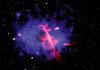
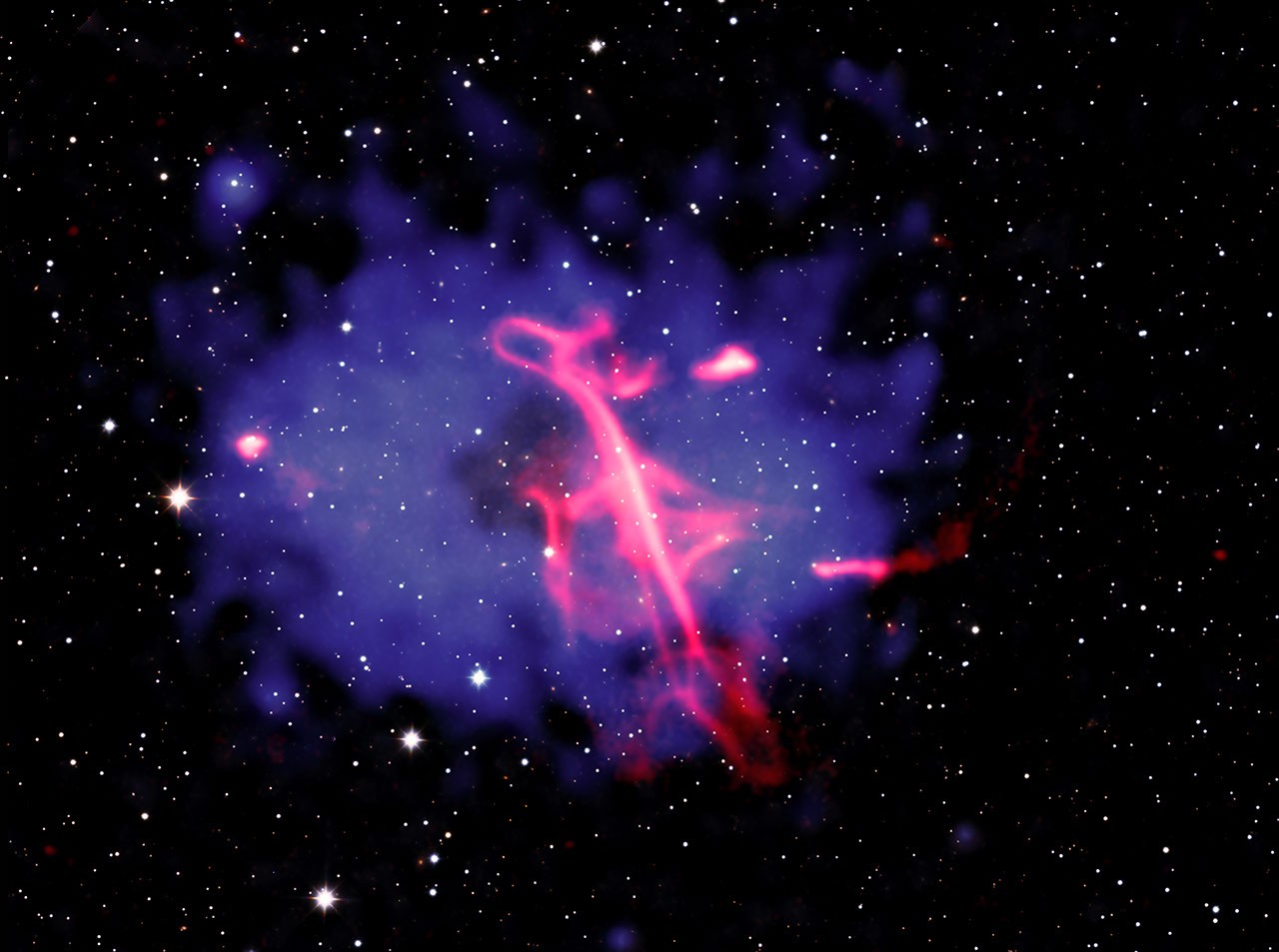
The new composite image of the “Treble Clef” and its host cluster combines data from multiple sources. The multi-million-degree gas detected by Chandra and eROSITA is rendered in blue. Specific processing techniques were applied to some of Chandra’s data to highlight crucial details. Radio data from the LOw Frequency ARray (LOFAR) – a large network of radio telescopes across Europe – is shown in red, reproducing the same shape that resembles musical notation. Infrared data from the United Kingdom Infrared Telescope (UKIRT) adds white hues to the image.
The study’s authors concluded that the “Treble Clef” likely formed through a two-stage process:
- Initially, a powerful outflow from a supermassive black hole at the center of a galaxy cluster ejected clouds of charged particles and magnetic fields at nearly the speed of light. This created a kind of “cosmic crescendo,” initially generating bright radio waves that later faded as they lost energy.
- Subsequently, the collision of the two clusters compressed or re-energized this gas cloud, causing it to become brighter again in radio wavelengths. Shock waves, akin to the sonic booms from supersonic aircraft, may have played a role in this process.
To detect evidence of the cluster collision within Chandra’s data, the authors employed a specialized technique that analyzed deviations in the hot gas’s symmetry. Typically, gas at the center of a cluster forms an oval, symmetrical structure. By subtracting this symmetrical component, the residual X-ray emission appeared brightest on the sides and weakest in the center. This indicates that the collision between the two clusters likely occurred from left to right in the image, with the clusters moving away from each other.
It is worth noting that the resemblance to a treble clef is an example of pareidolia – a psychological phenomenon where humans perceive familiar patterns in random data. There is no scientific connection to musical notation itself.
Source: NASA