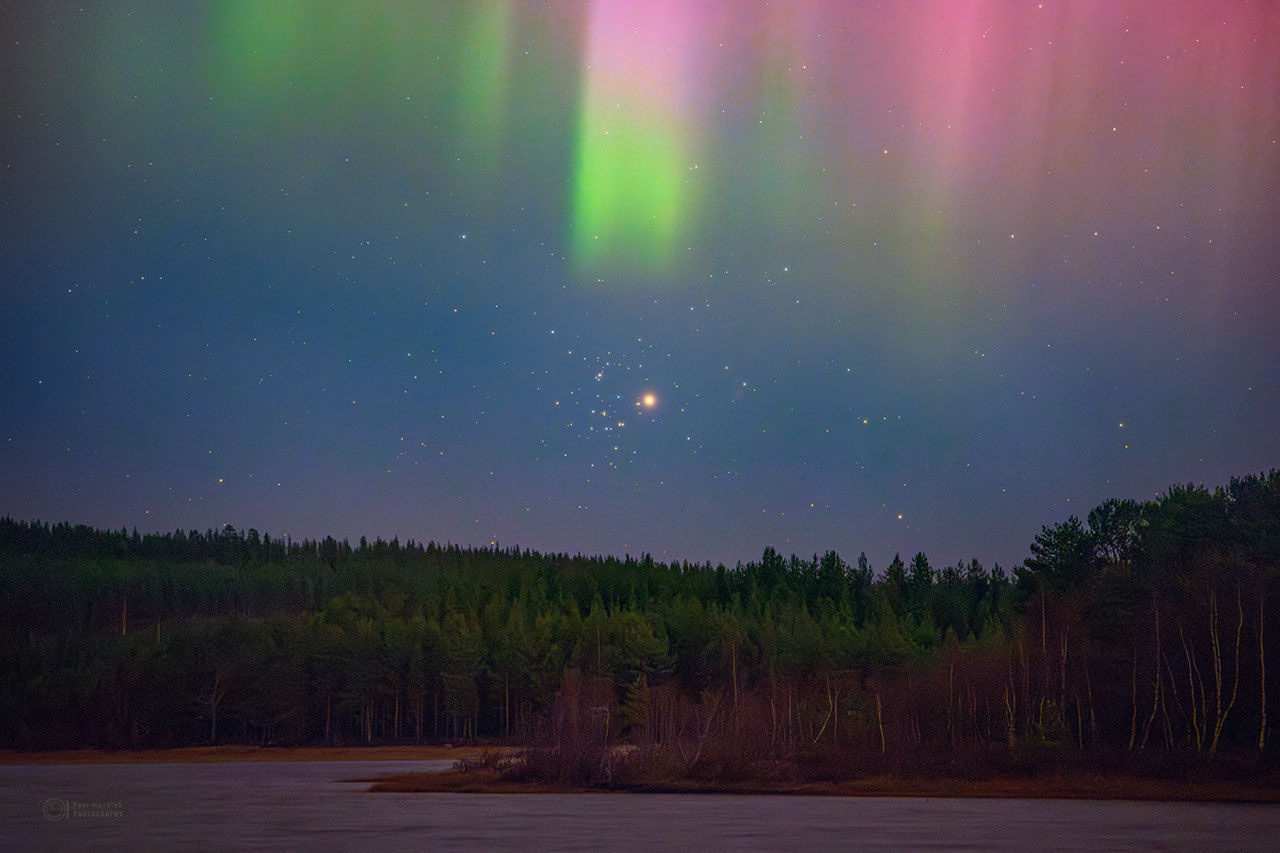
In a breathtaking cosmic coincidence, the red planet Mars aligned with the famous Beehive star cluster (M44) beneath a vibrant auroral display. Captured near Lansjärv, Sweden, this stunning image showcases the dramatic intersection of solar activity, planetary positions, and deep-sky wonders. The aurora, a celestial light show typically seen near the Earth’s poles, was triggered by a powerful solar eruption that reached our planet, exciting atmospheric particles and causing them to emit light.
A Celestial Dance Under the Northern Lights
The photograph, taken on October 14, 2026, highlights a rare alignment where Mars appeared almost directly in line with the heart of the Beehive cluster. This open cluster, also known as Praesepe, is a collection of young, hot stars located about 580 light-years away in the constellation Cancer. While bees have ventured into space, this cluster’s name refers to its appearance as a swarm of stars rather than actual insects. Studying the rotation of these stars has provided valuable insights into how stars evolve and slow down over time, losing mass through stellar winds.
The Science Behind the Spectacle
The spectacular aurora, known as ‘guovssahasat’ in the North Sámi language, is a direct result of the Sun’s dynamic activity. A significant eruption from the Sun on October 10, 2026, sent a wave of energetic particles towards Earth. When these particles interact with Earth’s magnetic field and atmosphere, they excite atmospheric molecules, causing them to release energy in the form of colorful light. This phenomenon is not only visually stunning but also a constant reminder of the powerful forces at play in our solar system.
The indigenous Sámi people, who traditionally inhabit Arctic regions like Sweden, have long held a deep respect for auroras, viewing them as significant natural phenomena. The convergence of Mars and the Beehive cluster with this terrestrial light show adds another layer of wonder to this already captivating astronomical event.
Source: NASA