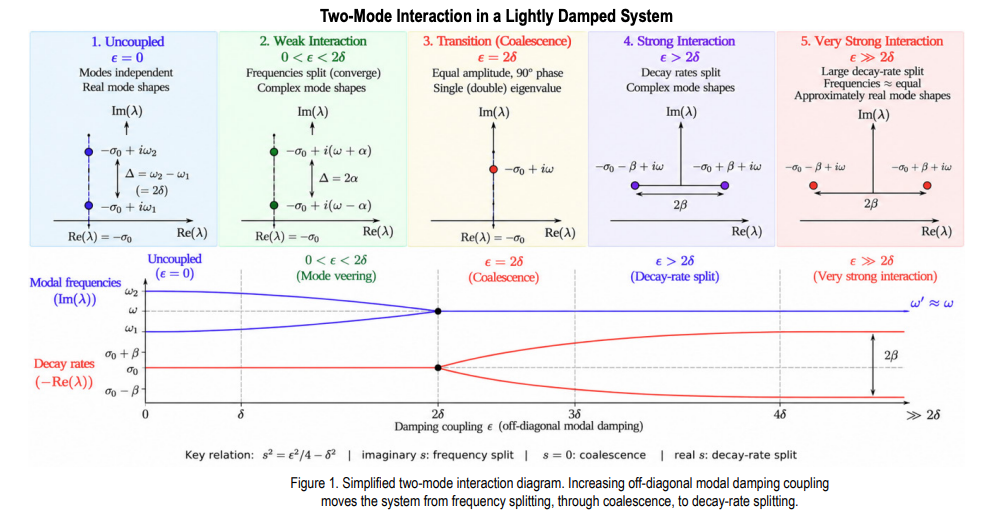
NASA engineers have developed a new way to understand how the structures of spacecraft and other complex systems can behave in unexpected ways, even when they are designed with minimal energy loss. This research, focusing on ‘complex modes,’ provides crucial insights for designing more stable and reliable spacecraft, potentially impacting everything from satellites to deep space exploration vehicles.
Understanding ‘Complex Modes’ in Engineering
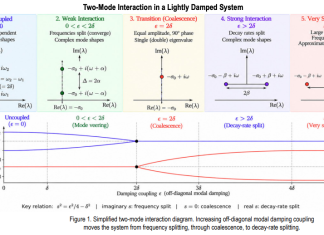
When engineers analyze the structural integrity of objects like spacecraft, they often assume that vibrations will dissipate quickly due to damping. However, NASA’s latest research reveals that even in systems with very low damping, ‘complex modes’ can emerge. These complex modes occur when two specific vibrational frequencies of a structure are very close together and interact in a unique way. As this interaction intensifies, the frequencies appear to merge, and the way the structure vibrates (its ‘mode shape’) becomes significantly more intricate.
From Simple Vibrations to Intricate Patterns
Traditionally, engineers have viewed the vibrations of lightly damped structures as predictable and easily managed. This new perspective highlights that when two structural modes are closely spaced in frequency, they can become coupled through nonproportional damping. This coupling can lead to a phenomenon where the two frequencies appear to coalesce, or come together, at a critical point. Beyond this point, the frequencies might remain similar, but the way these vibrations decay can become distinctly different, splitting into separate decay rates. This detailed understanding helps engineers interpret complex vibrational behaviors that might otherwise be mistaken for issues like material fatigue, nonlinearity, or even faulty test data. The framework developed by NASA offers a more nuanced interpretation of these phenomena, including ‘mode veering,’ the formation of complex modes, eigenvalue coalescence, and decay-rate splitting, providing a vital tool for advanced structural analysis.
Source: NASA