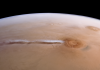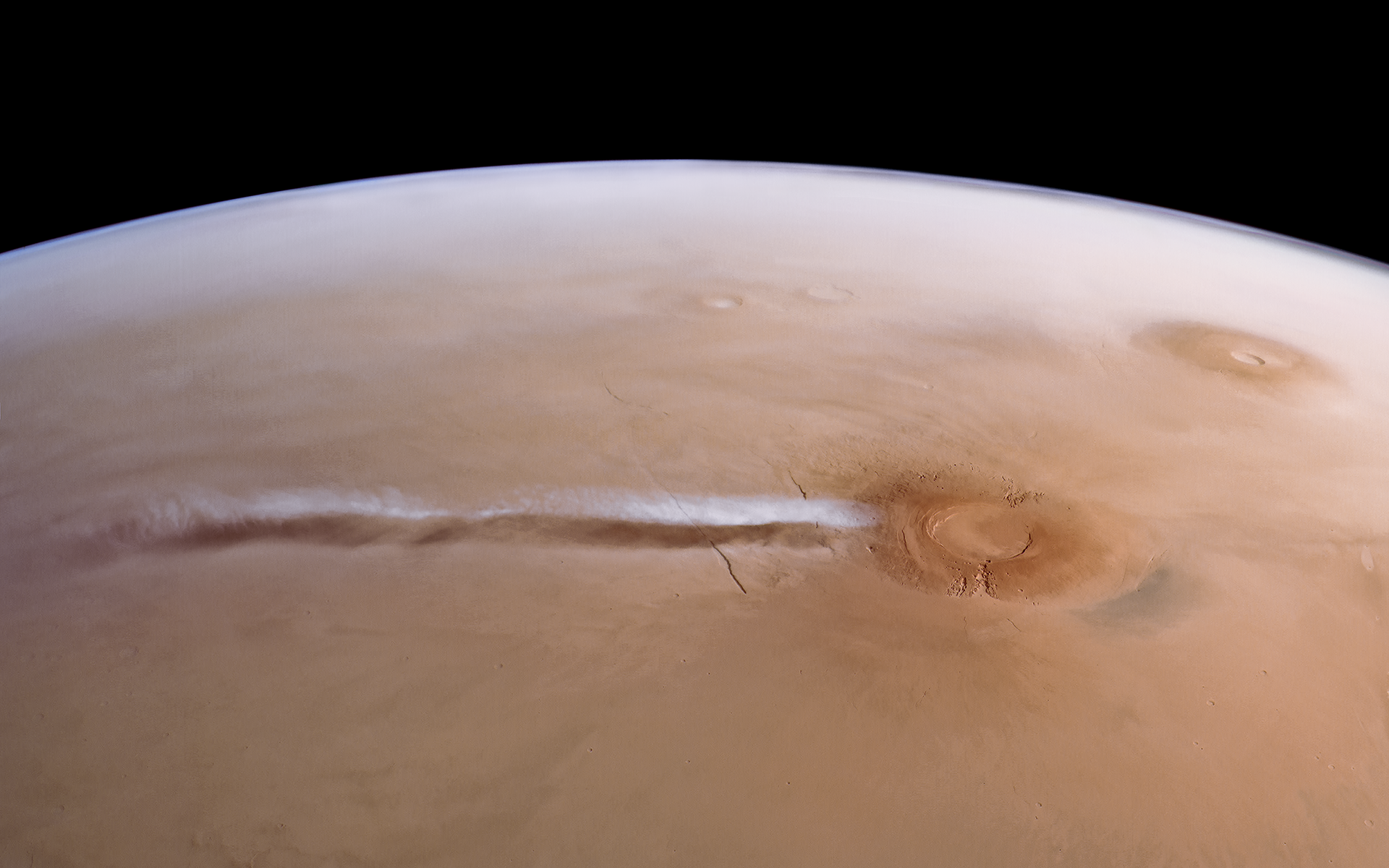
Scientists have uncovered evidence suggesting that Mars’s most visually striking cloud, the Arsia Mons Elongated Cloud (AMEC), might form through a rare and exotic atmospheric process previously thought to be theoretical. Using data from the European Space Agency’s Mars Express orbiter and a sophisticated meteorological model, researchers found that the cloud’s formation likely involves water vapor freezing directly into ice crystals without the need for atmospheric particles, a phenomenon known as homogeneous nucleation. This process, rarely observed and never before definitively identified in a planetary atmosphere, could revolutionize our understanding of cloud formation not only on Mars but also across the cosmos.
A Daily Martian Spectacle Explained
Each Martian spring and summer, as the Red Planet enters its dusty season, a remarkable white cloud emerges downwind of the massive Arsia Mons volcano. This cloud, officially named the Arsia Mons Elongated Cloud (AMEC), is a striking phenomenon, stretching up to an astonishing 1800 km – nearly twice the length of the UK. It materializes, grows, and dissipates daily, repeating this cycle for several months. First observed by Mars Express in 2018, the AMEC was initially understood to be an orographic cloud, similar to those formed on Earth when wind interacts with mountains. However, previous attempts to model its formation failed to accurately replicate the observed cloud, prompting further investigation into the underlying physics.
Unexpected Physics Behind the Cloud
The breakthrough came when researchers incorporated a less common, almost theoretical, physical process into their modeling: homogeneous nucleation. Unlike typical cloud formation, which relies on water vapor condensing onto tiny particles like dust or salt (heterogeneous nucleation), homogeneous nucleation allows water vapor to directly transform into ice crystals. “For the AMEC, it seems that cloud formation takes place without needing any of this ‘stuff’,” explained Jorge Hernández-Bernal, lead author of the new study. “Water vapour turns directly into icy cloud particles without any middle step. It’s akin to droplets of condensation appearing in the middle of a room, rather than on a window. We call this homogeneous nucleation, and we’ve never seen it before in a planetary atmosphere. It’s wholly unexpected.” This phenomenon requires extreme humidity levels, far exceeding those typically experienced on Earth, suggesting that Mars’s atmosphere can indeed reach such extraordinary conditions in specific locations. The unique topography of Arsia Mons, combined with Mars’s thin atmosphere, creates powerful atmospheric waves that rapidly lift moist air, causing a dramatic drop in temperature and a spike in humidity, thus enabling this rare process.