Amazon’s Strands Agents team has unveiled a new open-source decision model, dubbed Strands Decider 2B. Announced on October 1st, this innovative model is now available on GitHub, with its weights accessible via Hugging Face. A key feature of Strands Decider 2B is its capability to run efficiently on local CPU and GPU hardware, marking a significant step towards more accessible and decentralized AI applications.
Technical Foundations and Architecture
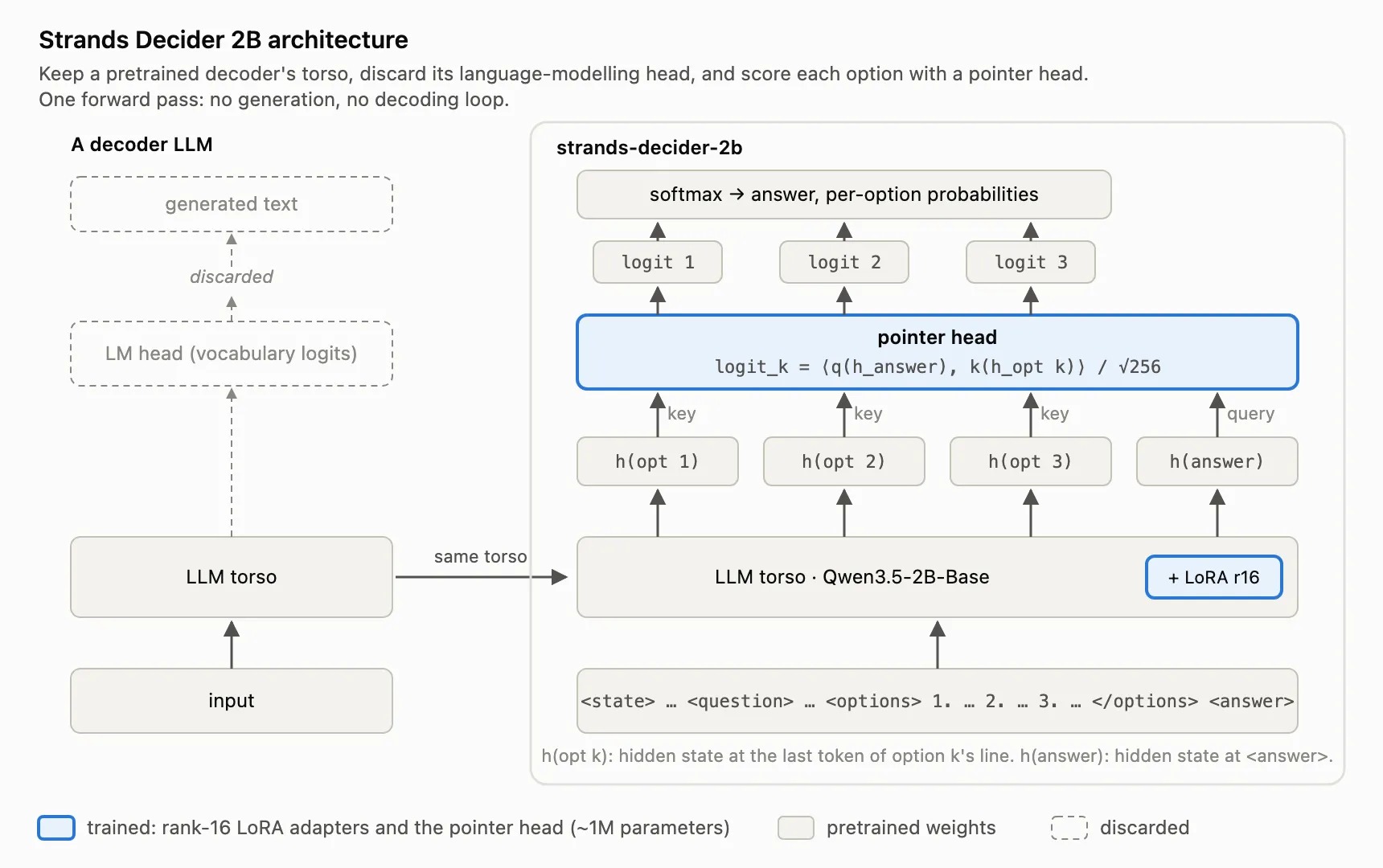
Strands Decider 2B is built upon the foundation of the pre-trained Qwen3.5-2B model, serving as its ‘trunk.’ However, Amazon’s team has ingeniously replaced the original language model’s ‘head,’ which was designed for text generation, with a new ‘head’ specifically engineered for scoring capabilities. This new head is remarkably compact, featuring just over a million parameters. The ‘trunk’ itself undergoes fine-tuning through a rank-16 LoRA adapter, optimizing its performance for decision-making tasks.
Performance and Benchmarking
In terms of performance, Strands Decider 2B has demonstrated impressive results on the JevBench public dataset, showcasing both high accuracy and good calibration. Notably, within the 2B parameter class of models, it secured the 3rd position, outperforming all competitors that strictly adhere to the 2B parameter limit. This ranking highlights the model’s efficiency and effectiveness in its size category.
Local Deployment and Latency
One of the most compelling aspects of Strands Decider 2B is its low latency when running on commonly available hardware. The model achieves a median decision latency of 113 milliseconds for local deployments. When tested on a high-end NVIDIA GeForce RTX 3090 GPU, it handled small decision tasks with a median latency of 153 milliseconds. These figures underscore the model’s suitability for real-time applications where swift decision-making is crucial.
Implications for Developers and Businesses
The open-sourcing of Strands Decider 2B, coupled with its ability to run locally, offers significant advantages for developers and businesses. It lowers the barrier to entry for implementing sophisticated AI decision-making capabilities, allowing for greater control over data privacy and potentially reducing operational costs associated with cloud-based AI services. The model’s performance on standard hardware suggests it could be integrated into a wide range of applications, from robotics and automation to data analysis and customer service tools, without requiring massive computational resources.
The Future of Local AI
Amazon’s release of Strands Decider 2B aligns with a growing trend towards edge computing and on-device AI. By providing powerful, yet resource-efficient, open-source models, companies like Amazon are empowering a broader community of innovators to develop and deploy AI solutions more flexibly. The focus on decision-making specifically also points to the increasing sophistication of AI models that can go beyond simple pattern recognition to perform complex logical operations.