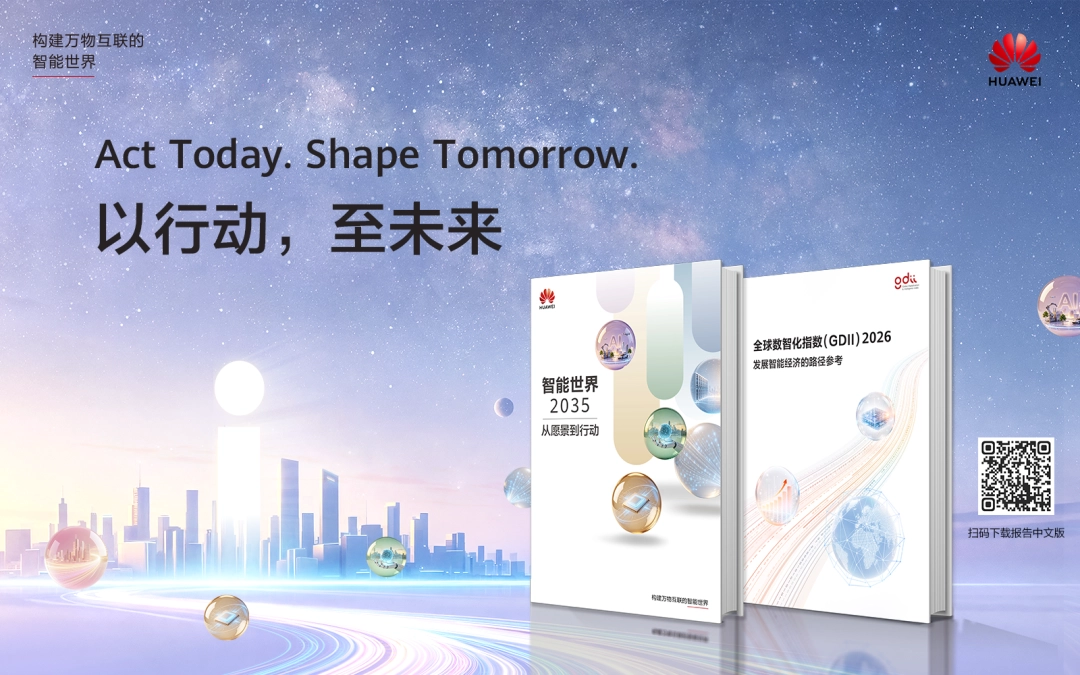
Huawei has unveiled its latest report, Intelligent World 2035: From Vision to Action, charting a course toward a future dominated by intelligent agents. The report, released during a virtual conference themed ‘Action, Towards the Future,’ outlines ten key propositions crucial for navigating this transformative era.
AI Agents: The New Paradigm
The report highlights a significant shift in the digital landscape, moving from an application-centric model to one centered around intelligent agents. These agents are characterized by their ability to continuously perceive their environment, make autonomous decisions, dynamically utilize tools, and interact with humans in real-time. Each of these actions generates and circulates a massive volume of ‘tokens,’ a fundamental unit for AI processing.
Huawei forecasts a staggering 100,000-fold increase in global annual token consumption by 2035. With agent traffic expected to constitute over 90% of this total, the demands placed on computing power, network infrastructure, and cloud services will far exceed those of traditional internet applications. This projection forms the basis for the report’s ten key propositions and research directions.
Ten Propositions for an Intelligent Future
The report’s ten propositions address the core challenges and opportunities in building this future:
- Achieving AGI: Developing Artificial General Intelligence (AGI) with autonomous cognition and universal capabilities, emphasizing that progress in areas like language intelligence, embodied intelligence, and scientific intelligence is vital, and interaction with the physical world is a necessary step.
- Computing Power Expansion: A hundredfold increase in computing cluster scale and a thousandfold decrease in agent task costs, shifting computational architecture from single-chip power to a ‘super-node’ centered Token high-efficiency system.
- Intelligent Memory Systems: Building new storage and memory systems that are causally accurate and traceable, facilitating an evolution from ‘data’ to ‘knowledge and memory.’
- AI-Integrated Networks: Fully integrating AI into communication systems to create an experience-centric intelligent connectivity foundation.
- Next-Gen Chip Design: Deepening chip design methodologies and tools under Moore’s Law, replacing ‘geometric scaling’ with ‘time scaling’ to optimize latency and energy efficiency, ensuring continued semiconductor industry evolution.
- Agent Operating Systems: Evolving from environmental control to self-evolution, with Agent OS becoming the native technical foundation for intelligent agents. Its core capabilities are summarized as ‘(Synergy Power × Execution Power × Memory Power × Connectivity Power) ^ Evolution Power’.
- Ubiquitous Terminal Intelligence: Defining new forms of terminal intelligence that are seamlessly adaptive and universally accessible, allowing intelligent services to persist across devices and scenarios.
- Autonomous Driving Evolution: Achieving self-learning and extreme safety in intelligent driving, transforming vehicles from mere transportation tools into ‘mobile embodied intelligent agents.’
- IDC Power and Cooling: Overcoming power supply and cooling challenges to enable Intelligent Data Centers (AIDC) to support even larger computing scales.
- Agent Security and Privacy: Establishing robust security and privacy protection for autonomous agents to build a trusted and controllable security foundation for the intelligent world.
Economic Impact of Digital Transformation
In conjunction with the Intelligent World 2035 report, Huawei also released the Global Digital and Intelligent Index (GDII) 2026, co-authored with the Institute of Economics at Tsinghua University. This report projects that AI will generate over $27 trillion in cumulative economic value over the next five years. It also anticipates accelerated investment in global digital and intelligent infrastructure, with a compound annual growth rate of 19.14%, exceeding $4 trillion by 2030.
The findings underscore the profound societal and economic shifts anticipated in the coming decades, driven by advancements in artificial intelligence and the increasing integration of intelligent agents into every facet of life.