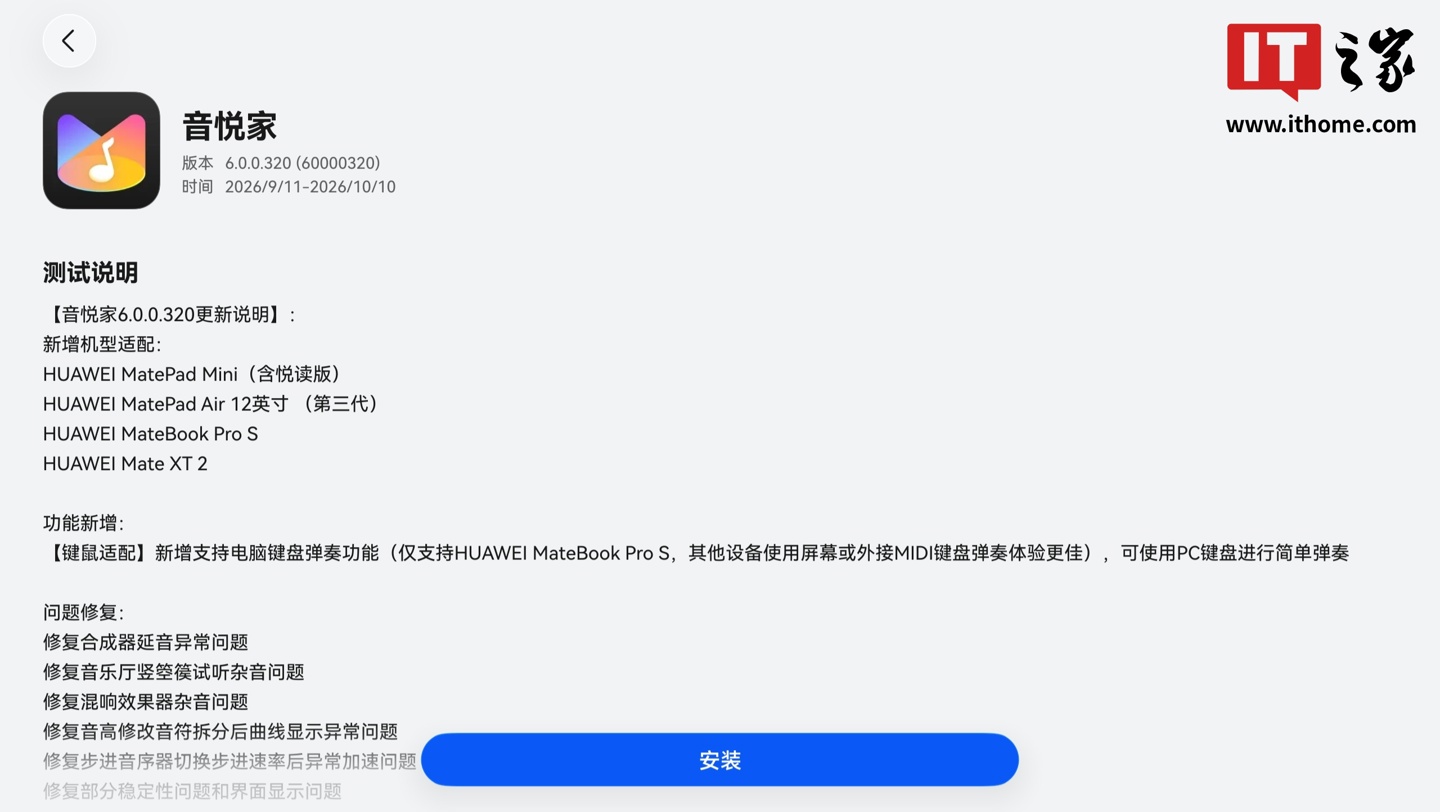
Huawei has rolled out a significant update to its SoundUp (音悦家) App, bringing version 6.0.0.320 to users via the Huawei App Gallery. This latest release introduces support for several new devices, including the HUAWEI MatePad Mini (including the Reading Edition), the HUAWEI MatePad Air 12-inch (3rd generation), the HUAWEI MateBook Pro S, and the much-anticipated HUAWEI Mate XT 2.
SoundUp is Huawei’s in-house developed application designed to cover the entire digital music creation workflow. It encompasses four core stages: composition, recording, arrangement, and mixing. The app boasts a comprehensive library of over 200 classic Western and Chinese instruments, aiming to provide musicians with a powerful tool for their creative endeavors. Public beta testing for SoundUp commenced on June 1st of this year.
It’s important to note that SoundUp has relatively high hardware performance requirements and is currently only compatible with devices running HarmonyOS 6.1 or later. Huawei has provided a detailed support plan outlining device compatibility and estimated support timelines, which extends to Q3 and Q4 of 2026 for many models, indicating a commitment to long-term software support for its ecosystem.
Device Compatibility and Support Timelines
- Notebooks: The HUAWEI MateBook Fold series and HUAWEI MateBook Pro S are slated for support until Q3 2026.
- Tablets: Several MatePad models, including the MatePad Pro series (various screen sizes and years), MatePad Mini series, and MatePad Air series, have staggered support end dates through Q3 and Q4 of 2026. Some models like MatePad Edge, MatePad Pro 12-inch, and MatePad Air 12-inch (3rd Gen) are already available on the app market.
- Smartphones: The HUAWEI Mate XT 2 is also now available on the app market.
In a previous statement, Zhu Dongdong, President of Huawei’s Terminal Tablet and PC Product Line, acknowledged that developing professional music creation software like SoundUp is a significant investment with no immediate commercial return, describing it as a “pure input” effort. He highlighted that while domestic companies are developing note-taking and drawing software, the music application space was largely vacant, prompting Huawei to take the initiative.
“Huawei aims to bring China’s classical instruments, at least those found in museums, into the software,” Zhu Dongdong stated previously. “This will allow music producers to use high-precision sampled classical instruments to compose music in the future.”
This initiative underscores Huawei’s commitment to enriching its HarmonyOS ecosystem with advanced creative tools. By digitizing and making accessible a vast collection of classical instruments, Huawei is not only supporting professional musicians but also fostering music education and cultural preservation within its digital platform. The expansion of SoundUp’s device compatibility is a welcome move for music enthusiasts and creators within the Huawei user base.