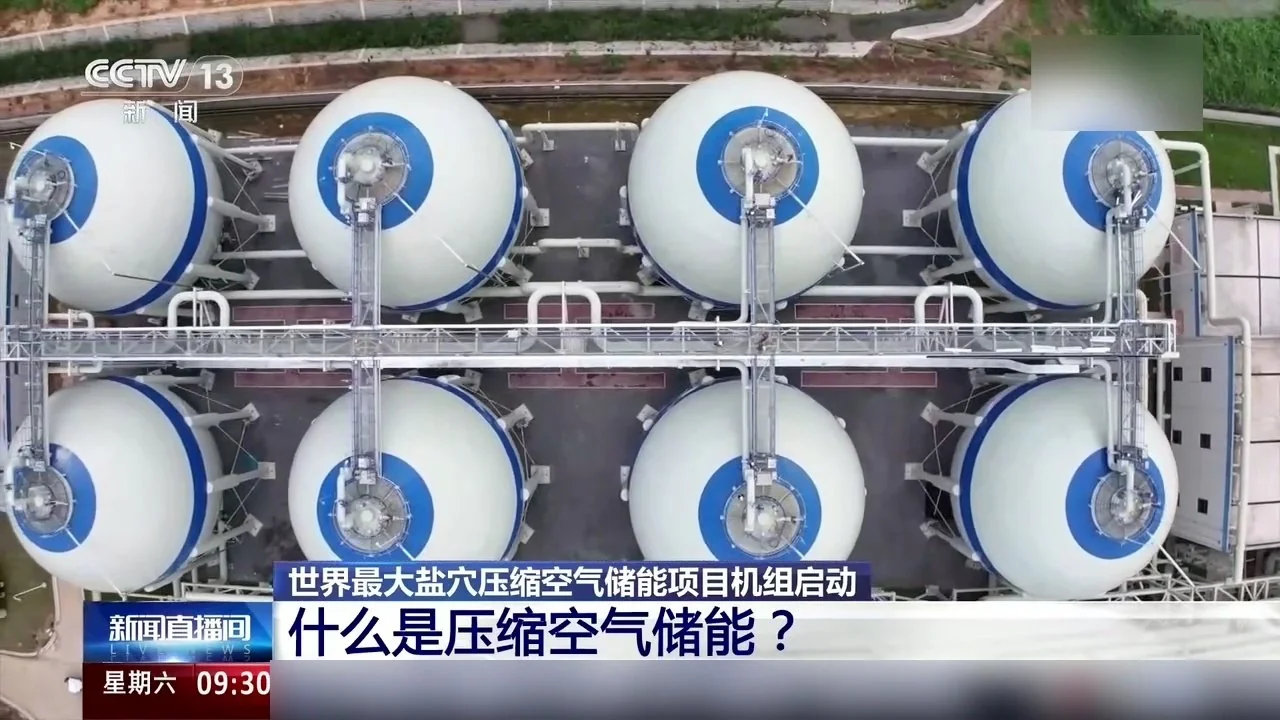
In a significant advancement for energy storage, the world’s largest salt cavern compressed air energy storage (CAES) project has successfully completed the full startup of its two units in Jintan District, Changzhou, Jiangsu, China. This milestone, reported by CCTV News, validates the operational stability of the equipment and marks a major breakthrough in China’s core technologies and system integration capabilities for large-scale salt cavern CAES.
A ‘Super Power Bank’ for the Grid
Compressed air energy storage power stations function like a ‘super power bank’ for the electricity grid, utilizing a cycle of heat and gas storage for low-peak electricity storage and high-peak power generation. Crucially, this process requires no burning of fossil fuels, achieving true zero-carbon emissions.
How It Works
- During periods of low electricity demand, surplus power from the grid is used to drive compressors. These compressors then pressurize ambient air to over 130 atmospheres, injecting it into underground salt caverns for storage. Simultaneously, a thermal storage system captures and recycles the heat generated during compression.
- When demand peaks, the high-pressure air from the salt caverns is steadily released to drive turbine generators, producing a continuous supply of clean electricity.
Air stored deep within salt caverns, approximately 1000 meters underground, is released at high pressure (over 130 atmospheres). This high-pressure air is then transported to the surface power plant, where it drives generator units to produce a steady stream of clean, green electricity.
As an energy storage facility, the project is designed for approximately 330 charge-discharge cycles annually, with the capacity to store 2.8 million kilowatt-hours of electricity on a single charge.
Record-Breaking Capacity and Performance
The two units that recently underwent full startup each possess a capacity of 350 megawatts (MW). This brings the total installed capacity of the project to the forefront globally for salt cavern CAES initiatives.
During the startup process, critical indicators such as vibration, temperature, and pressure all performed better than their designed specifications. Once operational, the project is poised to provide robust support for grid peak shaving and supply assurance. Furthermore, it is expected to significantly enhance the capacity for integrating renewable energy sources like wind and solar power into the grid.