Xiaomi has officially entered the advanced structured data landscape with the release of its groundbreaking large model, Xiaomi-TabLDM. This innovative model promises to revolutionize how businesses handle and analyze tabular data, a format ubiquitous across critical sectors like finance, healthcare, manufacturing, and logistics.
A Unified Approach to Tabular Data
Traditionally, working with tabular data has been a resource-intensive process. Each new dataset or analytical task often required extensive retraining, parameter tuning, and complex model integration. This meant significant deployment costs and management overhead. Xiaomi-TabLDM aims to change this paradigm by introducing a “train once, use across tasks” foundation model approach specifically designed for structured data.
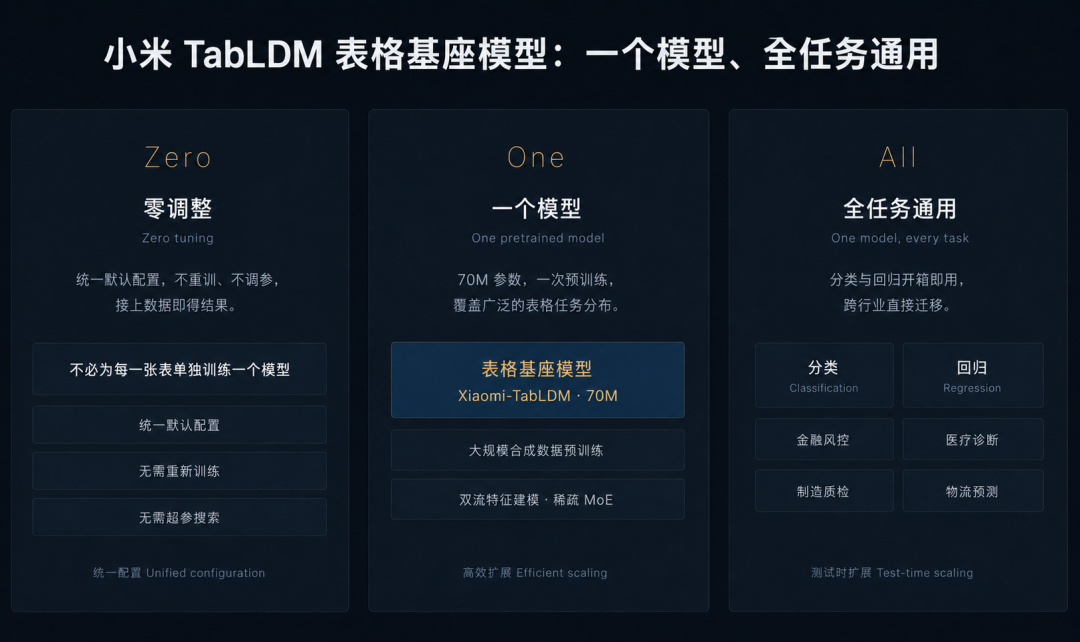
The core strength of Xiaomi-TabLDM lies in its ability to adapt to different tabular datasets with a single pre-trained model and uniform default configurations. This eliminates the need for task-specific retraining or fine-tuning, streamlining the entire analytical workflow for classification and regression predictions.
Advancing the Frontiers of Tabular AI
Xiaomi-TabLDM pushes the boundaries in three key areas:
1. Advanced Pre-training
The model’s pre-training is built entirely upon a massive synthetic dataset generated using Structural Causal Models (SCM). This approach ensures coverage of diverse data scales, variable types, dependency relationships, and functional relationships, significantly broadening the pre-training task distribution and enhancing generalization capabilities.
2. Innovative Model Architecture
Xiaomi-TabLDM incorporates a sophisticated architecture featuring:
- Dual-stream feature grouping: This technique allows for modeling feature relationships at different granularities.
- Lightweight Attention Residual: Enhances the model’s ability to capture complex patterns efficiently.
- Sparse Mixture-of-Experts (MoE): This mechanism expands the model’s capacity by selectively activating specialized sub-networks, leading to more efficient and powerful processing.
3. Enhanced Inference Capabilities
The model explores “Test-Time Scaling” to further boost predictive performance. By increasing computational effort during the inference phase without altering the pre-trained model parameters, Xiaomi-TabLDM can continuously improve its prediction accuracy.
Top-Tier Performance Across Benchmarks
Xiaomi-TabLDM has demonstrated exceptional performance, securing a place in the top tier across four major public benchmarks:
- It achieved the number one ranking on the OpenML-CTR23 regression leaderboard.
- On the TALENT, TabArena, and BCCO regression tasks, it secured the second position.
- Furthermore, it claimed the first place in the TALENT binary classification task.
The model also excels in balancing performance and efficiency. In the TabArena regression task, for instance, Xiaomi-TabLDM achieved the second-highest Elo score while significantly outperforming competitors in training and prediction times. It required 82% less training time and 68% less prediction time compared to the top-ranked TabFM.
Real-World Industrial Validation
Beyond benchmarks, Xiaomi-TabLDM has been validated in real-world industrial scenarios, showcasing superior predictive accuracy and cross-scenario adaptability compared to traditional machine learning methods:
- In material property prediction, the model achieved a 130% increase in predictive accuracy without any fine-tuning, drastically reducing the need for costly trial-and-error testing by approximately 90%.
- For part weight prediction, it reduced the proportion of erroneous samples by about 31% compared to XGBoost.
- In production component prediction, the average error was reduced by approximately 54% compared to XGBoost. Notably, when production conditions changed, the model could adapt rapidly by incorporating just around 30 new samples from the changed conditions, reducing the average error by approximately 62%.
Accessibility and Open Source
Xiaomi-TabLDM is designed for ease of use, offering a scikit-learn compatible interface that can be easily installed via pip. This makes it accessible for a wide range of developers and data scientists.
In a move that underscores its commitment to advancing AI research, Xiaomi has made the model weights and code publicly available. Researchers and developers can access the code on GitHub and the model weights on Hugging Face, along with a detailed technical report on arXiv.