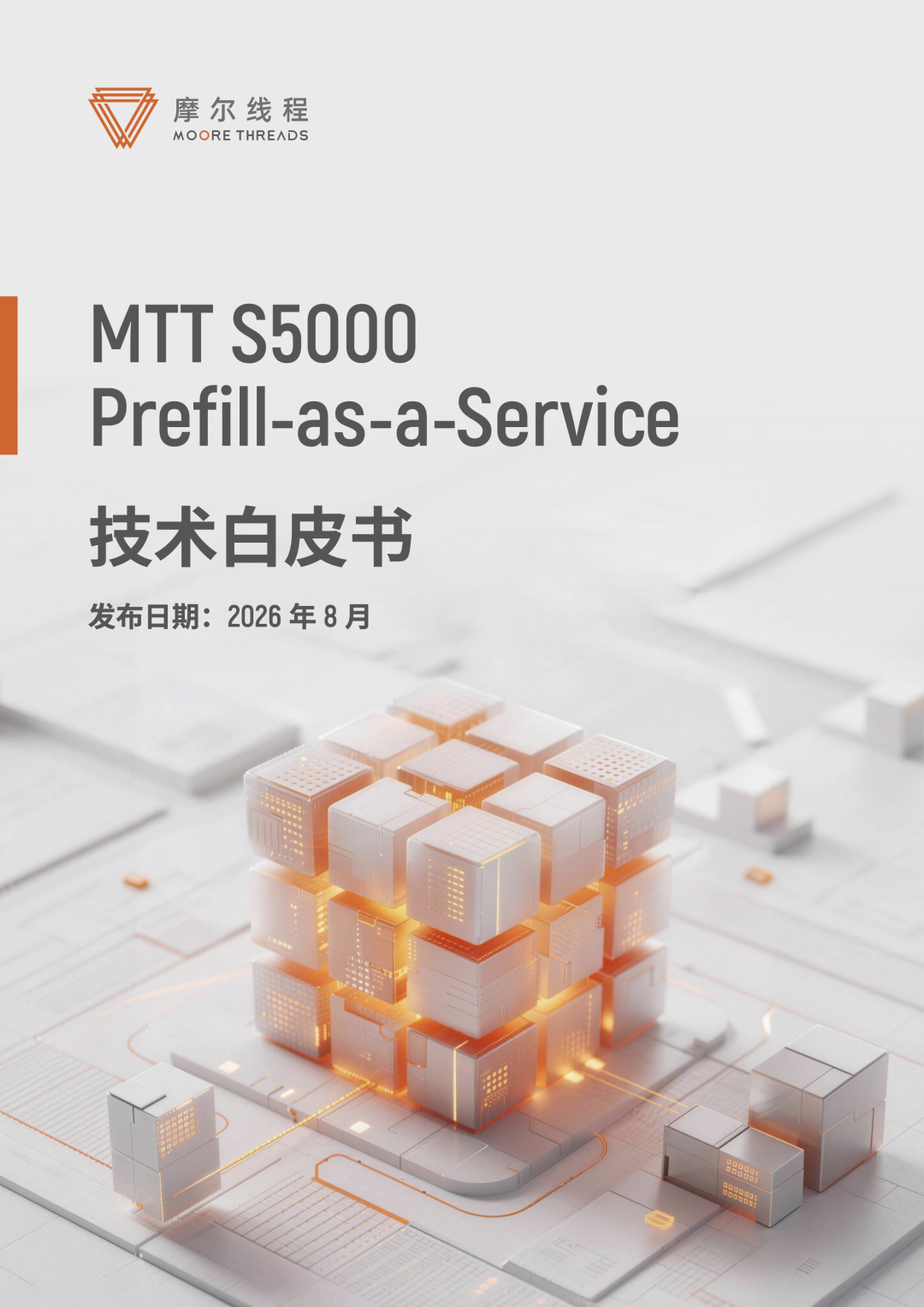
Moore Threads has officially launched its groundbreaking 《MTT S5000 Prefill-as-a-Service 技术白皮书》 (MTT S5000 Prefill-as-a-Service Technical White Paper). This new paradigm, built upon their flagship AI training and inference integrated computing card, the MTT S5000, aims to address the escalating costs and efficiency bottlenecks associated with long-context reasoning in artificial intelligence.
The white paper details a novel approach designed for demanding AI applications such as AI Agents, code generation, and extensive document analysis. It proposes a practical solution that balances inference efficiency, cost control, and the monetization of computing power.
The Challenge of Long Context Reasoning
As large language models (LLMs) rapidly expand their input context windows to hundreds of thousands or even a million tokens, the computational demands and initial token latency (TTFT) are soaring. This surge in resource consumption is becoming a significant barrier for businesses aiming to deliver efficient AI inference services and manage their total cost of ownership (TCO).
According to Moore Threads, traditional homogeneous computing clusters are ill-equipped to handle the diverse hardware requirements of different computational stages in LLM inference. The core issue lies in a structural mismatch:
- Prefill Stage: This initial input processing phase is compute-intensive, primarily limited by floating-point arithmetic capabilities.
- Decode Stage: The subsequent output generation phase is memory-access intensive, constrained by memory bandwidth.
Running these two distinct phases on the same physical resource pool inevitably leads to inefficiency. If resources are provisioned based on the demands of the Decode stage (which requires high memory bandwidth), the substantial memory capacity needed for the Prefill stage remains underutilized. Conversely, if resources are sized for the Prefill stage’s computational power, the processing units for the Decode stage experience significant idle time.
The Prefill-as-a-Service Solution
The key to overcoming this bottleneck, as highlighted in the white paper, is the complete decoupling of the Prefill and Decode stages. This separation allows each stage to operate on hardware resources best suited to its specific computational characteristics:
- Prefill Compute Pool: Optimized for high compute utilization and extremely low Time To First Token (TTFT).
- Decode Resource Pool: Designed for high concurrency and stable Iterative Token Latency (ITL).
By implementing a tiered hardware investment strategy, Moore Threads shifts from a model of “general redundancy” to one of “on-demand matching.” This approach ensures that service-level objectives (SLOs) are met while simultaneously reducing the infrastructure cost per token.
The MTT S5000, a powerful AI training and inference integrated computing card, serves as the foundation for this innovative service model. Its capabilities are leveraged to create dedicated resource pools that cater to the distinct needs of Prefill and Decode operations, promising a more cost-effective and efficient future for long-context AI applications.
The full technical white paper, 《MTT S5000 Prefill-as-a-Service 技术白皮书》, provides in-depth details on this new architecture and its implications for the AI industry.