The International Xinghan Alliance has officially released the ‘Xinghan SLE 3.0 Technology Standard Evolution Blue Book,’ detailing the evolution and objectives of its core technologies. This update aims to significantly enhance wireless audio capabilities, particularly for XR devices, by boosting data rates and enabling true Hi-Res lossless audio experiences.
Key Enhancements in Xinghan SLE 3.0
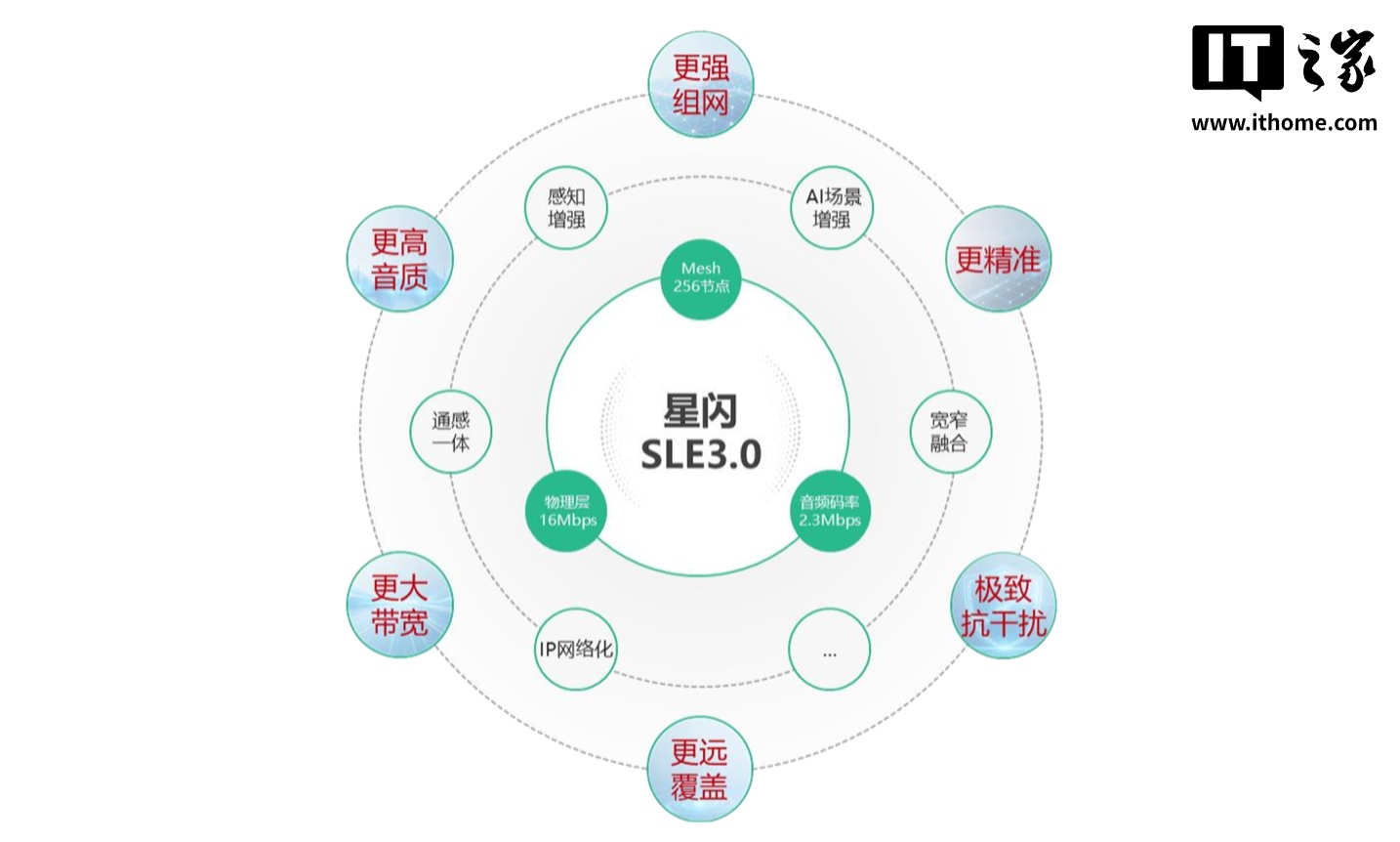
Building upon the current Xinghan SLE standard, which supports a 12Mbps physical layer suitable for general data transmission and high-definition audio, Xinghan SLE 3.0 is set to elevate the peak link rate to over 16Mbps. This substantial increase is achieved through a combination of advanced techniques, including further optimization of Polar coding to improve receiving sensitivity, the introduction of application beamforming, and the implementation of narrower channel partitioning.
These advancements are designed not only to increase application coverage but also to enhance the access capabilities for large-scale node deployments. Xinghan SLE 3.0 will support distributed self-networking, multi-concurrent scheduling, multi-layer synchronous networks, low network latency, and network self-healing capabilities. This robust framework is crucial for the seamless operation of complex, interconnected systems.
Advancements in Ranging and Audio Quality
Precision ranging is another area slated for significant improvement. Currently, Xinghan’s ranging technology has achieved sub-meter accuracy in applications such as digital car keys and device finding. The Blue Book indicates a commitment to further refining these capabilities, with a focus on enhancing multi-node ranging, backhaul-free ranging, and multi-antenna ranging. The frequency of ranging operations is expected to increase by 4 to 5 times, offering greater precision and efficiency.
Perhaps the most exciting development for consumers is the push towards lossless audio. By increasing the physical layer’s speed and introducing support for lossless audio with bitrates above 2.3Mbps, Xinghan SLE 3.0 aims to deliver true Hi-Res lossless sound quality. This stands in stark contrast to the lossy compressed audio typically found in traditional wireless headphones. Furthermore, the standard is future-proofing by reserving sufficient physical layer bandwidth for multi-channel high-definition spatial audio and high-definition low-latency applications, laying the groundwork for immersive audio experiences in the metaverse and beyond.
Addressing Connectivity Challenges
The Blue Book also addresses the challenges of operating in increasingly crowded wireless spectrums. While Xinghan SLE supports high-order modulation and large bandwidth, the traditional 2.4GHz band is becoming congested. To mitigate this, Xinghan SLE 3.0 plans to improve the efficiency of using higher frequency bands, such as 5GHz, which will enhance user experience in densely populated areas like airports.
In extreme interference scenarios, the standard will continue to strengthen adaptive autorate optimization, ensuring a smooth transition from high-order rates to basic rates to maintain continuous service experience. The future may also see the introduction of joint source-channel coding technologies to further improve channel utilization efficiency.
Implications for XR and Beyond
The upgrades in Xinghan SLE 3.0 are particularly significant for the burgeoning XR (Extended Reality) market. The demand for high-bandwidth, low-latency wireless audio is paramount for creating truly immersive and responsive virtual and augmented reality experiences. By providing a robust and high-performance wireless solution, Xinghan SLE 3.0 is well-positioned to become a key enabling technology for the next generation of XR devices.
The focus on lossless audio and spatial audio also hints at a broader ambition to redefine wireless audio standards across various consumer electronics, promising a richer and more authentic listening experience for audiophiles and casual listeners alike.