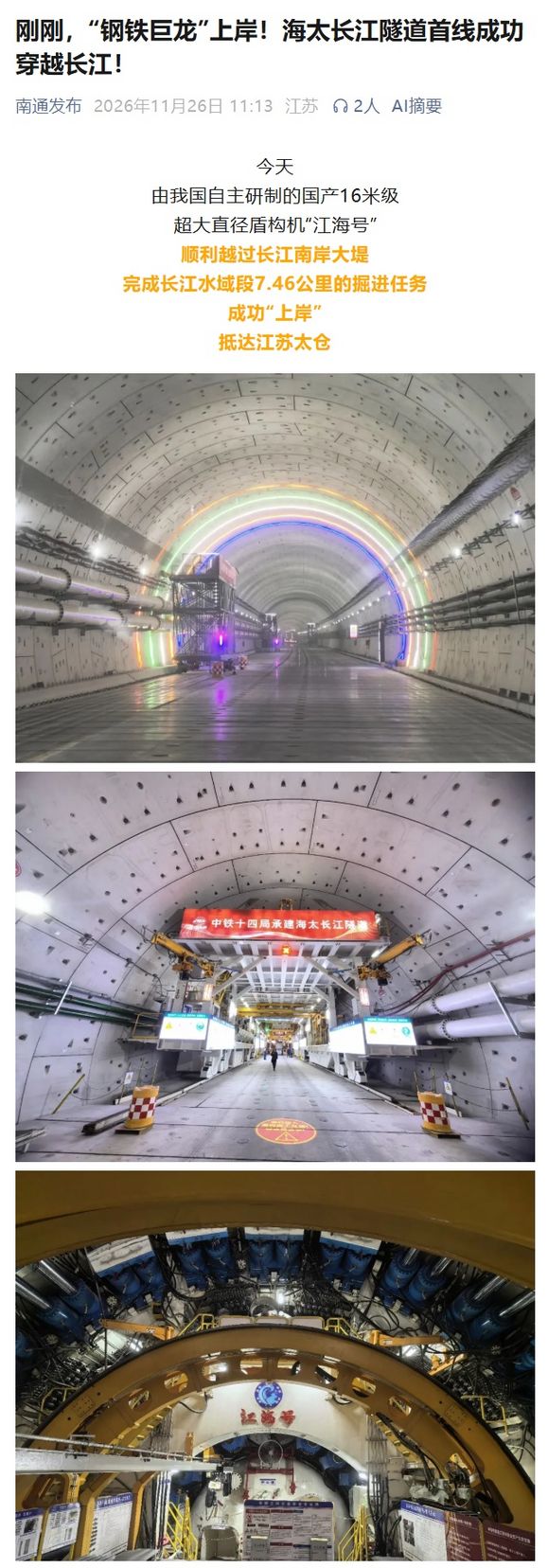
The world longest road tunnel has reached a critical milestone as China’s 16-meter Kirin-class “Jianghai” TBM successfully completed its underwater crossing of the Yangtze River. This breakthrough marks the completion of the 7.46-kilometer subsea segment of the Haitai Yangtze River Tunnel, positioning it on track to be fully operational soon.
Project Overview and Technical Feats
Spanning a total length of 39.07 kilometers, the Haitai Yangtze River Tunnel connects Nantong Haimen in the north to Suzhou Taicang in the south. It is designed as a six-lane highway tunnel with a speed limit of 100 km/h. The Yangtze crossing itself extends 11.185 kilometers, built through a combined open-cut and shield tunneling method. The tunnel segments feature a massive 16-meter outer diameter, making it the largest diameter tunnel built beneath the Yangtze and the longest subsea road tunnel in the world.
The right-line tunnel segment, 9,315 meters in length, was excavated by the indigenous “Jianghai” tunnel boring machine, which boasts a record-breaking 16.64-meter maximum excavation diameter. Since April 2025, the TBM commenced its operation from Nantong Haimen, completing land segments before starting the challenging underwater phase in September 2025.
Engineering Challenges and Achievements
During the 14-month-long underwater excavation, the “Jianghai” machine navigated steep inclines, a maximum burial depth of 75 meters, and complex soil layers while managing intense water pressure. It achieved a daily average advance of 20 meters and set a new monthly excavation record of 664 meters. Successfully surfacing at Taicang, this tunnel showcases China’s advancements in large-diameter and high-pressure subsea tunnel technology.
The Haitai Yangtze River Tunnel project is a key component of regional infrastructure initiatives, including the Yangtze River Mainline Crossing Layout Plan (2020–2035) and the Jiangsu Yangtze Economic Belt Integrated Transport Corridor. Upon completion, it will drastically reduce travel time between Nantong, southern Jiangsu, and Shanghai, boosting connectivity within the Yangtze River Delta’s core economic zone.