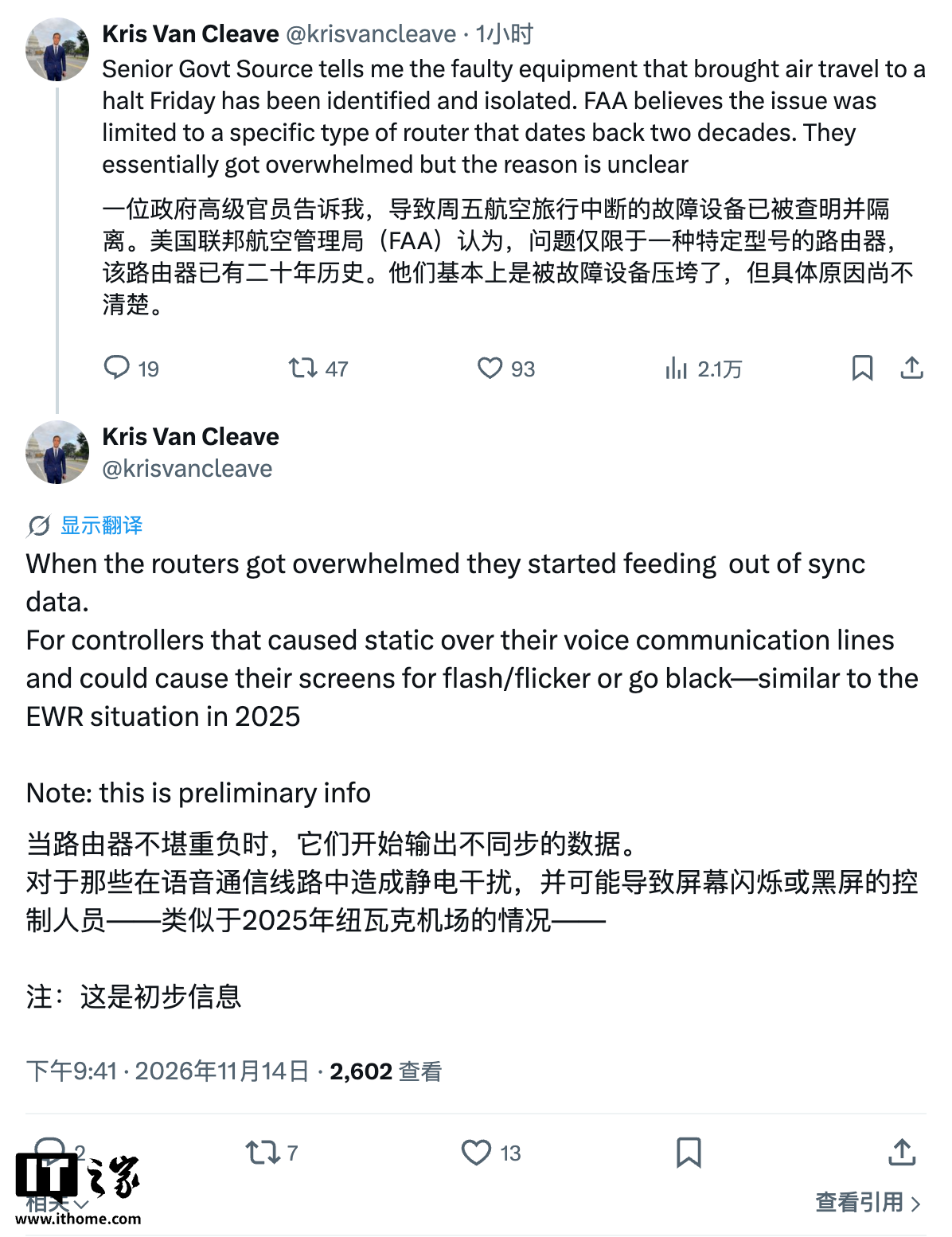
The widespread disruption that grounded flights across the United States earlier this week has reportedly been traced to a single, aging piece of networking equipment. According to a senior U.S. government official cited by CBS News transportation reporter Kris Van Cleave, the culprit is a 20-year-old router of a “specific model” that experienced a critical failure.
Old Router Overloaded, Causing System Glitches
The official explained that the system was “essentially crushed by load,” though the precise reasons for this overload remain unclear. Preliminary information suggests that once the router became overwhelmed, it began transmitting unsynchronized data. This malfunction manifested as static in air traffic controllers’ voice communication lines and also caused display screens to flicker or go black.
This scenario bears a striking resemblance to a similar incident that occurred at Newark Liberty International Airport in 2025, indicating a potential recurring issue with legacy infrastructure in critical air traffic control systems.
Massive Flight Cancellations Followed the Outage
The communication failure, which occurred on November 13th, led to a nationwide ground stop for all aircraft. Data from flight tracking website FlightAware indicated that by November 14th, over 3,300 flights within the U.S. or traveling to or from the country had been canceled. This significant disruption underscored the fragility of the current air traffic control communication network and the potential impact of even a single point of failure.
FAA Investigates, Focuses on Legacy Hardware
The Federal Aviation Administration (FAA) is understood to be investigating the incident. The focus on a 20-year-old router highlights a critical challenge faced by aviation authorities: the need to modernize aging technological infrastructure. While specific details about the router model and the exact cause of the overload are still under investigation, the immediate isolation of the faulty device suggests a swift response to restore normal operations.
This event brings to the forefront the ongoing debate about cybersecurity and system resilience in critical infrastructure. As the FAA works to understand the full scope of the failure and implement necessary upgrades, the incident serves as a stark reminder of the importance of maintaining and updating the technological backbone that keeps the nation’s airspace safe and operational.