In a move that has raised eyebrows across the tech world, U.S. President Donald Trump has declared that the term “Artificial Intelligence” (AI) will be officially replaced with “Superintelligence” (SI) in all relevant government documents and communications. The president announced his intention on his social media platform, Truth Social, on October 27th, stating that the current terminology is “inaccurate.”
The president’s directive, though announced publicly, lacked specific details on how this ban and rebranding would be implemented across federal agencies. This sudden linguistic shift has sparked debate, with some questioning the rationale and practical implications of such a mandate.
Trump specifically called out The Wall Street Journal for its continued use of the term “Artificial Intelligence,” which he described as “very bad and inaccurate.” The newspaper had previously published an article arguing against Trump’s call for a name change, labeling his push for “Superintelligence” as a “big mistake.” Currently, the majority of U.S. media outlets continue to use the established term “Artificial Intelligence.”
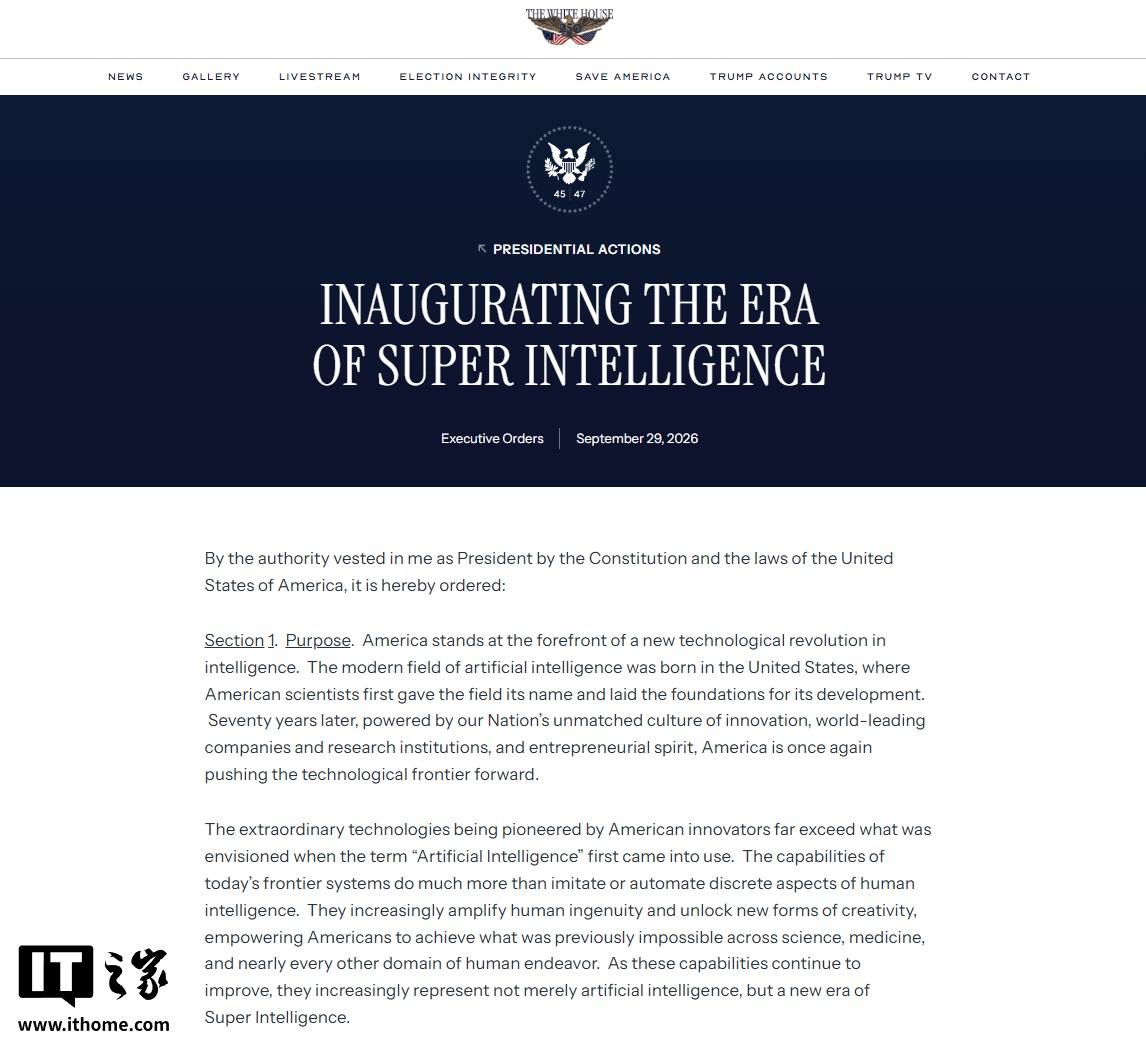
This is not the first time Trump has signaled a preference for the term “Superintelligence.” On September 29th, he signed an executive order directing all executive departments and agencies to adopt the term “Superintelligence (SI)” in place of “Artificial Intelligence (AI).”
The Rationale Behind the Rebranding
In the executive order, Trump articulated his reasoning, suggesting that the “remarkable technologies” pioneered by American innovators have far surpassed the original conception of “Artificial Intelligence.” He argued that current cutting-edge systems do more than just mimic or automate discrete aspects of human intelligence. Instead, they amplify human creativity and unlock novel forms of innovation, enabling Americans to achieve previously impossible goals across science, medicine, and nearly every other field of human endeavor.
As these capabilities continue to evolve, Trump contended, they increasingly represent “not just artificial intelligence, but a new era of superintelligence.” The executive order stipulated that the terminology used by the U.S. federal government should reflect the transformative capabilities of these technologies and the “unlimited opportunities” they create for the American people.
Consequently, “Superintelligence” was deemed a more accurate descriptor of the potential, power, and rapid advancement of these technologies. The policy outlined in the executive order stated that, to the greatest extent permitted by law, executive departments should use “Superintelligence” and “SI” in lieu of “Artificial Intelligence” and “AI,” and would not recognize the use of “Artificial Intelligence” and “AI” in any applicable context.
Government-Wide Implementation and Judicial Adherence
Following the executive order, the U.S. Department of Justice reportedly issued instructions to its internal staff on October 7th, directing them to use “Superintelligence” rather than “Artificial Intelligence” when referring to the technology in most contexts, including court documents. This directive underscores the administration’s commitment to enforcing the new terminology within the federal government.
The implications of this linguistic directive for the broader technology sector and public discourse remain to be seen. However, the president’s firm stance suggests a deliberate effort to reshape how advanced technologies are discussed and understood within the United States.