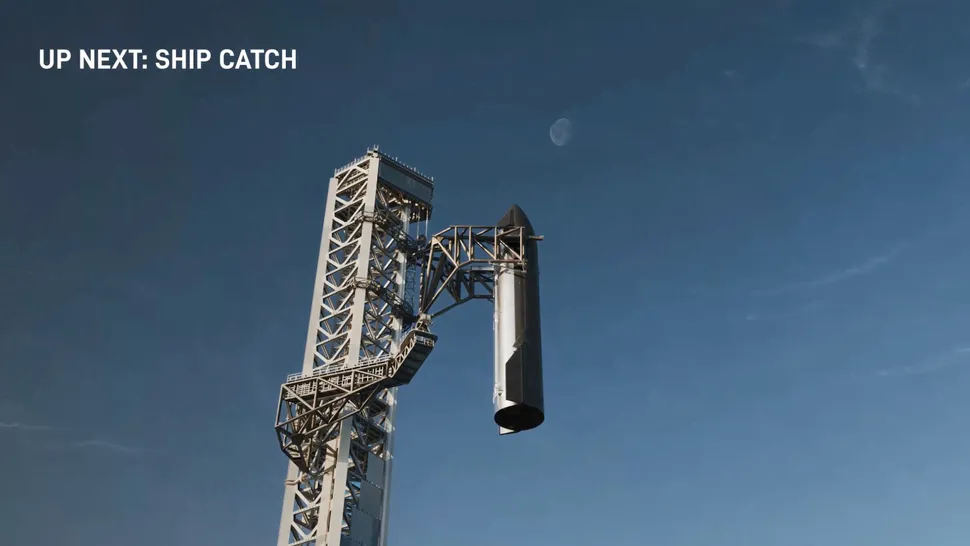
Elon Musk, the visionary CEO of SpaceX, has announced an ambitious goal for the company: the first attempt to recover both the Starship spacecraft and its Super Heavy booster simultaneously next month. This maneuver, if successful, would mark a historic milestone in spaceflight – the first complete recovery of an orbital launch system.
A Historic Leap for Reusability
Speaking during SpaceX’s third-quarter earnings call, Musk expressed cautious optimism, stating that while success is not guaranteed, the probability of a successful flight is now “greater than failure.” He further indicated that even if the upcoming attempt doesn’t go as planned, SpaceX will persist with Starship test flights before the year’s end and accelerate its launch cadence in the coming year.
Starship, SpaceX’s colossal two-stage heavy-lift launch vehicle, stands approximately 400 feet (122 meters) tall with a diameter of 9 meters. It utilizes liquid methane and liquid oxygen as propellants. While SpaceX has repeatedly demonstrated its ability to catch the Super Heavy booster with the launch tower’s mechanical arms, recovering the Starship upper stage presents a significantly greater challenge due to its higher altitude, faster speed, and greater distance traveled.
Lessons from the Latest Flight
The most recent Starship mission achieved a significant first by successfully sending the spacecraft into Earth orbit and deploying dozens of Starlink satellites. However, the flight was cut short. One of the Raptor engines shut down prematurely, reducing the mission from its planned 10 hours and six orbits to about 3 hours and two orbits. In the end, neither the Super Heavy booster, which splashed down in the Gulf of Mexico, nor the Starship, which performed a controlled vertical splashdown in the Pacific Ocean north of Hawaii, were recovered.
The Impact of Full Recovery
Achieving dual-stage recovery would dramatically enhance SpaceX’s operational efficiency. It would enable faster inspection, refurbishment, and relaunch of Starship vehicles, leading to a significant increase in launch frequency and a substantial reduction in per-launch costs. Musk’s long-term vision is for Starship to conduct over 10,000 launches annually by 2030.
A Milestone for Civilization
Musk emphasized the profound significance of fully reusable orbital rockets, positioning them as a cornerstone for extending human activities beyond Earth. He described this technological achievement as a “profound technological milestone in the history of civilization and consciousness.” This capability is considered crucial for enabling Mars colonization, large-scale satellite deployments, and future deep space missions.
“Fully reusable orbital rockets are a prerequisite for continuously expanding human activity beyond Earth and represent a profound technological milestone in the history of civilization and consciousness,” Elon Musk stated.
The upcoming launch attempt represents another bold step in SpaceX’s relentless pursuit of making space access more routine and ultimately, enabling humanity’s multi-planetary future.