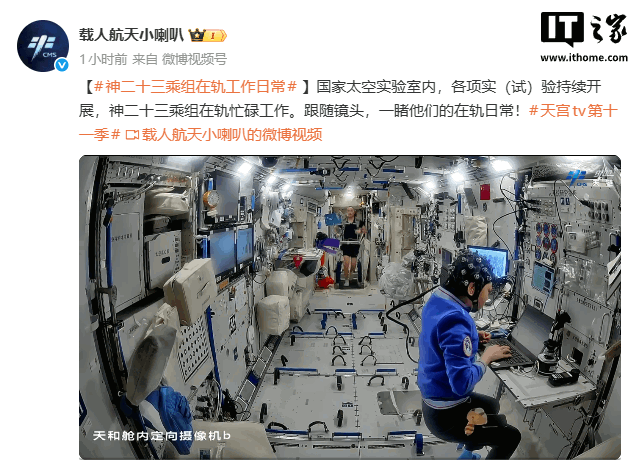
The Shenzhou 23 crew continues to make strides in their in-orbit experiments, as detailed in the latest vlog released by the China Manned Space Engineering Office. The three astronauts have been actively engaged in a variety of scientific tests aimed at understanding the effects of long-duration spaceflight on the human body and brain.
Brain Network and Cognitive Studies
Last week marked the successful execution of several brain-related experiments. Utilizing advanced electroencephalogram (EEG) equipment, the crew performed tests focusing on brain network mapping, visual-motor processing, and the dynamic characteristics of spatial brain networks. These studies are crucial for gathering data on how prolonged exposure to microgravity impacts astronauts’ brain function, cognitive abilities, and neural connectivity.
Exploring Tactile Perception and Motor Control
Beyond neurological research, the Shenzhou 23 astronauts also conducted experiments on tactile perception in space and precise force control. These investigations are designed to shed light on how astronauts’ sense of touch and their ability to perform fine motor tasks evolve during extended missions. The insights gained will be invaluable for developing better support systems and training protocols for future space explorers.
Microgravity Physics and Station Maintenance
In line with the microgravity physics science domain, the crew efficiently managed experimental hardware. This included clearing sample chambers in the experimental cabinet, replacing experimental samples, and performing maintenance on the axial mechanism electrodes. Furthermore, they conducted thorough inspections and upkeep of the two-phase system experimental cabinet, ensuring the smooth operation of critical scientific equipment.
Safety Drills and Environmental Monitoring
Maintaining readiness for emergencies and ensuring the habitable environment of the space station were also key priorities. The Shenzhou 23 crew completed planned checks and tests on their intravehicular pressure suits. They also participated in an in-orbit emergency rescue and life-saving training drill, reinforcing their preparedness for unforeseen circumstances.
In addition, the crew diligently attended to the space station’s integrated platform, conducting essential tasks such as measuring internal temperature and airflow. This meticulous attention to the station’s environment is vital for the well-being and performance of the astronauts.
Continuous Health Monitoring
The astronauts’ health remains under constant surveillance. Last week’s health monitoring activities included comprehensive visual function measurements, intraocular pressure and fundus examinations, and transorbital B-mode ultrasound measurements. They also used the “space scale” to monitor their body mass, allowing researchers to track physiological changes in the microgravity environment.
The China Manned Space Engineering Office confirmed that the crew is in good physical and mental condition, and their in-orbit mission is progressing efficiently. The ongoing research and operational tasks underscore the multifaceted nature of human spaceflight and the dedication of astronauts to advancing scientific knowledge.