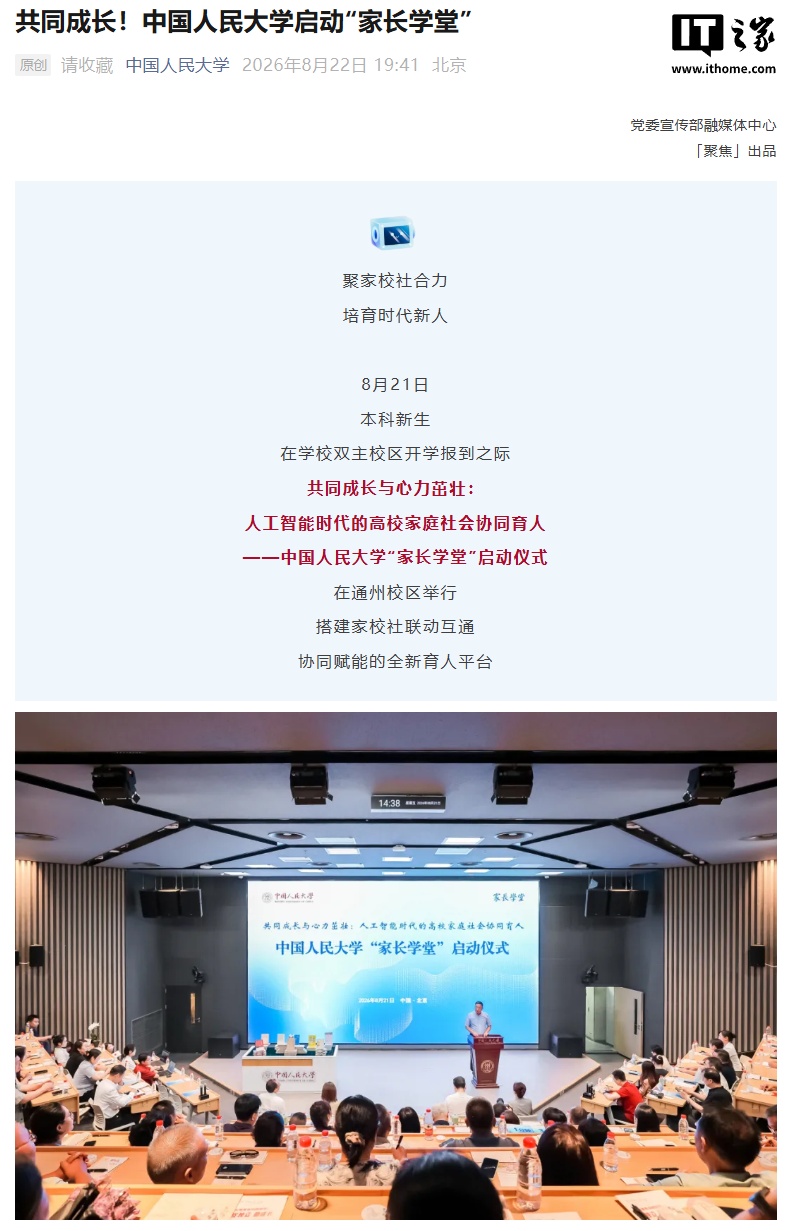
China’s Renmin University has taken a pioneering step by launching a “Parent School” program, aiming to foster a new model of collaboration between universities, families, and society in the age of artificial intelligence. The initiative, announced on August 21st, held its inaugural event on August 21st, with over 7,000 new students’ parents tuning into a live broadcast, participating either online or in person.
Addressing the AI Impact on Education
Ding Hongxing, Deputy Director of the Ministry of Education’s Department of Ideological and Political Work, highlighted the transformative power of new technologies, particularly AI, on the values of young people. He emphasized the urgent need to update ideological and political education and family communication strategies. Ding stated that Renmin University’s “Parent School” is a timely response, leveraging its academic strengths to explore collaborative educational models suited for the AI era. He urged all parties involved to use this initiative as an opportunity to align educational goals, methodologies, and approaches, building a consensus on values and creating complementary, integrated collaborative mechanisms. The goal is to establish a work structure empowered by intelligence and involving everyone in fostering new learning experiences.
Redefining the Role of Parents in Higher Education
Li Yongzhi, Party Secretary and President of the Chinese Academy of Educational Sciences, remarked that in the AI era, families are no longer mere “supporting actors” or “helpers” in education. Instead, they are becoming indispensable educational entities that even algorithms cannot replace. He underscored the significant value of Renmin University’s “Parent School” in helping parents bridge information gaps and reshape their understanding of AI’s integration into education. Li clarified that the essence of university-family collaboration lies in “mutual learning” rather than “joint management.” Unlike in primary and secondary schools, the focus in higher education must shift from “supervision” to “support.”
Navigating AI Responsibly: A Shared Responsibility
Li Yongzhi further elaborated on the evolving landscape, stressing that as AI technology advances, universities and families must collectively establish boundaries and regulate its use in learning. He advocated for leveraging the unique strengths of human interaction—such as systematic value guidance, collective social experiences, emotional connections, and character development—to help students master AI tools. The ultimate aim is to cultivate students’ intrinsic motivation, thereby facilitating their growth and success.
“The essence of university-family collaboration is ‘mutual learning’ rather than ‘joint management.'” – Li Yongzhi, Party Secretary and President of the Chinese Academy of Educational Sciences
Renmin University’s “Parent School” initiative represents a forward-thinking approach to adapting educational practices for the complexities of the digital age, acknowledging the crucial role of parents and families in shaping students’ development alongside technological advancements.