In a significant move towards advancing artificial intelligence on mobile devices, OPPO, in collaboration with OpenKG and leading academic institutions including Zhejiang University, Tongji University, and Southeast University, has launched MobileMem. This new benchmark is designed to evaluate the crucial capability of on-device AI memory.
Shifting the AI Paradigm
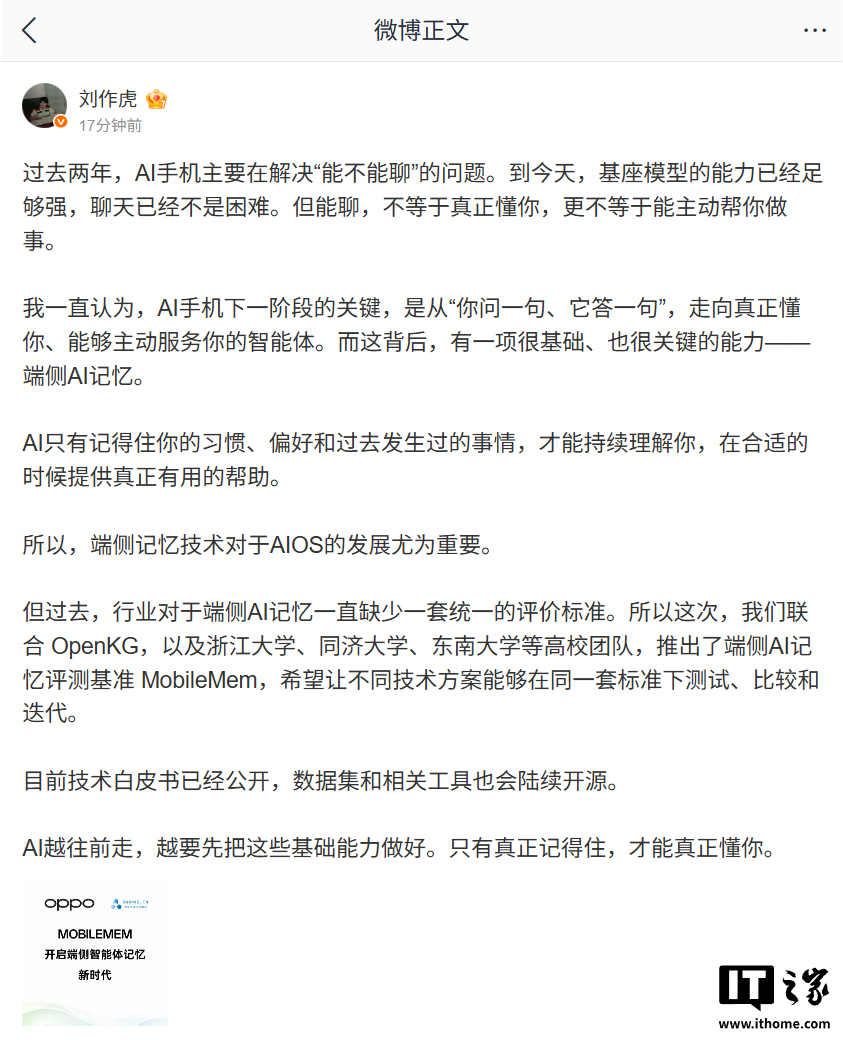
Liu Zuohu, OPPO’s Chief Product Officer and founder of OnePlus, highlighted the evolution of AI in smartphones. “For the past two years, AI phones have primarily focused on the question of ‘Can it chat?'” he stated. “Today, the capabilities of foundational models are robust enough that chatting is no longer a challenge. However, being able to chat doesn’t equate to truly understanding you, nor does it mean proactively assisting you.”
Liu emphasized his vision for the next phase of AI phones: “I’ve always believed that the next stage for AI phones is to move from a model of ‘you ask one question, it answers one question’ to becoming intelligent agents that truly understand you and can proactively serve you. Underlying this is a fundamental and critical capability – on-device AI memory.”
The Importance of AI Memory
He elaborated on why memory is key: “AI can only continuously understand you and provide truly useful help at the right time if it can remember your habits, preferences, and past events. Therefore, on-device memory technology is particularly crucial for the development of AIOS.”
Until now, the industry has lacked a unified standard for evaluating on-device AI memory. To address this, OPPO, OpenKG, and the university teams have created MobileMem. “We hope this will allow different technical solutions to be tested, compared, and iterated upon under the same set of standards,” Liu explained.
Openness and Future Development
The technical whitepaper for MobileMem has been publicly released, and the dataset and related tools will be gradually open-sourced. This move signifies OPPO’s commitment to fostering collaborative development in the AI space.
Liu concluded with a forward-looking statement: “The further AI progresses, the more essential it is to solidify these foundational capabilities. Only by truly remembering can we truly understand.”
Looking Ahead: ColorOS 17
This announcement comes in the lead-up to the OPPO ColorOS 17 Release and Developer Conference, scheduled for September 17, 2026, at 10:00 AM in Zhuhai, Guangdong. Attendees and observers can anticipate significant updates regarding AI advancements within the new ColorOS 17 operating system.