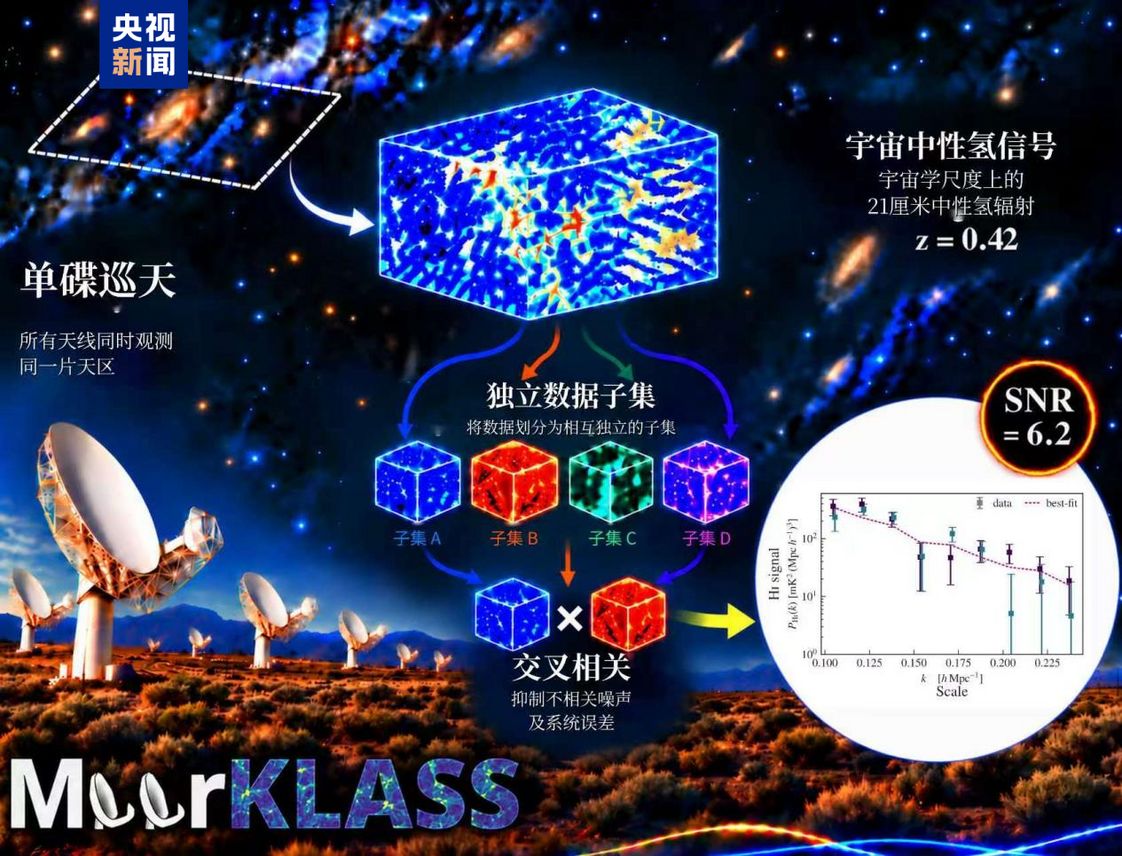
Neutral hydrogen signal detection has been achieved on an unprecedented cosmic scale, marking a significant milestone in astronomical observation. Using the South African MeerKAT radio telescope, the international MeerKLASS collaboration successfully captured the faint neutral hydrogen 21 cm emission with a signal-to-noise ratio of 6.2, paving the way for independent cosmological studies.
Breakthrough in Cosmic Neutral Hydrogen Mapping
Neutral hydrogen atoms, which remain un-ionized across the universe, emit a 21-centimeter radio wave critical for understanding cosmic evolution. This emission allows scientists to trace how matter clumps under gravity, forming galaxies and large-scale cosmic structures. Unlike traditional galaxy surveys that detect individual galaxies, 21 cm intensity mapping measures aggregate hydrogen emissions over large sky areas, offering faster and broader surveys essential for exploring cosmic expansion and dark energy.
One of the major challenges has been isolating this extremely weak signal from overwhelming foreground emissions like the Milky Way and other celestial sources, which are thousands of times stronger, and mitigating telescope noise and instrumental errors. For over a decade, detecting neutral hydrogen directly on cosmological scales without auxiliary galaxy surveys remained elusive.
China’s Key Role and Future Prospects
The Shanghai Astronomical Observatory team led by Chinese researchers developed the crucial data calibration pipeline, KATcali, employing innovative techniques to suppress system errors and significantly reduce observational noise. This enabled the team to pull out the self-power spectrum of the weak neutral hydrogen signal from deep L-band observations made by MeerKAT in 2021, covering about 236 square degrees and observing the universe as it was 4.5 billion years ago.
By treating each of MeerKAT’s 64 antennas as independent telescopes and segmenting data into multiple subsets to remove foreground interference and noise correlations, the collaboration achieved this breakthrough. The success sets a strong foundation for future large-scale radio arrays like the Square Kilometre Array (SKA), with planned sky mapping volumes a thousand times greater, promising new insights into the growth of cosmic structures, universal expansion, and the nature of dark energy.