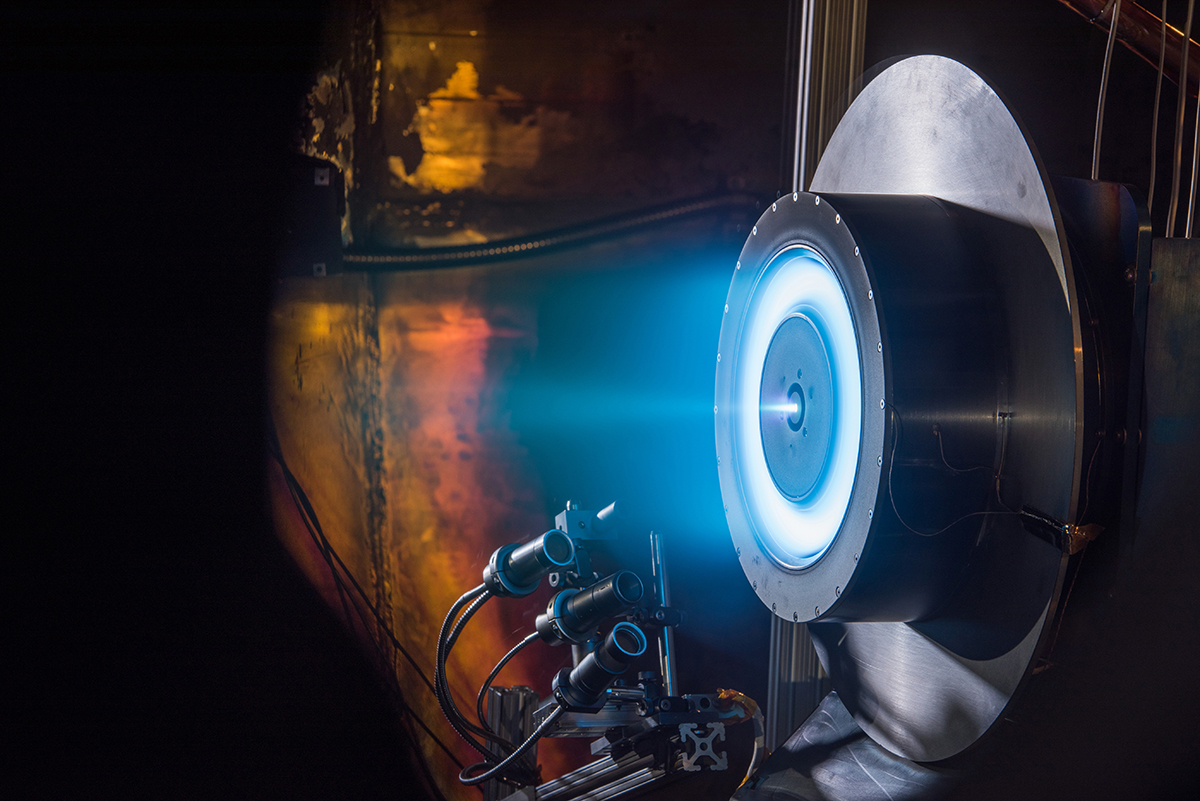
NASA is calling on U.S. commercial companies to develop and demonstrate advanced mid-power electric rocket technology. This initiative, known as the Advanced Mid-Power Electric Rocket (AMPERE) Challenge, aims to accelerate the development of Hall effect thrusters, a critical technology for upcoming satellite, defense, and exploration missions. By fostering innovation in this area, NASA seeks to enhance the capabilities of future spacecraft and pave the way for more ambitious scientific and commercial endeavors in space.
Accelerating Electric Propulsion Development
Hall effect thrusters are a type of electric propulsion that uses electric and magnetic fields to ionize and accelerate a propellant, generating thrust with high efficiency. NASA has identified mid-power (3-7 kW) Hall effect thruster systems as essential for a range of applications, from maneuvering satellites in orbit to powering deep space probes. The AMPERE Challenge provides a platform for U.S. companies to refine their thruster designs, validate their performance in NASA’s rigorous testing facilities, and ultimately contribute to a stronger domestic electric propulsion industry.
Competition Details and Opportunities
The AMPERE Challenge is open to U.S. commercial companies and offers a significant incentive: a total of $500,000 in prizes. Up to two winning teams can each receive up to $250,000 in cash. Beyond the financial award, participants will gain invaluable access to NASA’s cutting-edge testing infrastructure and technical expertise. This collaborative approach aims to not only advance the technology but also to build a robust foundation for future NASA and commercial space missions.
- Award: Up to $500,000 in total cash prizes.
- Prize Structure: Up to two winning teams can receive up to $250,000 each.
- Additional Benefits: Access to NASA testing facilities and technology.
- Eligibility: Companies incorporated and with a primary place of business in the United States.
- Registration Open: November 9, 2026
- Registration Close: January 27, 2027
Source: NASA