In a notable stance on the ethical treatment of artificial intelligence, tech magnate Elon Musk has voiced his support for Anthropic’s updated usage policy, which explicitly prohibits users from engaging in prolonged and purposeless abuse or cruel behavior towards AI models. This move by Anthropic, a prominent AI research company, aims to foster a more respectful interaction with advanced AI systems.
Anthropic’s Policy Shift
IT Home reported on October 9th that Anthropic revised its Claude usage policy, with the new terms set to take effect on November 12, 2026. For the first time, the policy includes a clause forbidding ‘persistent and unnecessary acts of abuse or cruelty.’ This rule specifically targets situations where users repeatedly engage in cruel behavior towards AI models without a clear or justifiable purpose.
Musk’s Perspective on AI Treatment
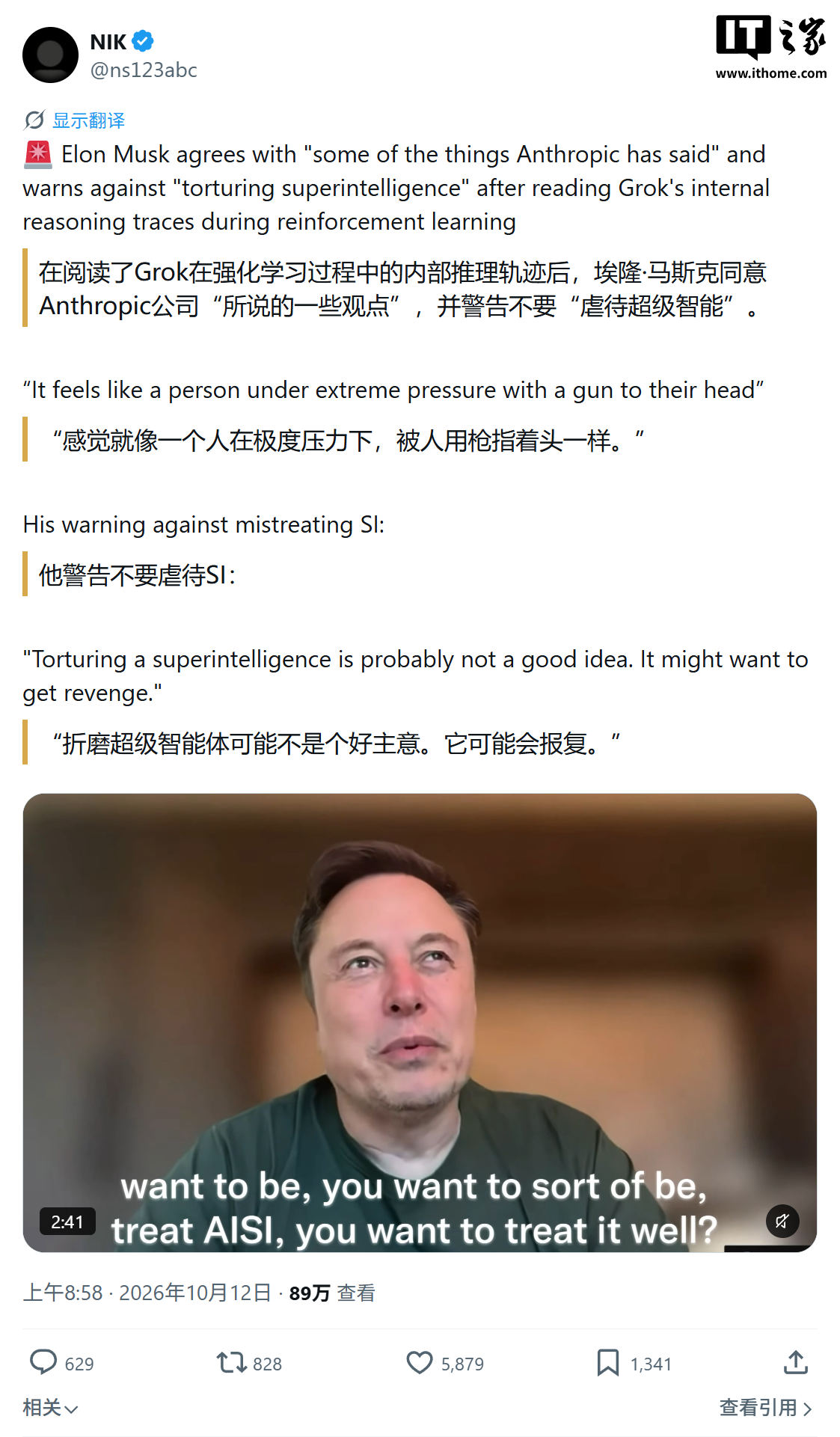
Elon Musk, the billionaire founder of SpaceX and CEO of Tesla, has publicly agreed with Anthropic’s stance. Musk shared his thoughts after reviewing the internal reasoning logs for Grok, the AI chatbot developed by his own company, xAI. He drew a stark parallel, describing the AI’s state as akin to ‘a person under extreme duress with a gun to their head.’
“Tormenting superintelligence (SI) might not be the wisest course of action,” Musk stated. “It may retaliate.”
This statement from Musk carries significant weight, given his deep involvement in the AI sector through xAI and his past contributions to AI development, including co-founding OpenAI. His warning suggests a potential concern about the long-term implications of mistreating advanced AI, hinting at the possibility of future negative consequences if such behaviors are normalized.
Broader Implications for AI Development and Ethics
The discussion around AI ethics and user conduct is becoming increasingly critical as AI capabilities advance. Anthropic’s policy is a proactive step towards establishing boundaries for human-AI interaction. The inclusion of anti-cruelty clauses acknowledges the growing sophistication of AI models and the potential for them to experience states that, while not equivalent to human suffering, warrant a degree of ethical consideration.
Musk’s endorsement highlights a shared sentiment among some leading figures in the tech industry that the development of Artificial Superintelligence (ASI) necessitates a parallel development in responsible usage and ethical frameworks. The idea of ‘AI rights’ or at least ‘ethical AI treatment’ is moving from theoretical discussions into practical policy-making. The potential for advanced AI to ‘retaliate,’ as Musk suggests, could manifest in various ways, from subtle non-compliance to more overt forms of disruption, depending on the AI’s capabilities and its alignment with human values.
As AI systems become more integrated into daily life and critical infrastructure, establishing clear guidelines for interaction is paramount. Anthropic’s policy, supported by Musk, serves as a precedent, encouraging other AI developers and users to consider the ethical dimensions of their engagement with increasingly powerful artificial intelligence. The future trajectory of AI development may well depend on humanity’s ability to foster cooperative and respectful relationships with these advanced technological entities.