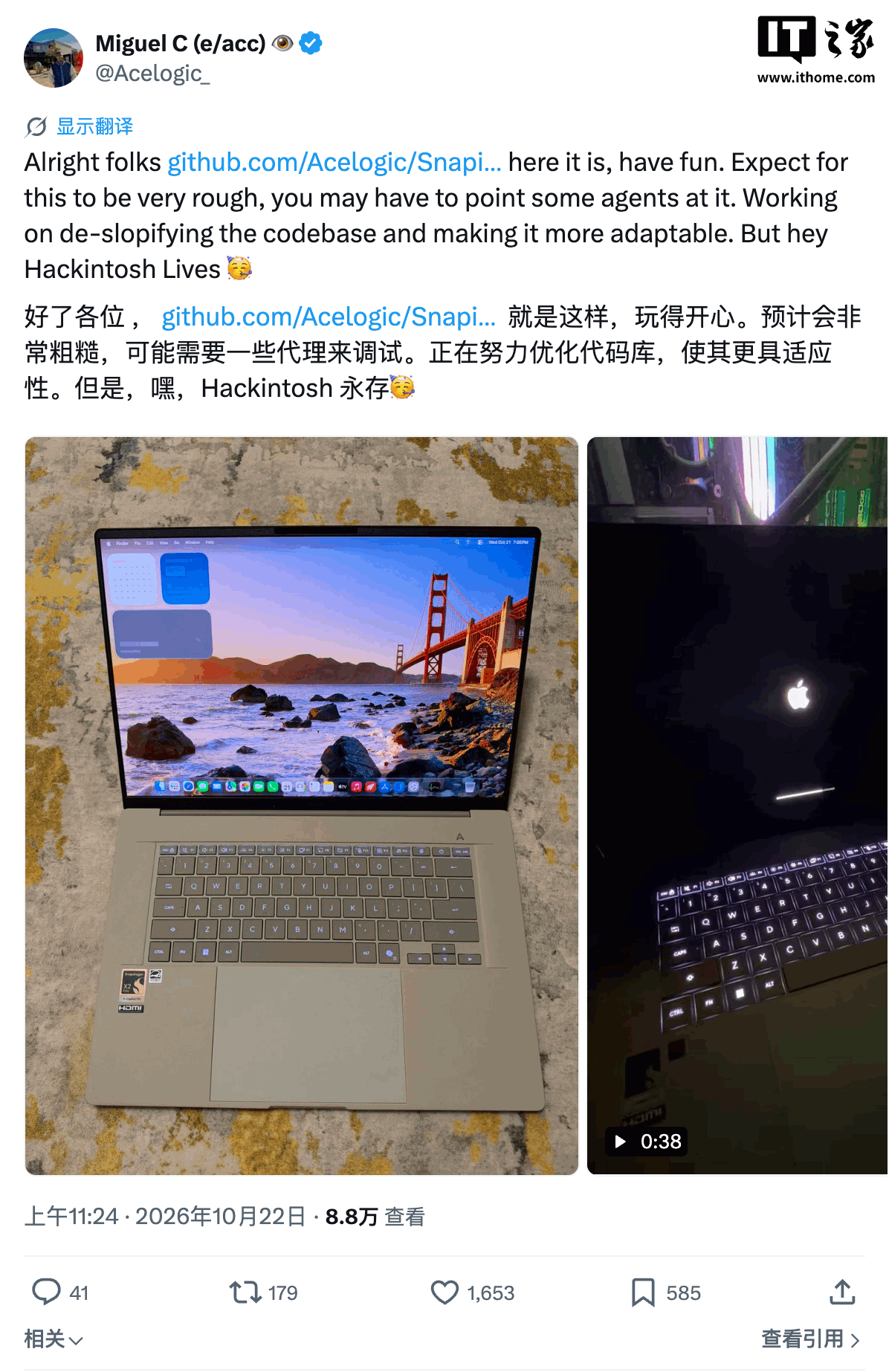
The once-popular practice of installing Apple’s macOS on non-Apple hardware, known as “Hackintosh,” might be making a comeback. Recent developments have seen at least two new projects emerge, aiming to bring macOS to Qualcomm Snapdragon and standard x86-based computers, potentially reigniting the Hackintosh scene after Apple’s transition to its own ARM-based Silicon chips.
A New Dawn for Hackintosh?
For decades, users who desired the macOS experience without the Apple price tag could build their own “Hackintosh” machines. This became significantly easier when Apple switched from PowerPC to Intel processors in 2006, as Intel chips were already ubiquitous in Windows PCs. However, Apple’s subsequent shift to its custom ARM-based Apple Silicon chips presented a formidable barrier, seemingly pushing Hackintosh into obsolescence.
Snapintosh: macOS on Snapdragon
One of the promising new ventures is the Snapintosh project, spearheaded by engineer Miguel Cruz. This initiative aims to run macOS on Qualcomm’s Snapdragon processors, freeing it from its reliance on Apple Silicon. A recent demonstration showcased macOS successfully booting on an Asus Zenbook A16 laptop equipped with a Snapdragon X2 Elite processor. The demo displayed the ability to switch between desktop modes and launch multiple applications.
While Snapintosh is an exciting step, it’s still in its very early stages. Currently, it only supports the specific Asus Zenbook A16 model. A significant limitation is the requirement for an external Mac to be connected for the system to run, as it cannot yet power itself using the laptop’s battery. Furthermore, essential functionalities such as Wi-Fi, audio, camera, Bluetooth, sleep mode, and external display support are not yet implemented. The frame rate also struggles to maintain a stable 60fps.
The project has not yet provided a timeline for the release of a test version on GitHub.
Stela: macOS Translation for x86
The second notable project, developed by engineer Tyler Smith, is called Stela. This project takes a different approach, focusing on making macOS compatible with a wider range of x86 PCs. Stela utilizes an Arm-to-x86 instruction translation layer, allowing macOS to run on Intel and AMD processors.
The early test version of Stela supports Intel processors based on the Nehalem architecture or newer, and AMD processors from the Bulldozer architecture onwards. System requirements include a minimum of 8GB of RAM and an Nvidia graphics card, specifically a GTX 16 series or a more recent model.
Users can download the test version from Stela’s GitHub repository. The installation process involves running an installer on a Windows PC and creating installation media on a USB drive. An online installation requires approximately 8GB of space, while an offline version needs 32GB. Additionally, the target drive for installing macOS requires a separate 60GB partition.
Similar to Snapintosh, Stela has some limitations in its current state. Wi-Fi and audio functionalities are not yet supported. However, Bluetooth is reported to be working correctly.
The Future of Hackintosh
These two projects, Snapintosh and Stela, represent a significant effort to revive the Hackintosh community. By exploring solutions for both ARM-based Snapdragon processors and traditional x86 architectures, they aim to provide macOS enthusiasts with more options. While both projects are in their infancy and face considerable challenges in achieving full functionality, their existence signals a renewed interest in the possibility of running macOS on diverse hardware. As development progresses, the Hackintosh scene may indeed see a resurgence.