Loongson Zhongke, a prominent Chinese technology company, has unveiled exciting plans for its upcoming products, including the 9A1000 graphics card and its next generation of high-performance CPUs. During a semi-annual performance briefing, Chairman and General Manager Hu Weiwu shared key details about these developments.
9A1000 Graphics Card: A Dual-Purpose Powerhouse
The Loongson 9A1000 graphics card is anticipated to hit the market in the first half of next year. Hu Weiwu highlighted that its pricing will largely depend on the cost of its LPDDR4 memory. This new card is designed with a dual purpose, serving effectively as both a graphics card and an AI accelerator.
In its capacity as a graphics card, the 9A1000 is expected to be competitive in markets with a strong emphasis on independent technology. For the open market, it’s benchmarked against AMD’s RX 550, with its success contingent on the successful adaptation of Windows drivers. As an AI accelerator, the card is poised to meet the demands of most embodied intelligence applications, with early users already developing AI agents based on the 9A1000.
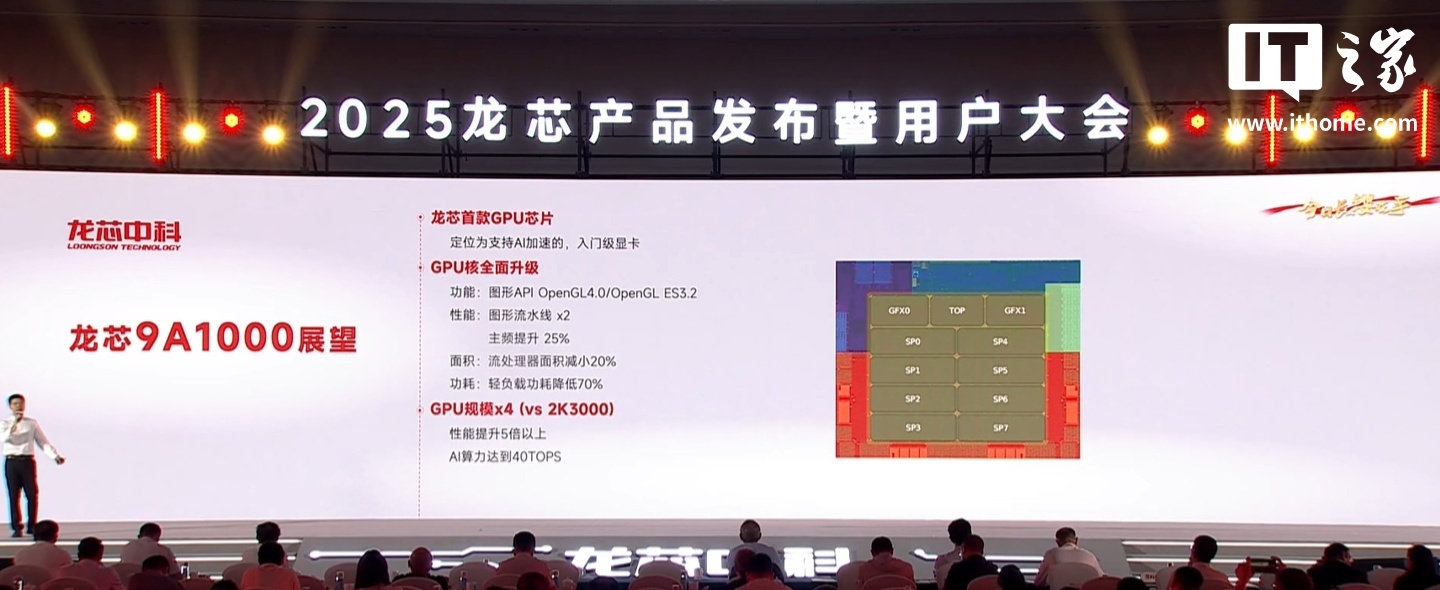
Technically, the Loongson 9A1000 represents a significant upgrade. It boasts support for OpenGL 4.0 / OpenGL ES 3.2, features a doubled graphics pipeline, and a 25% increase in core frequency. Despite an x4 increase in GPU scale compared to the 2K3000, its stream processor area has been reduced by 20%. Power consumption is also notably improved, with a 70% reduction in power usage under light loads. The card offers a substantial performance boost of over 5 times compared to its predecessor and an impressive AI computing power of 40TOPS.
Loongson Zhongke aims to develop Windows drivers for the 9A1000, enabling its use in conjunction with Windows PCs. This strategic move, alongside its own CPUs, aims to achieve maximum system cost-effectiveness. The company previously indicated in May that the 9A1000 was being fabricated on an independent domestic process line and was nearing the testing phase, with technical support for multi-GPU configurations with CPUs.
Next-Generation CPUs and System Integration
Looking further ahead, Hu Weiwu revealed that Loongson has already commenced research and development for its sixth-generation high-performance CPU core. While specific specifications are yet to be finalized, these cores are intended for use in the successors to the Loongson 7000 series CPUs.
The company’s immediate goal for this year is to achieve initial system integration of the 3B6600, 7A3000, and 9A1000. This milestone is dependent on the timely availability of the 3B6600 chip. Once the hardware is ready, developers are estimated to require an additional 3-6 months for further refinement.
Android Adaptation and Future Outlook
Addressing inquiries about Android adaptation, Hu Weiwu confirmed significant interest from both domestic and international clients for porting Android to the Loongson 2K3000. A dedicated team has been established in Shenzhen to focus on adapting the LoongArch architecture with open-source HarmonyOS and Android. A foundational version is already in place, with some applications available for open-source HarmonyOS.
However, Android on Loongson is currently geared towards applications with relatively fixed scenarios, such as industrial tablets and commercial display terminals like hospital self-service kiosks. Direct application on commercial smartphones and tablets is not yet considered realistic.
Finally, Hu Weiwu clarified that Loongson currently has no plans to develop dedicated chips for routers.