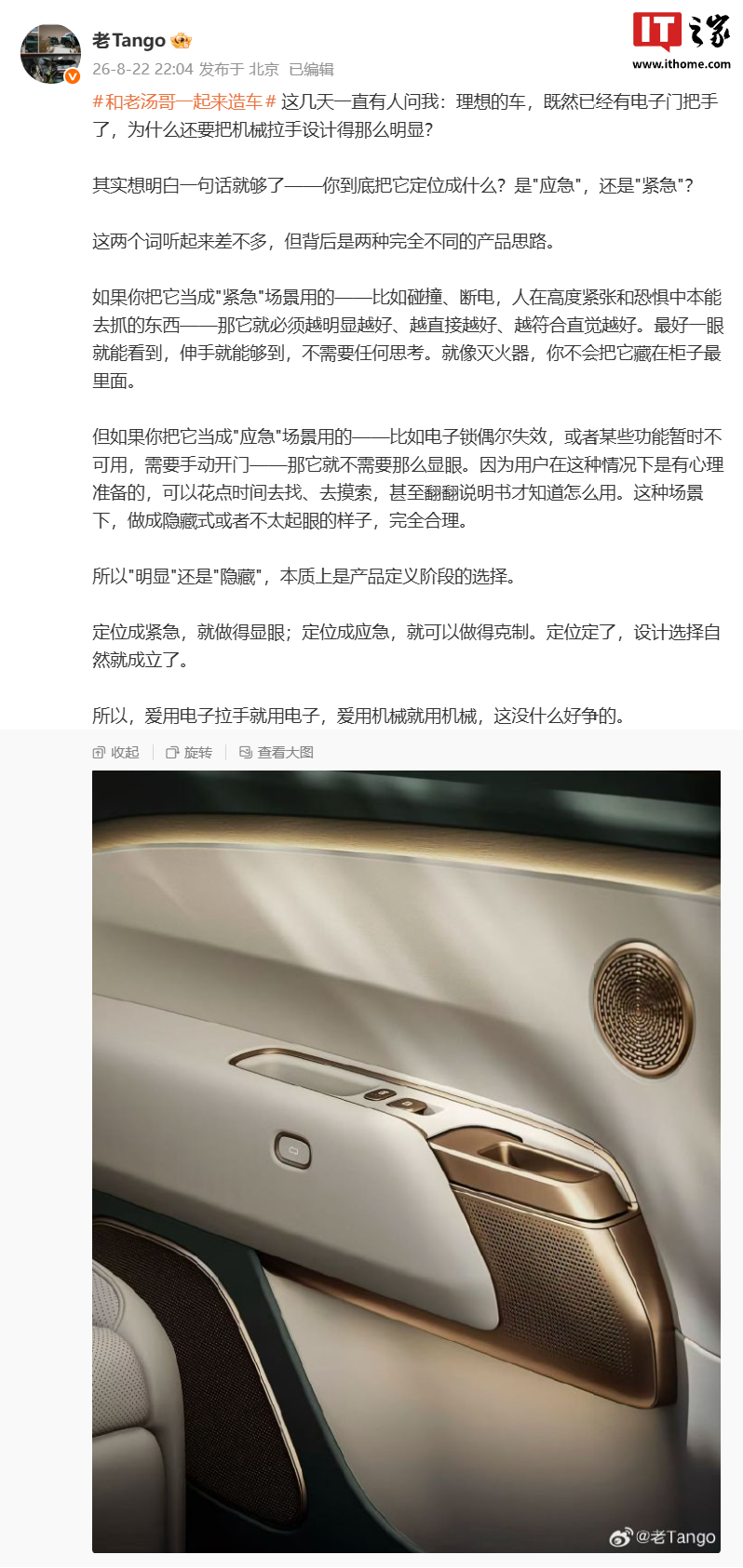
Li Auto’s Head of Product, Tang Jing, has shed light on the design philosophy behind the car manufacturer’s approach to door handles, specifically addressing the placement and visibility of mechanical emergency release mechanisms.
Emergency vs. Urgent: A Tale of Two Design Philosophies
Tang Jing clarified the distinction between “emergency” and “urgent” scenarios, explaining that these terms represent fundamentally different product strategies for designing these critical components. The core of the discussion revolves around why Li Auto, despite featuring electronic door handles, still opts for a noticeable mechanical release.
If you consider it for an “urgent” scenario – like a crash or power failure, where a person instinctively reaches for something in a state of high tension and fear – then it must be as visible as possible, as direct as possible, and as intuitive as possible. It should be visible at a glance and reachable without any thought, much like a fire extinguisher that wouldn’t be hidden in the back of a cabinet.
Conversely, Tang Jing explained the “emergency” approach:
But if you consider it for an “emergency” scenario – such as an occasional electronic lock failure or temporary unavailability of certain functions, where manual door opening is needed – then it doesn’t need to be so conspicuous. In such situations, users are mentally prepared and can take some time to locate it, explore, or even consult the manual to understand its operation. In this context, a hidden or less noticeable design is perfectly reasonable.
Product Definition Dictates Design
According to Tang Jing, the decision between a “visible” or “hidden” door handle is fundamentally a choice made during the product definition stage. If a scenario is classified as urgent, the design will be prominent. If it’s categorized as an emergency, a more restrained design is appropriate. Once the positioning is determined, the design choice naturally follows and becomes justifiable.
He emphasized that there’s no inherent superiority in choosing electronic over mechanical handles, or vice versa. “So, use electronic handles if you like electronic ones, and use mechanical ones if you prefer mechanical ones. There’s nothing to argue about,” Tang Jing stated.
Context: Recalls and Visibility Issues
This discussion comes at a time when automotive safety and accessibility are under scrutiny. Previously, IT之家 reported on the recall of vehicles from nine major manufacturers, including Tesla, Nio, and Geely, due to issues with the “in-car emergency mechanical release handle being difficult to identify and operate.” This highlights the critical importance of intuitive design for safety features, aligning with Tang Jing’s emphasis on the “urgent” scenario’s need for immediate visibility and accessibility.
The differing approaches to door handle design underscore a broader trend in the automotive industry: balancing aesthetic integration with functional safety requirements. While sleek, hidden designs appeal to modern aesthetics, the paramount need for quick access in critical situations cannot be overlooked. Li Auto’s stance suggests a commitment to user safety by ensuring that even with advanced electronic systems, a readily accessible mechanical backup remains a priority, designed with immediate, intuitive access in mind.