Kingsoft Software posted a net loss of 204 million yuan in Q3 2026, reversing from profit a year ago despite a 1% increase in total revenue. The report highlights growth in AI-powered office solutions alongside short-term pressure in the gaming segment.
Q3 Financial Overview and Business Highlights
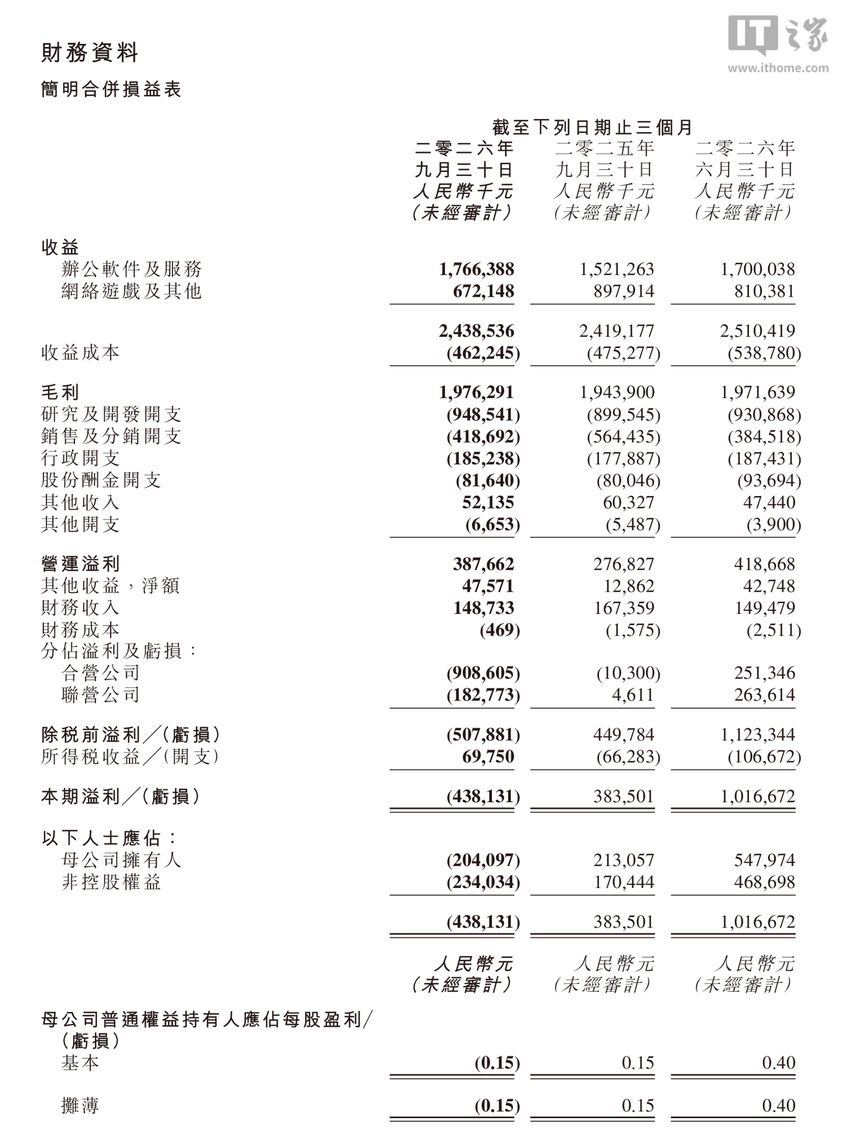
For the quarter ending in September 2026, Kingsoft Software recorded total revenue of 2.439 billion yuan, up 1% year-over-year but slightly below market consensus of approximately 2.533 billion yuan. Gross profit stood at 1.976 billion yuan, maintaining an 81% margin, a year-over-year improvement.
The primary earnings setback stemmed from a reported net loss attributable to shareholders of 204 million yuan. This loss was mainly due to a non-cash fair value decline of 1.091 billion yuan related to investments in listed tech companies and equity funds. Adjusted net profit, excluding such investment and stock compensation effects, rose 12% to 301 million yuan, indicating core business stability.
Kingsoft’s core office software segment continued strong performance, generating 1.766 billion yuan in revenue — a 16% year-on-year increase — driven by WPS products including WPS Personal (1.05 billion yuan, +17%), WPS 365 (270 million yuan, +34%), and other software revenues. Conversely, the gaming division faced declines, with revenue dropping 25% year-over-year to 672 million yuan due to product lifecycle adjustments; the company is investing heavily in flagship IPs like “Jianwang 3” and “Jianxia World 4”.
The associated Kingsoft Cloud delivered impressive growth with 3.478 billion yuan in revenue, up 40% year-over-year, propelled by AI cloud billing income which surged over 115% to 1.683 billion yuan.
Strategic Outlook and Financial Health
Looking ahead, Kingsoft aims to accelerate AI integration across its office suite and cloud services while expanding WPS 365 and AI-native products like Lingxi. The company also plans to leverage AI to enhance game development efficiency and deepen AI cloud cooperation with Xiaomi’s ecosystem.
Financially, Kingsoft ended the quarter with strong liquidity, holding 24.462 billion yuan in cash and bank deposits, representing about 59% of total assets. Operating cash flow decreased by 24% year-over-year to 375 million yuan amid 25.9 million yuan in capital expenditures. The company’s low debt level is reflected in a stable 17% asset-liability ratio.
Despite short-term volatility from investment valuations, Kingsoft’s AI-driven office business growth and cloud service expansion underpin its long-term value proposition. Investors should watch the recovery pace of gaming revenue, Kingsoft Cloud’s AI monetization, and continued user conversion in office software.