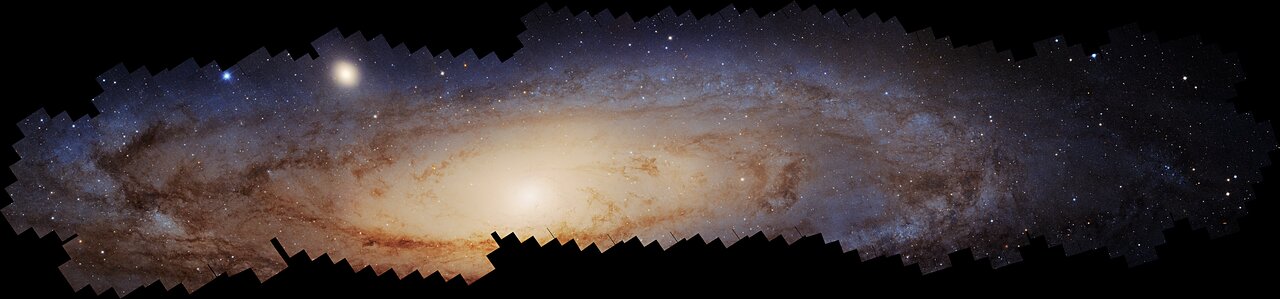
Scientists have demonstrated the largest photomosaic of the Andromeda galaxy, assembled from observations by the Hubble Space Telescope. The data collection for this colorful portrait of our neighboring galaxy took more than 10 years and was created from more than 600 images. This stunning, colorful mosaic captures the glow of 200 million stars and is approximately 2.5 billion pixels in size.
The magnificent Andromeda Galaxy
In the years since the launch of the Hubble Space Telescope, astronomers have counted more than 1 trillion galaxies in the Universe. But only one galaxy stands out as the most important stellar island near our Milky Way: the magnificent Andromeda Galaxy (Messier 31). It can be seen with the naked eye on a very clear autumn night as a faint cigar-shaped object with an angular diameter roughly equal to the apparent angular diameter of our Moon.
One hundred years ago, Edwin Hubble first discovered that this so-called “spiral nebula” is actually far beyond our Milky Way galaxy – at a distance of about 2.5 million light-years, or about 25 diameters of the Milky Way. Prior to this, astronomers had long believed that the Milky Way encompassed the entire universe. Hubble’s discovery turned cosmology upside down overnight, revealing an infinitely vast universe.
Now, a century later, the space telescope named after Hubble has made the most comprehensive survey of this fascinating empire of stars yet. The Hubble telescope provides new clues to Andromeda’s evolutionary history, and it looks markedly different from that of the Milky Way.
Without Andromeda as a proxy for spiral galaxies in the Universe as a whole, astronomers would know much less about the structure and evolution of our Milky Way. That’s because we are embedded within the Milky Way.
A trillion stars in Andromeda
Hubble’s crisp image is able to distinguish between more than 200 million stars in the Andromeda Galaxy, revealing only stars brighter than our Sun. They look like grains of sand on a beach. But this is just the tip of the iceberg. Andromeda’s total population is estimated at 1 trillion stars, with many less massive stars falling below the Hubble’s sensitivity limit.
Photographing Andromeda was very challenging because the galaxy is a much larger target in the sky than the galaxies Hubble typically observes, which are often billions of light-years away. The complete mosaic was completed as part of two Hubble observing programs. In total, it took more than 1000 Hubble orbits, which lasted more than ten years.

Photo: NASA, ESA, B. Williams (University of Washington)
Panoramas of Andromeda
This panorama was created as part of the Panchromatic Hubble Andromeda Treasury (PHAT) program about ten years ago. The images were acquired in the near ultraviolet, visible, and near infrared wavelengths using the Advanced Imaging Camera and Wide Field Camera on board Hubble to photograph the northern half of Andromeda.
This program was followed by the Panchromatic Hubble Andromeda Southern Treasury (PHAST) program, which added images of approximately 100 million stars in the southern half of Andromeda. This region is structurally unique and more sensitive to the galaxy’s merger history than the northern disk imaged in the PHAT survey.
The combined programs cover the entire disk of Andromeda, which is visible almost from the edge – tilted 77 degrees relative to Earth’s view. The galaxy is so large that the mosaic is assembled from about 600 separate fields of view. The mosaic image consists of at least 2.5 billion pixels.
Additional Hubble observing programs provide information on the age, heavy element content, and stellar masses inside Andromeda. This will allow astronomers to distinguish between competing scenarios of Andromeda merging with one or more galaxies. Hubble’s detailed measurements constrain models of Andromeda’s merger history and disk evolution.
The similarity of our galaxies
Although the Milky Way and Andromeda probably formed around the same time many billions of years ago, observational evidence shows that they have very different evolutionary histories, despite growing up in the same cosmological neighborhood. Andromeda is more populated by young stars and has unusual features such as coherent stellar flows, the researchers say. This means that it has a more active recent history of star formation and interaction than the Milky Way.
A possible culprit is the compact companion galaxy Messier 32, which resembles the truncated core of a once spiral galaxy that may have interacted with Andromeda in the past. Computer modeling suggests that when a close encounter with another galaxy uses up all the available interstellar gas, star formation subsides.
The new Hubble discoveries will support future observations by the James Webb Space Telescope.