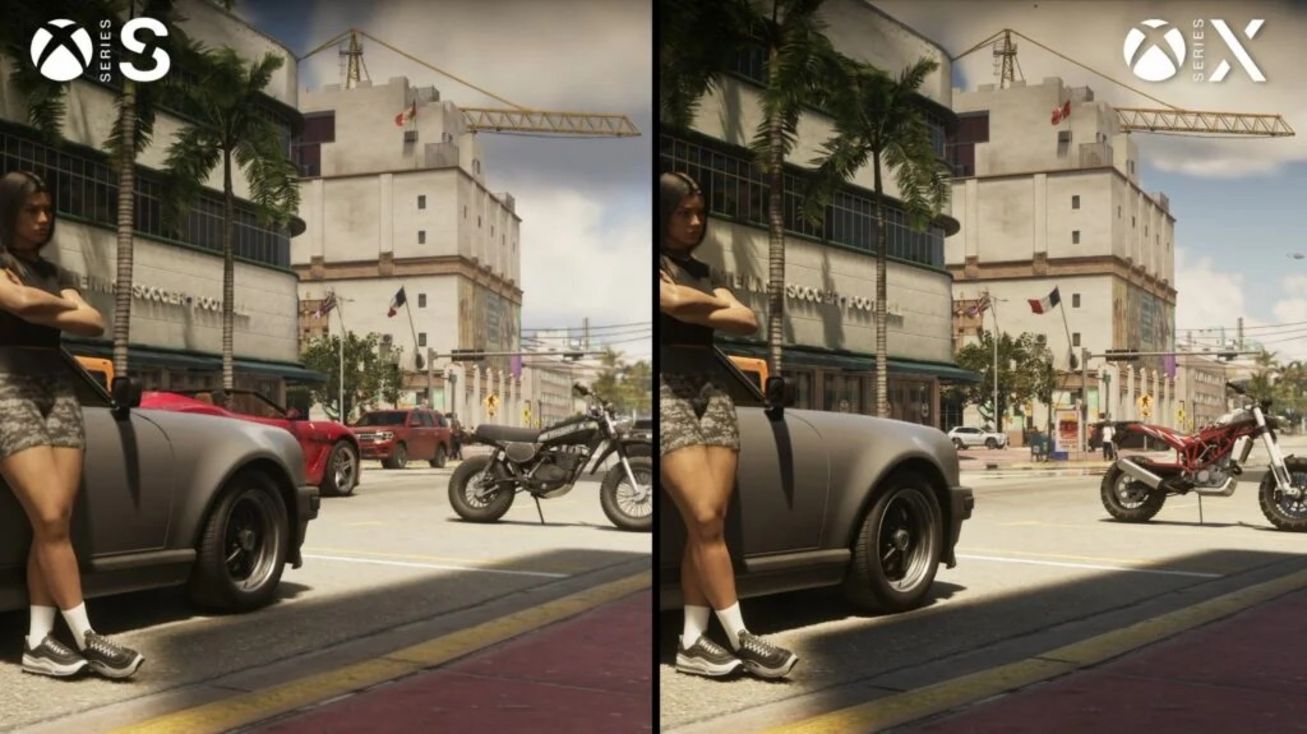
Digital Foundry, the renowned tech analysis group, has released its in-depth performance review of Grand Theft Auto VI on Xbox consoles, offering a detailed look at how the highly anticipated title runs on the Xbox Series X and Series S. While the Series X delivers a mostly stable experience, the Series S faces significant performance challenges.
Xbox Series X: A Stable 30 FPS Experience
For the Xbox Series X, Digital Foundry’s analysis suggests a performance profile comparable to the standard PlayStation 5 version. The console largely maintains an internal rendering resolution of 1440p, targeting a smooth 30 frames per second (FPS). While the game generally achieves this target, some frame drops are still noticeable during particularly demanding moments with complex scenes and high loads.
Analyst Oliver Mackenzie noted that during regular gameplay, GTA 6 on Series X consistently hits and holds 30 FPS. Even in intense combat or during rapid movement, the game manages to maintain a frame time of around 33 milliseconds. Mackenzie reported that most combat scenarios ran stably at 30 FPS with infrequent dips, and cutscenes also performed well without noticeable stuttering.
“In the single-player campaign, players might encounter frame rate drops in some particularly intense chases or firefights,” Mackenzie explained. “However, for the vast majority of the time, the Xbox Series X provides a stable 30 FPS gaming experience.”
Xbox Series S: Visuals Impress, Performance Falters
The Xbox Series S version presented a more complex picture. Mackenzie found the graphical presentation on the less powerful console to be “quite interesting,” especially considering the hardware compromises made. Notably, demanding graphical features like individual hair strand rendering and ray-traced reflections were not removed from the Series S version.
“Overall, the game’s visuals are remarkably close to the Series X version,” Mackenzie stated. “However, players will notice a series of smaller visual downgrades.” These include reduced lighting precision, blurrier reflections, and more aliased shadows. The most significant compromise appears to be in resolution, with Mackenzie estimating the Series S to render internally at 720p, compared to the Series X’s 1440p. Despite the lower internal resolution, the final output image quality on the Series S is described as significantly better than expected, with the gap in sharpness and detail not appearing as vast as the resolution difference might suggest.
“The Series S version does cut back on a fair amount of visual effects, and I suspect there are some more significant downgrades I haven’t noticed,” Mackenzie admitted. “But the core experience is preserved, which frankly exceeded my expectations. The Series S is still playing the GTA 6 that we all know, and the compromises made aren’t as drastic as what we often see in Series S versions of other AAA titles.”
Performance Bottlenecks on Series S
However, these visual concessions come at a considerable cost to performance. The Series S version of GTA 6 suffers from serious frame rate issues. Although it aims for 30 FPS, the frame rate frequently dips below this target in many standard gameplay scenarios.
Mackenzie elaborated, “Even just driving a slower car at a moderate pace, the frame rate can linger in the mid-to-late 20s for extended periods. Standard combat scenes generally stay in the 20s. Essentially, any scenario requiring significant AI processing or dynamic asset loading will strain Microsoft’s entry-level console.”
He added, “Of course, I believe the game’s actual frame rate likely remains above 30 FPS most of the time, so it’s not entirely without merit. Cutscenes typically run fine, and basic walking exploration is generally not problematic.”
“But as soon as combat or high-speed movement is involved, the frame rate takes a noticeable hit. Pushing the game’s performance limits even further, in particularly complex areas, the frame rate can drop as low as approximately 20 FPS.”
Rockstar’s Optimization Efforts and Future Potential
Despite the performance concerns on the Series S, Mackenzie expressed admiration for Rockstar’s work in adapting such a massive game to less powerful hardware. He highlighted that many developers struggle with Series S optimization even for games considerably smaller in scope than GTA 6.
“Rockstar has created a Series S version that is quite faithful to the original design philosophy, and the core technologies are retained in a relatively sensible manner,” Mackenzie concluded. “However, the frame rate performance on the Series S is indeed unsatisfactory, and therefore, I currently recommend players prioritize other console platforms for their playthrough.”
The question remains how much Rockstar can improve the Series S performance through post-launch updates. The recent announcement that Xbox Series X/S consoles will receive AMD’s latest FSR 4.1 upscaling technology in a future system update could offer a glimmer of hope. Similar to NVIDIA’s DLSS, FSR 4.1 allows developers to render games at a lower resolution and then upscale them to near-native resolution, boosting performance and potentially enabling higher frame rates with minimal visual loss.
While there’s no current indication that Rockstar plans to implement FSR 4.1 in GTA 6 for Xbox, adopting such technology could significantly enhance the frame rate experience on the Series S, making it a more viable option for players.