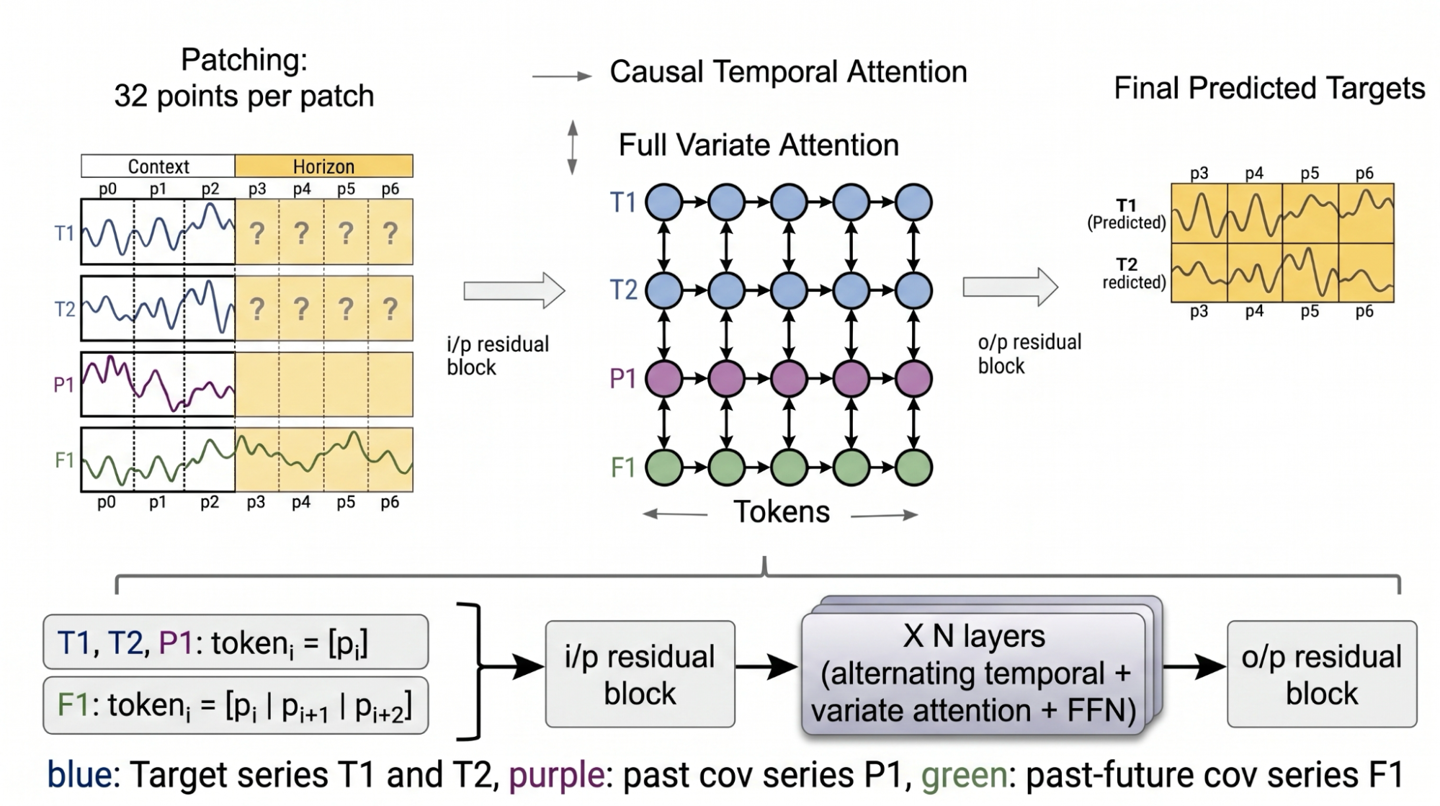
Google has announced the release of TimesFM-3, the third generation of its foundation model series designed for time series forecasting. This new model boasts enhanced capabilities for zero-shot multivariate time series prediction, featuring a dual attention mechanism and continuous patch masking.
TimesFM-3: A Leap in Time Series Forecasting
TimesFM-3 is built with 330 million parameters and has undergone extensive pre-training on a massive dataset comprising over a trillion time points from both real-world and synthetic time series. This extensive training allows the model to inherit the efficiency and zero-shot generalization capabilities of its predecessors while significantly improving its support for complex multivariate scenarios without requiring task-specific fine-tuning.
Key Features of TimesFM-3
The model introduces several native features designed to handle the complexities of time series data:
- Multi-target Prediction: TimesFM-3 can jointly predict multiple related time series simultaneously. For example, it can forecast sales for different brands of ice cream concurrently. The model supports both point predictions and quantile predictions for all targets, offering a more comprehensive view of potential outcomes.
- Past Covariates: The model can incorporate features that are only known from historical data. This could include factors like past foot traffic, which can inform future predictions based on historical patterns.
- Past-Future (Dynamic) Covariates: TimesFM-3 can leverage known future events to guide its predictions. Examples include planned promotional activities or weather forecasts, allowing for more accurate forecasts when such information is available.
Enhanced Multivariate Forecasting
A significant advancement in TimesFM-3 is its ability to jointly predict multiple, co-evolving time series. By capturing the intricate dependencies between these series, the model aims to improve overall prediction accuracy. This capability is particularly valuable in scenarios where multiple factors influence each other over time, such as in economic modeling, retail sales forecasting, or energy consumption prediction.
The foundation model approach means that TimesFM-3 is designed to be a versatile tool, capable of addressing a wide range of forecasting tasks without needing to be retrained or heavily modified for each new problem. This zero-shot capability is a key differentiator, promising to reduce the time and resources typically required to deploy forecasting solutions.
The Power of Foundation Models
The development of foundation models like TimesFM-3 signifies a broader trend in artificial intelligence, moving towards more general-purpose models that can be adapted to various downstream tasks. By training on vast amounts of data, these models learn underlying patterns and structures that are transferable across different domains. For time series forecasting, this means a potential for more robust, accurate, and efficient predictions across a multitude of industries and applications.
Google’s continued investment in this area underscores the growing importance of accurate forecasting in today’s data-driven world. With TimesFM-3, the company aims to provide a powerful and accessible tool for businesses and researchers tackling complex time series challenges.