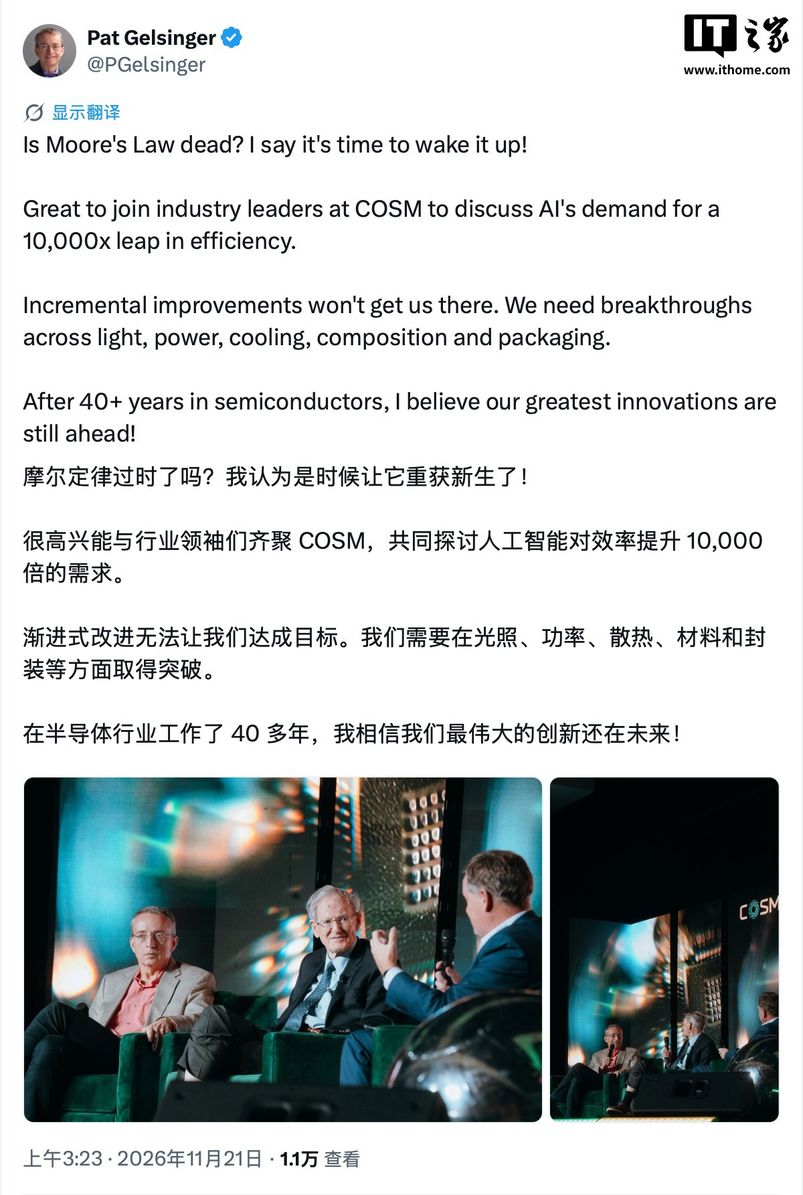
Advancements in chip performance alone will not be enough to meet the burgeoning demands of artificial intelligence, according to former Intel CEO Pat Gelsinger. He argues that AI requires a monumental 10,000-fold leap in efficiency, underscoring the need for fundamental breakthroughs in key engineering areas beyond traditional scaling. Gelsinger, while rejecting the notion that Moore’s Law is dead, emphasized that progress hinges on innovation across five critical domains.
Key Challenges for Future Chip Development
Speaking at the COSM 2026 technology summit, Gelsinger delivered a keynote titled “Realities: Beyond the Limits of Chips.” He stressed that AI’s insatiable appetite for computational power cannot be satisfied by incremental hardware improvements. Instead, a radical shift in computing efficiency is necessary, targeting a 10,000x increase over current capabilities.
The former Intel head countered the idea that Moore’s Law has reached its physical limitations. In his view, the path forward lies in disruptive advancements in five foundational areas: optics, power, cooling, materials, and chip packaging.
Innovations Beyond Traditional Scaling
Since joining venture capital firm Playground Global in March 2025, Gelsinger has been actively investing in startups addressing these critical hardware challenges. Among his ventures is xLight, aiming to push the boundaries of ASML’s EUV lithography, and Alva Energy, which focuses on nuclear power solutions.
Beyond lithography and power supply, Gelsinger is a strong proponent of optical interconnects and silicon photonics. The goal is to replace conventional copper wiring with light signals for data transmission, promising significant improvements in speed and efficiency.
Reflecting on his insights, Gelsinger posted on social media platform X: “Moore’s Law is not dead – it’s time to awaken it! My 40 years in the industry confirm that the most significant innovations are still ahead.”