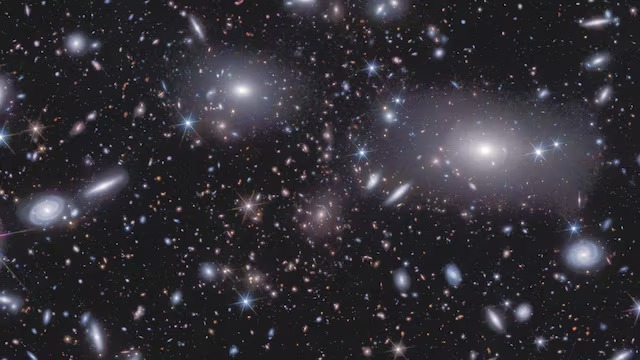
The European Space Agency (ESA) has unveiled the first major data release from its groundbreaking Euclid space telescope. This mission, dedicated to mapping the large-scale structure of the universe, has now provided observations of over 900 million galaxies, offering scientists a new, powerful tool to investigate the mysterious components that dominate the cosmos: dark matter and dark energy.
The newly released data, announced on a Thursday, covers a sky area approximately 9,500 times the visual size of the Moon as seen from Earth. Euclid’s ultimate ambition is to construct the most comprehensive 3D map of the universe ever created by 2031, spanning more than a third of the entire sky.
This significant data dump originates from approximately 13 months of Euclid’s observations and totals an astounding 1.7 petabytes (PB), equivalent to 1.7 million gigabytes (GB).
Valeria Pettorino, Euclid Project Scientist at ESA and an astrophysicist, commented on the milestone: “This is an important milestone for ESA’s Euclid mission and for everyone involved.”
Launched from Florida, USA, in July 2023, Euclid is actively gathering data on the universe’s expansion, how its structure has evolved over time, the fundamental nature of dark energy and dark matter, and the role of gravity in shaping cosmic structures. Pettorino elaborated on the telescope’s capabilities, stating, “Euclid will not only capture 2D images of galaxies across the sky but also measure their distances, providing a third dimension. This will help us understand where galaxies are located in space and time, tracing cosmic history back up to 10 billion years, and observing the universe in all directions beyond the plane of our own Milky Way.”
She further explained the significance of this mapping: “Galaxies cluster together in filamentary structures, surrounded by vast empty regions, ultimately forming a network we call the ‘cosmic web.’ Euclid will reconstruct this cosmic web and reveal how it has evolved over time. This research is crucial because the specific shape of the cosmic web – including how many clusters of galaxies and voids it contains, and how fast these structures evolve – depends on the properties of dark energy and dark matter.”
The universe is predominantly composed of ordinary matter, dark matter, and dark energy. Ordinary matter, which includes stars, planets, gas, dust, and everything familiar on Earth, constitutes about 5% of the universe’s total mass-energy. Dark matter, while invisible and undetectable through direct light observation, is inferred from its gravitational effects on galactic scales and is estimated to make up approximately 27% of the universe. Dark energy is believed to be the driving force behind the universe’s accelerating expansion, accounting for about 68%.
This latest data release represents over a year of observations, a substantial increase from previous releases that covered only a few days. Crucially, this 1.7 PB of data constitutes only 14% of the total sky area Euclid plans to observe in visible and near-infrared wavelengths over its six-year mission.
Gravitational Lensing: A Key Tool
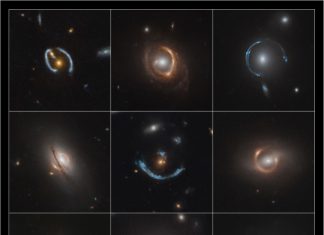
A key phenomenon Euclid is exploiting is gravitational lensing. Light from distant galaxies can be bent and distorted as it travels towards Earth, influenced by the gravity of intervening ordinary and dark matter. Essentially, the gravity of an object in the foreground alters the path of light from a more distant object behind it.
Gravitational lensing serves as a vital tool for mapping the distribution of dark matter. The current Euclid data release includes approximately 15,000 strong gravitational lensing candidate targets. This number significantly surpasses the total number of such candidates identified by humanity in the preceding half-century.
Natalie Lines, an astrophysics PhD student at the University of Portsmouth and a member of the Euclid Scientists’ Consortium, described gravitational lensing as “nature’s own weighing scales.” She explained, “The degree to which light is bent tells us how much mass is present in a galaxy, including invisible components like dark matter. By studying thousands of these lensing events, we can understand how dark matter is distributed within galaxies and, in turn, how galaxies have formed and evolved throughout cosmic history.”
Lines also highlighted Euclid’s impressive imaging clarity across vast cosmic scales. “Ground-based telescopes can observe large areas of the night sky, but atmospheric distortion often limits image clarity. The Hubble and James Webb Space Telescopes can capture extremely sharp images, but typically focus on small patches of the sky. Euclid achieves both: broad sky coverage with high resolution. This is vital for identifying rare and smaller objects, such as strong gravitational lenses,” she noted.
Because light from distant objects takes immense amounts of time to reach Earth, observing further away means looking further back in cosmic time. Euclid has already identified around 60 million quasars, the extremely luminous cores of galaxies powered by supermassive black holes. Lines mentioned, “Euclid has already found some very ancient quasars, which formed when the universe was just 5% of its current age. This means the light we are receiving today embarked on its journey approximately 13 billion years ago.”