ESA’s Week in Space: From Martian Clouds to Cosmic Jets

0
21
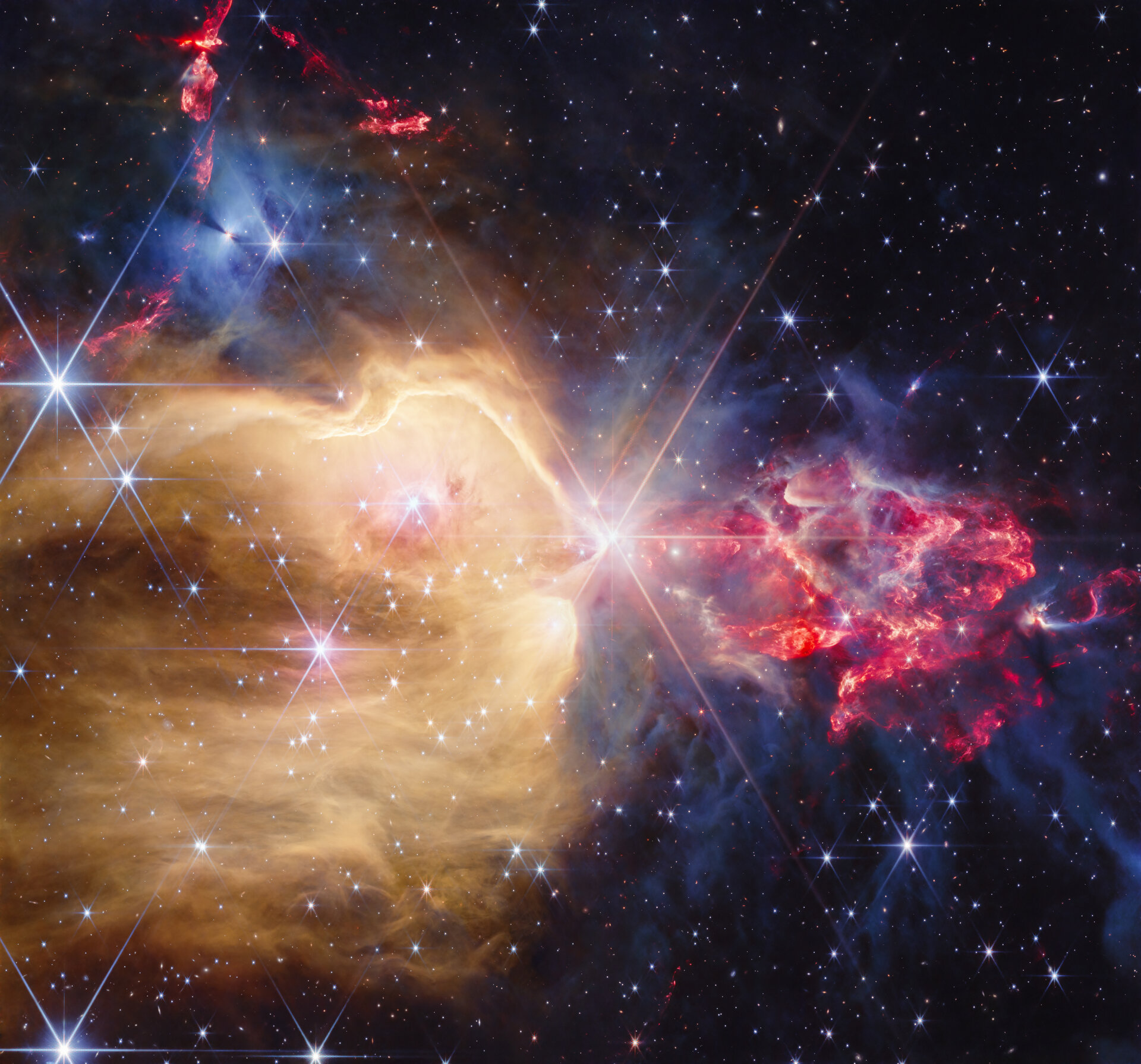
The NASA/ESA/CSA James Webb Space Telescope’s NIRCam (Near-InfraRed Camera) has revealed many protostars and stars within the glowing gases of NGC 7129.  The region to the left of the central star is filled with hot, atomic hydrogen gas, which creates a golden glow, while the region to the right is packed with cooler, molecular hydrogen. Embedded protostars in the rightmost region eject outflows that shock and heat the region, giving certain areas a red hue and a clumpy texture. Many of these red outflows, ejected as protostars accumulate mass, are visible throughout the image. The central star and the stars embedded within the golden region are at a more mature stage in their life cycle than the protostars growing to the right of the central star. Their heat breaks down the molecular hydrogen into atoms, driving the differences in temperature and color. The coldest, densest gas, where protostars have yet to form, is shown in gray. [Image description: A young star cluster filled with many stars that display Webb’s unique eight-pronged diffraction pattern. At its center is a yellow star which sports the largest diffraction pattern. To the left of the star, there is a region filled with yellow dust and gas that extends from the star to the left border of the image. This yellow region extends from the bottom, covering about two-thirds of the image. The yellow region has several blue stars of different sizes embedded within. The top third, which lies outside of the yellow region, holds a few bright protostars, within dense gray gas. Those stars illuminate the gas, making it appear blue. A few red outflows from other protostars are visible above this grayish-blue region. To the right of the central star, there is a clumpy, flame-like plume of red dust and gas with protostars that emit a soft white light within. The plume is surrounded by more dense gray gas and dust. There are several background galaxies strewn throughout the image.]

This past week, the European Space Agency (ESA) has delivered a stunning array of images and updates, offering a captivating glimpse into our universe and the cutting-edge technology humanity is deploying to explore it. From the rugged landscapes of Earth and Mars to the intricate dance of stellar nurseries, ESA’s latest dispatches highlight significant progress in planetary science, Earth observation, and deep space missions.

Earth’s Delicate Balance and Martian Wonders

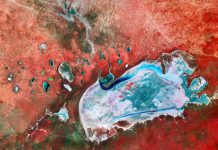
ESA’s Copernicus Sentinel-2 satellite has captured a breathtaking view of the Etosha National Park in northern Namibia, showcasing the planet’s diverse ecosystems. Meanwhile, the Mars Express orbiter continues its vigilant watch over the Red Planet, providing remarkable imagery of the Arsia Mons Elongated Cloud – a vast atmospheric phenomenon that stretches for thousands of kilometers.

Venturing to Asteroids and the Cosmos

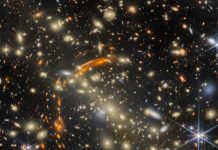
The Hera mission, ESA’s groundbreaking asteroid-deflection endeavor, has taken a significant step forward. Hera’s ‘first glimpse’ of its target asteroid system, Didymos, marks a crucial milestone in the mission’s preparation. This mission aims to understand the effects of an impact and gather vital data for planetary defense. Beyond our solar system, the powerful capabilities of the James Webb Space Telescope are being leveraged to study the intense stellar jets emanating from a nebula, offering unprecedented insights into the birth and evolution of stars.

Technological Advancements and Future Exploration

The week also saw significant progress in the development of future space technologies. The Lunar Pathfinder spacecraft is undergoing crucial integration and testing, paving the way for future lunar exploration. Simultaneously, the LandCam-X instrument is being integrated onto the Griffin-1 lander, promising enhanced surface reconnaissance capabilities. ESA also showcased its innovative Ultra-Wideband (UWB) technology demonstrator, hinting at new possibilities for communication and navigation in space.
LEAVE A REPLY

Please enter your comment!
Please enter your name here