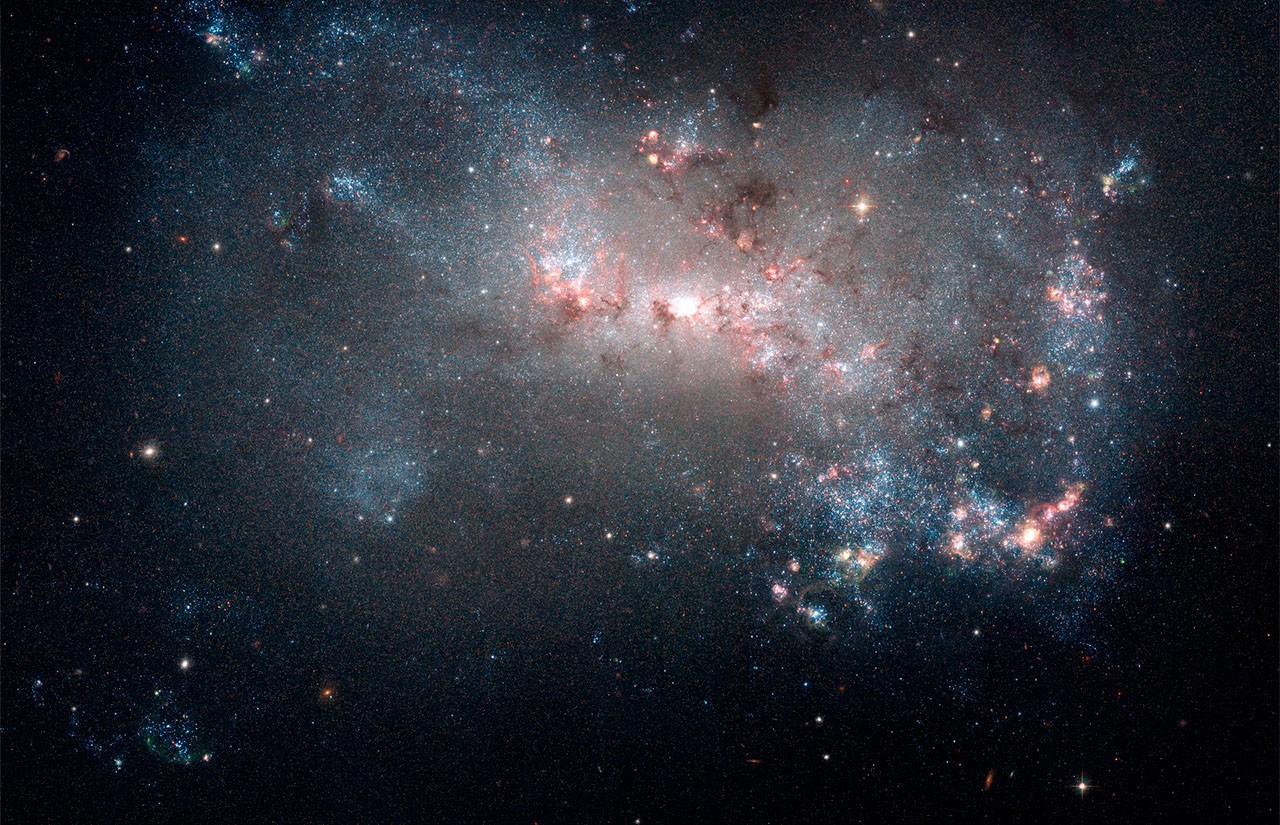
Don’t let its size fool you: the dwarf galaxy NGC 4449, a mere fraction of our own Milky Way’s grandeur, is making a surprisingly significant impact on the universe. New observations from the Hubble Space Telescope reveal that these smaller cosmic islands are remarkably efficient at dispersing the heavy elements essential for forming stars, planets, and potentially, life itself. This discovery challenges our understanding of galactic evolution and the distribution of cosmic ingredients across the cosmos.
The Mighty Miniature Galaxy
While our Milky Way galaxy stretches an immense 100,000 light-years across and harbors hundreds of billions of stars, dwarf galaxies like NGC 4449 are considerably smaller, often measuring just a tenth of that size and containing only a few billion stars. Despite their diminutive stature, dwarf galaxies are the most prevalent type of galaxy in the universe. The Hubble Space Telescope has captured a stunning image of NGC 4449, highlighting its intricate stellar structures and providing a closer look at its surprising capabilities.
Galactic Engines at Work
Scientists have observed that NGC 4449 and similar dwarf galaxies are losing more oxygen than current models predict. This phenomenon is attributed to the powerful outflows generated by their resident stars. Intense stellar winds, coupled with the explosive deaths of massive stars in supernova events, are effectively expelling oxygen and other heavier elements from the galaxy’s core. This cosmic expulsion plays a crucial role in enriching the intergalactic medium, acting as a widespread delivery system for the fundamental building blocks of future cosmic structures.
Source: NASA