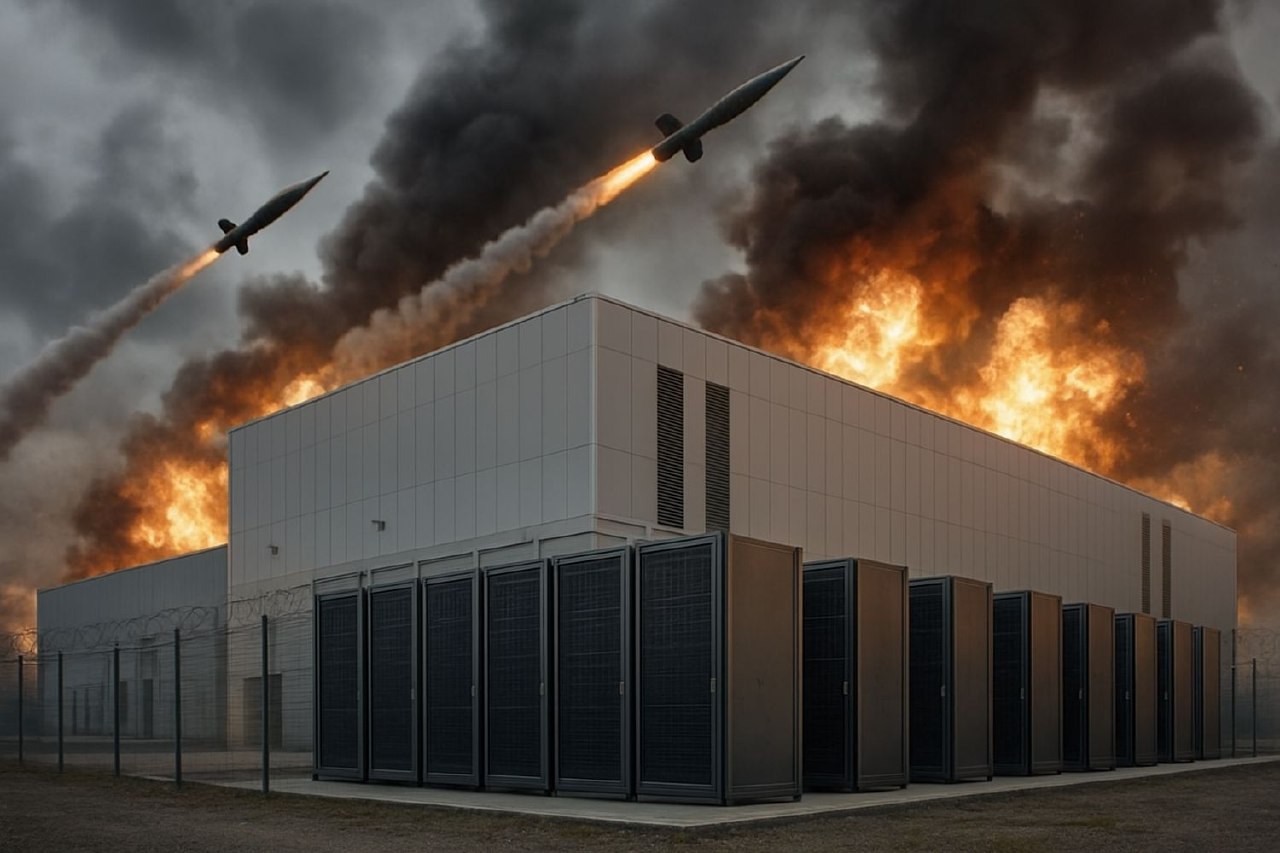
The year 2026 has marked a pivotal moment for global digital infrastructure, as data centers have transitioned from purely commercial IT facilities to prime targets in modern military conflicts. Drone strikes on Amazon Web Services (AWS) facilities in the UAE and Bahrain, the destruction of Ukrainian provider MiroHost’s Kyiv site by a Russian attack, and subsequent retaliatory strikes on Yandex data centers in Russia are forcing the global industry to re-evaluate security standards.
A report by Scientific American has explored why traditional physical security for server rooms is no longer a guarantee of business continuity, and how the experience of Ukrainian businesses is becoming a global benchmark for disaster resilience.
MiroHost Case Study: 95% of Clients Remained Online After Kyiv Site Destruction
On September 23, 2026, a Russian attack destroyed a data center in Kyiv that housed the infrastructure of MiroHost, Ukraine’s largest hosting provider and domain registrar. When the company’s president, Oleksandr Olshanskyi, arrived at the scene, the facility was in ruins, but thankfully, no employees were harmed as personnel were located in safe areas.
“As I approached the data center, I saw a column of black smoke, and the block was cordoned off by police and fire trucks.”
Despite the direct destruction of its Kyiv facility, only about 5% of MiroHost’s clients experienced an outage. The company had proactively prepared for the worst-case scenario by reserving sufficient computing power in Poland, the Czech Republic, and Slovakia for the immediate deployment of backups from its Ukrainian infrastructure.

Why Traditional Data Center Security Standards Fail Against Drones and Missiles
Historically, data centers were designed according to stringent physical and engineering security protocols (Tier III / Tier IV levels), including controlled access, 24/7 video surveillance, backup diesel generators, and gas fire suppression systems. However, these solutions were aimed at preventing internal breaches or equipment failures, not direct hits from aerial attacks.
According to Doug Madory, Director of Internet Analysis at Infoblox, 2026 was the first year that drone strikes on data centers became a systemic reality, catching the industry unprepared.
Connor Martin of the Council on Foreign Relations (CFR) emphasizes that data centers are vulnerable targets from the air: they are massive buildings filled with extremely expensive equipment that cannot be easily moved. Oleksandr Olshanskyi, however, believes that attempting to build an “impenetrable fortress” in a combat zone is futile.
“No fire suppression system is designed to withstand a direct hit from a bomb, missile, or drone.”
Physical Shielding vs. Geographic Redundancy
Industry experts identify two primary approaches to mitigating the risks of military attacks on digital infrastructure:
- Local Engineering Hardening: Peter Judge, Senior Analyst at Uptime Institute, notes that operators can install protective screens around vulnerable external components such as generators, chillers, and air conditioning systems, as well as deploy anti-drone nets against UAVs and aerial reconnaissance. More sophisticated systems integrate radar and radio frequency sensors for drone detection. However, legislation in many countries restricts private companies from jamming radio signals, and modern autonomous drones often do not require constant radio communication with their operators.
- Geographically Distributed Redundancy: This is the only proven reliable method. Burying data centers deep underground is economically unfeasible for the commercial sector. Instead, distributing loads across multiple sites in different countries ensures service survival.
To implement this strategy, MiroHost effectively doubled its available computing power by investing in duplicating its infrastructure within the EU. Doug Madory of Infoblox points out that cloud providers have long offered geographical redundancy tools, but most companies neglect them due to high costs and technical complexity.
“It is always better to have two copies of something than just one, even if that one is very well protected.”

Comparison of Data Center Infrastructure Protection Approaches in Wartime
| Security Approach | Technical Implementation | Effectiveness Against Missiles/UAVs | Economic Viability |
| Classic Standards (Tier III/IV) | Access control, gas fire suppression, backup DGs | Low (cannot withstand direct hits) | Market standard |
| Local Shielding | Protective enclosures for chillers/generators, anti-drone nets | Medium (protects only against fragments and light UAVs) | Moderate upgrade costs |
| Underground Construction | Placing server rooms in deep bunkers | High | Critically high cost (unprofitable for the mass market) |
| Geographic Redundancy | Duplicating data and nodes in data centers in other countries (EU) | Maximum (ensures service continuity) | High (requires doubling infrastructure costs) |
The case of the MiroHost data center in Kyiv has become a practical survival guide for digital infrastructure worldwide. Ukraine’s experience proves that in an era of widespread use of attack drones and ballistic missiles, investments in “thick walls” or expensive fire suppression systems are secondary to investments in geographically distributed architecture (Multi-Region Redundancy). Duplicating infrastructure in Central European countries allowed MiroHost to maintain stable operations for 95% of its clients even after the physical destruction of its main site. For Ukrainian businesses and government registries, Oleksandr Olshanskyi’s principle of preferring two copies over one “super-protected” copy should become a baseline standard for designing any IT systems.