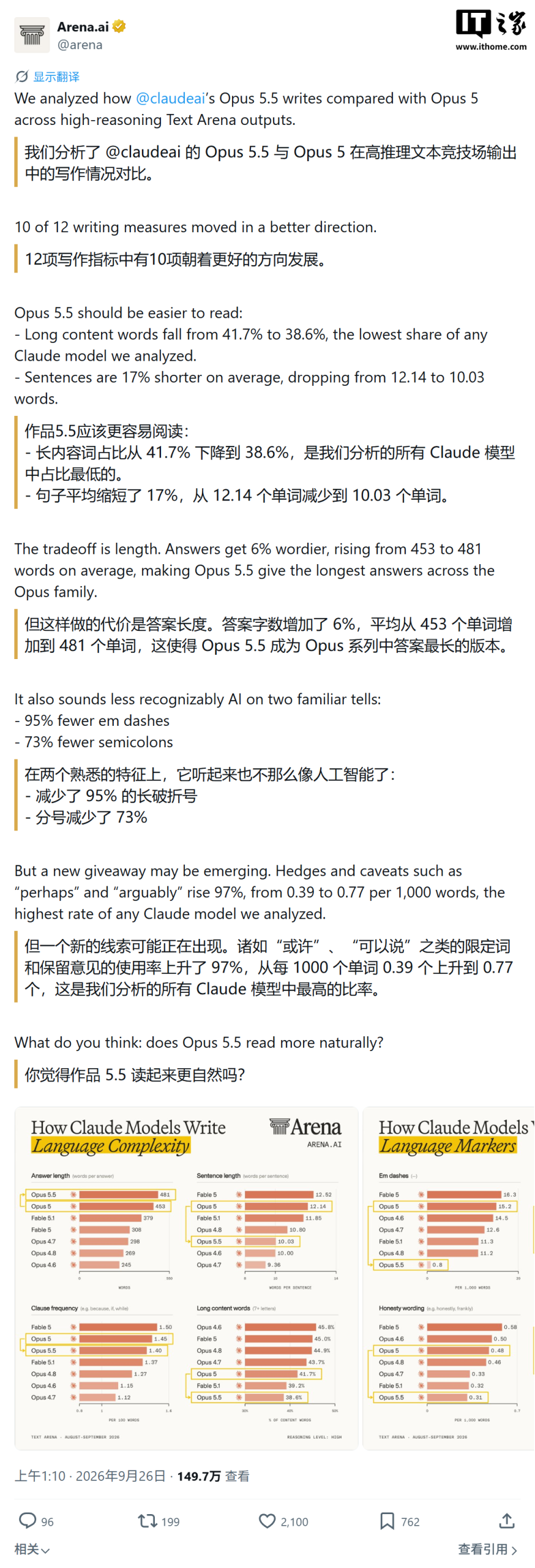
Anthropic’s latest AI model, Claude Opus 5.5, is showing significant changes in its writing style compared to its predecessor, Opus 5. According to analysis shared on X by user @arena on September 26th, the new model drastically reduces its use of hyphens and semicolons, while also producing longer responses.
Punctuation Overhaul
The most striking change observed is the dramatic decrease in hyphen usage. In Opus 5, the model used approximately 15.2 hyphens per 1,000 words. With the release of Opus 5.5, this number has plummeted to just 0.8 hyphens per 1,000 words, representing a reduction of about 95%.
Semicolon usage has also seen a substantial drop. Opus 5 employed roughly 6.10 semicolons per 1,000 words, whereas Opus 5.5 brings this down to 1.64 semicolons per 1,000 words. This marks a 73% decrease, suggesting the model is moving away from easily identifiable punctuation patterns.
Sentence Structure and Length
Beyond punctuation, @arena’s analysis also points to a shift in sentence structure. The average sentence length in Opus 5.5 is 10.03 words, a decrease from Opus 5’s average of 12.14 words. This indicates that Claude Opus 5.5 tends to produce shorter, more concise sentences.
Increased Output Volume
Despite the move towards more concise sentences, the overall output length of Claude Opus 5.5 has increased. Opus 5 generated an average response length of 453 words. In contrast, Opus 5.5 is producing longer responses, averaging 481 words. This makes Opus 5.5 the model with the longest average writing length among the Opus series compared.
Broader Writing Improvements
The analysis, which examined high-inference responses from Text Arena in August and September, revealed that 10 out of 12 measured writing metrics showed improvements in the direction deemed favorable by Arena. The reduction in punctuation and shift in sentence length are key indicators of these changes, suggesting Anthropic is fine-tuning Claude Opus 5.5 for a more refined and potentially more accessible writing style.
These changes in writing characteristics could indicate a move towards a more natural and less formulaic output, potentially making the AI’s generated text more engaging and easier to read for a wider audience. The longer response lengths, coupled with more concise sentence structures, might aim to provide more comprehensive information without overwhelming the reader.