China is forging ahead in the global race for fusion energy, with China Fusion Energy Co., Ltd. (CFE) spearheading the development of the world’s first High-Temperature Superconducting (HTS) Strong Field Steady-State Burning Experimental Platform, dubbed ‘China Fusion Torus 4’ (CFT-4).
Bridging the ‘Burning Plasma’ Gap
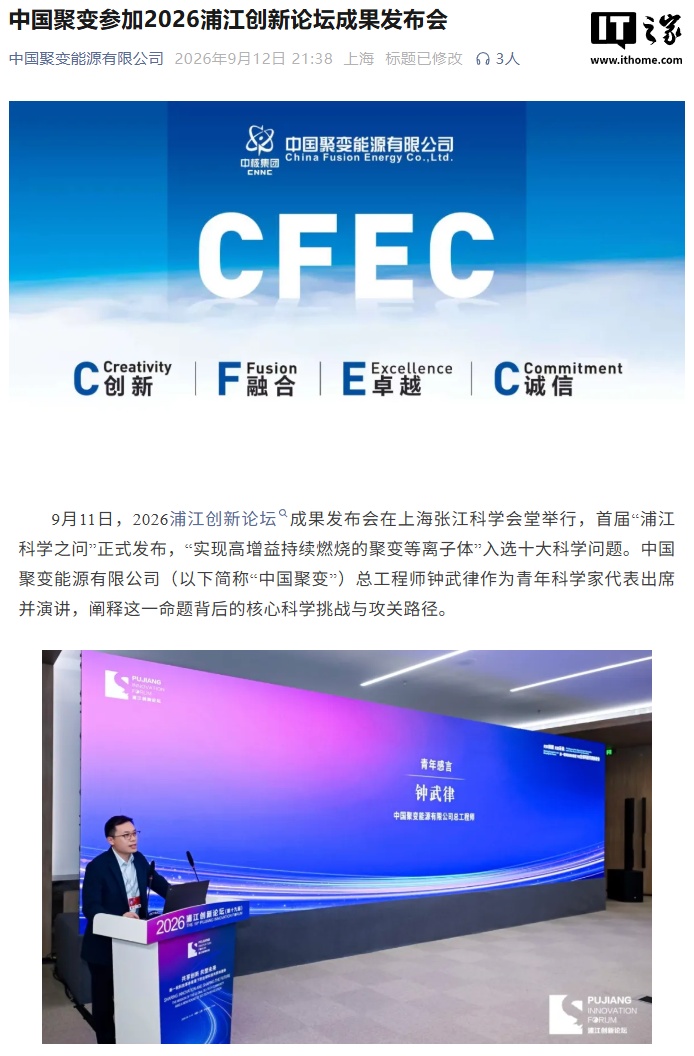
At the 2026 Pujiang Innovation Forum’s results release conference held in Shanghai, Zhong Wuli, Chief Engineer at CFE and a representative of young scientists, highlighted the critical scientific challenges in achieving sustained fusion reactions. The ultimate goal is to reach a ‘burning plasma’ state, where the fusion reactions themselves generate enough heat to maintain the plasma at temperatures exceeding 100 million degrees Celsius, leading to a self-sustaining, stable, and controllable reaction.
“Only by clarifying the scientific questions can we know where to go in engineering,” Zhong stated, emphasizing the need to overcome fundamental scientific hurdles before robust engineering solutions can be implemented. The development of CFT-4 is crucial to providing the necessary support for answering these profound scientific questions.
Leveraging HTS and AI for Fusion’s Future
CFE is strategically positioning itself to harness the power of two key technological advancements: high-temperature superconductivity and artificial intelligence. By embracing these opportunities, the company aims to navigate the path from experimental reactors to demonstration and commercial-scale fusion power plants.
“Starting from a good question, we delve into the deepest parts of science,” Zhong remarked, underscoring CFE’s commitment to pushing the boundaries of fusion research. This endeavor is driven by a determination to scale new heights, a long-term commitment, and a steadfast dedication to national development, with the aim of transforming today’s scientific inquiries into tomorrow’s ‘China Answers’.
A Legacy of Fusion Innovation
The ‘China Fusion Torus’ series of devices has a rich history, developed and built by the Southwestern Institute of Physics (SWIP) of the China National Nuclear Corporation (CNNC). SWIP, founded in 1965, is China’s earliest professional research institution dedicated to controlled nuclear fusion and plasma physics.
- China Fusion Torus 1 (CFETR-1): Built in the 1980s, it was the first national large scientific engineering facility in China’s fusion sector.
- China Fusion Torus 2 (CFETR-2): Constructed in the early 2000s, it laid the foundation for China’s fusion research, moving from principle exploration to large-scale experimental devices.
- China Fusion Torus 3 (HL-3): Inaugurated in December 2020, this advanced tokamak device, designed and built independently, is China’s largest and highest-parameter fusion device. It also serves as the sole satellite device for the ITER organization in China.
CFT-4: A New Era in Fusion Experimentation
China Fusion Energy Co., Ltd., a joint venture involving CNNC, PetroChina, the Shanghai Municipal Government, and the Sichuan Provincial Government with an investment of 15 billion yuan, is the primary entity driving the future fusion energy industry. Leveraging a ‘two locations, three zones’ layout in Shanghai and Chengdu, CFE is advancing the development of CFT-4.
The company is also leading the establishment of the Yangtze River Delta HTS Technology Innovation Consortium. This initiative aims to address the shortcomings in the industrialization and commercialization of high-temperature superconducting magnets, a critical component for achieving higher magnetic fields and more compact, cost-effective fusion reactors.
Zhong Wuli, who also served as the Chief Designer for the HL-3 project and Director of the Institute of Fusion Science at SWIP, has a distinguished career in magnetic confinement fusion physics and diagnostics research. His contributions have been recognized through accolades such as the National Science Fund for Excellent Young Scholars and the China Youth Science and Technology Award.
Key Objectives of CFT-4
The “burning plasma” state is defined by the self-heating of the plasma through the alpha particles (helium nuclei) produced by deuterium-tritium fusion reactions. This self-heating sustains the plasma at extremely high temperatures and maintains a long-term, stable, and controllable “burning” condition, marking a critical transition from experimental verification to engineering verification in global fusion research.
According to the ‘China Fusion Torus 4 Target Image’ released in August 2026, the platform will systematically validate the reliability of 25-tesla HTS magnets under complex fusion environments. It will also demonstrate intelligent full-system control for fusion reactors and achieve long-duration steady-state operation. The use of high-temperature superconductors is expected to enable higher magnetic fields, facilitating higher confinement performance within smaller device volumes, thereby reducing the overall size and construction costs of fusion reactors.