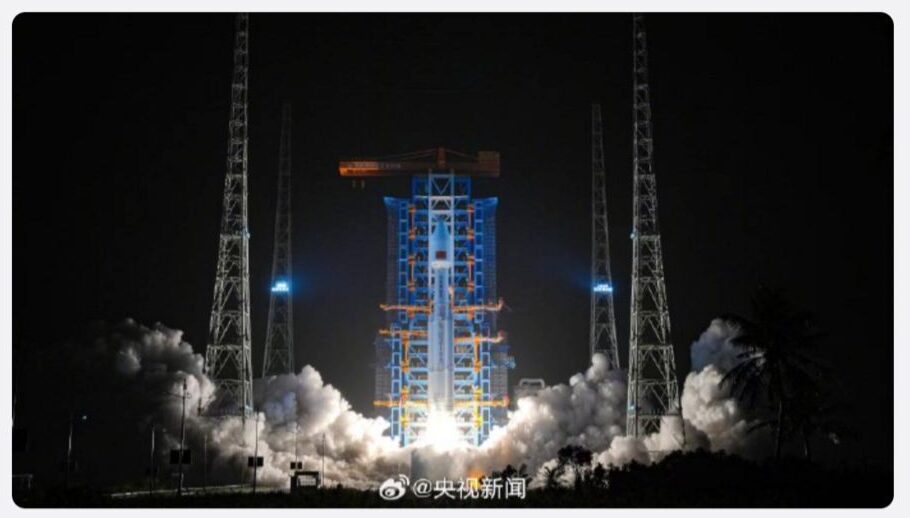
China has achieved another significant milestone in space technology with the successful launch of 30 groups of low-Earth orbit (LEO) satellites destined for internet services. The launch took place on November 20th at 19:59 local time from the Hainan Spaceport, utilizing the Long March-8 rocket. This deployment is part of China’s ambitious GW program.
The GW program is a large-scale satellite constellation designed for full integration with 6G airborne and space-based networks. The program aims to deploy over 12,000 satellites, divided into two sub-constellations: GW-A59, comprising 6,080 satellites operating below 500 km altitude, and GW-A2, with 6,912 satellites at an altitude of 1,145 km. The project is slated for completion by 2035.
Launch Details and Network Development Prospects
This launch follows another successful deployment earlier in the month, with the Long March-12 rocket carrying 29 satellite groups into orbit on November 9th. To facilitate rapid and mass deployment, an upgraded version of the Long March-8 rocket is being employed. This enhanced rocket boasts improved technical specifications, including a payload capacity of up to 7 tons for a 700 km sun-synchronous orbit.
As part of the GW system’s development, a test conducted in October 2026 featured the first video call conducted over the Earth’s poles. This demonstration highlighted stable communication speeds of up to 30 Mbps, marking a crucial step towards the implementation of global satellite internet leveraging 6G technologies.
Source: ithome.com