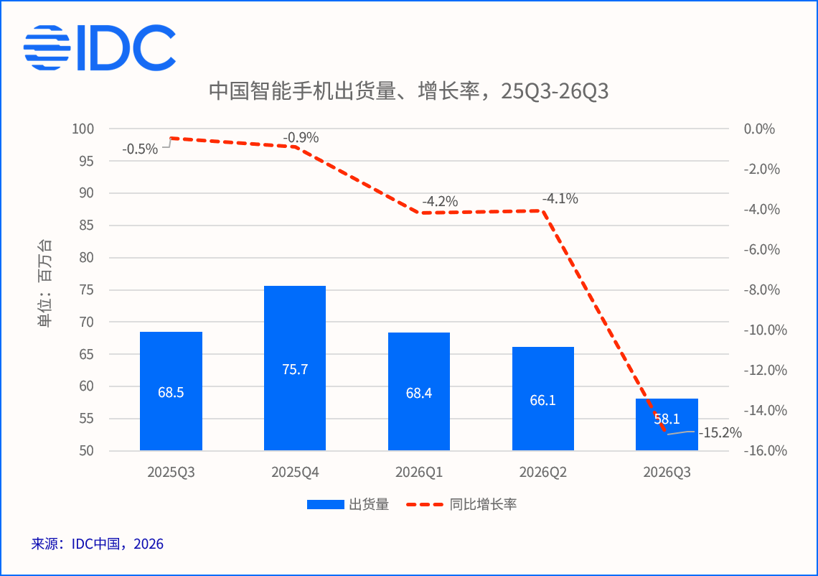
The Chinese smartphone market experienced a significant downturn in the third quarter of 2026, with shipments falling by 15.2% year-on-year to approximately 58.06 million units. This marks an acceleration in the market’s decline compared to the first half of the year, when the year-on-year drop was around 4%.
According to the latest smartphone quarterly tracking report from International Data Corporation (IDC), the surge in costs for components like storage has led to increased terminal prices and adjusted product configurations. This has demonstrably dampened consumer demand, with Android manufacturers and smaller brands feeling the pressure particularly acutely.
The market in Q3 2026 was characterized by a clear trend of declining volume and rising prices. Upstream cost pressures have been consistently passed on to consumers, resulting in higher pricing for new devices. Manufacturers have also been compelled to recalibrate their product portfolios to manage these escalating costs. Consumers, facing these price increases, require time to adapt, leading to extended replacement cycles and a direct drag on overall shipment performance. This situation highlights cost pressure as a critical factor influencing the current trajectory of the Chinese smartphone market.
Vendor Landscape: Huawei Ascends, Honor Shows Sequential Growth
Amidst the overall market slump, Huawei maintained its strong performance, driven by diverse product offerings and relatively restrained price increases. The company achieved double-digit year-on-year growth in shipments, boosting its market share to 21.1%.
Apple saw positive reception for its new product launches, exceeding expectations. However, due to a reduced number of models released this year, its overall shipments experienced a slight year-on-year decrease. Other leading Chinese brands faced considerable challenges but demonstrated resilience in navigating the current market conditions.
OPPO has consistently secured a top-three position in market shipments for four consecutive quarters. In the premium segment (above $600), its Find X10 model topped the sales charts for standard versions of new flagship products this year, contributing to three consecutive quarters of triple-digit year-on-year growth in shipments for OPPO in this price bracket. Within the $400-$600 mid-to-high-end market, the Reno 16 series, bolstered by its balanced product capabilities and deep channel penetration, maintained the top spot for Android single-model sales in its price segment, forming the core of OPPO’s sales base.
The sub-brand OnePlus stands out as the only brand to have achieved continuous year-on-year shipment growth from 2025 through Q3 2026, adding differentiated growth momentum to the overall product matrix.
vivo continued to show stable market performance, leveraging its robust product competitiveness. The new flagship X500 series further solidified its position in the high-end imaging segment. Its sub-brand, iQOO, precisely targets young gaming enthusiasts, with the iQOO 15 series continuing its strong sales and the new iQOO 16 also receiving a warm market reception post-launch. Together, the main brand and sub-brand helped vivo secure the leading position among Android brands in the premium market (above $600). In the mid-range segment, the S60 series outperformed its predecessor, helping vivo take the top spot in the $400-$600 price range and consolidate its sales base.
Xiaomi, upon re-entering the foldable market, saw its first domestic Android wide-foldable product, the Xiaomi 18 Fold, quickly capture market share thanks to its differentiated form factor and product capabilities, enabling Xiaomi’s return to third place in the foldable segment. Coupled with the launch of the new flagship Xiaomi 18 Pro series, this propelled Xiaomi to the top share in the Android market above $1,000. While many manufacturers were scaling back entry-level product lines due to high industry costs, Xiaomi maintained its commitment to the affordable market, holding the leading position below $100 and effectively catering to budget-conscious consumers.
Honor emerged as the only major mainstream manufacturer to achieve positive sequential shipment growth this quarter, indicating a clear rebound. The new Magic 9 series was the only mainstream flagship launched this year to record significantly higher sales in its debut compared to its predecessor. During the National Day holiday, it consistently ranked first in Android flagship sales, becoming a key driver of growth in the premium market. In the mid-range segment, the X80 Pro Max series quickly gained traction after its launch, reaching the top spot for single-model sales in the $200-$400 price bracket.
Price Structure: Mid-to-Low End Market Share Shrinks
The impact of rapidly increasing component costs became fully apparent in the latter half of 2026, driving up the overall market pricing center and exacerbating price structure differentiation.
- The premium market (above $600) expanded by 7.1 percentage points year-on-year, driven by the front-loaded launch cycles of flagship products from leading manufacturers and product upgrades. This segment emerged as the primary beneficiary of the current structural upgrade.
- The mid-to-high-end market ($400-$600) also saw expansion, with its share increasing by 4.6 percentage points year-on-year.
- The mid-range segment ($200-$400) remained relatively stable, experiencing a minor year-on-year share decrease of 0.7 percentage points.
- The low-end market (below $200) faced significant pressure, with its share declining by 13.9 percentage points year-on-year.
Overall, cost pressures are accelerating the market’s shift towards the mid-to-high-end, further compressing the space for low-end devices.
Foldables: Four Consecutive Quarters of Decline
In Q3 2026, shipments of foldable smartphones in China reached 1.77 million units, a year-on-year decrease of 32.7%. This marks the fourth consecutive quarter of year-on-year decline for the foldable market. Innovations in traditional form factors are yielding diminishing returns, failing to significantly stimulate consumer upgrade intentions. Conversely, brands that have adopted the new wide-foldable form factor have achieved better market performance due to their differentiated user experiences.
With Apple’s official entry into the foldable arena and the anticipated concentrated launch of new wide-foldable models by more mainstream brands in the first half of 2027, market attention and consumer appeal are expected to gradually recover. The foldable market in China is projected to stabilize and rebound starting next quarter, re-entering a growth trajectory.
- Huawei maintains absolute dominance with the most comprehensive product line-up in terms of form factors, holding over 70% of the foldable market share.
- The wide-fold product, Galaxy Z Fold8, achieved strong global sales, helping Samsung secure second place in the foldable market with an 8.0% share.
- Xiaomi also reclaimed third place in the foldable market thanks to its new wide-fold product, capturing a 6.4% market share.
- vivo and Honor ranked fourth and fifth, respectively.
Outlook: Market Stagnation Until Price Structure Readjustment
Looking ahead, component costs, including storage and other materials, are expected to remain high in the coming quarters, and smartphone prices are likely to continue their upward trend. Most consumers will require additional time to adjust to these price increases, potentially leading to even longer replacement cycles. Consequently, even with a concentration of new product launches across various segments, the Chinese smartphone market is unlikely to see significant improvement in Q4 2026.
The cost pressure is anticipated to persist through much of 2027, with the market likely continuing its downward trend. However, leading manufacturers, leveraging their strong brand appeal and comparatively more moderate price hikes, are well-positioned to capture a larger share of the market amidst intense competition. As time progresses, consumers will eventually adapt to and accept the new pricing structure. When the next upgrade cycle arrives, they will replace their devices, creating further market opportunities for other brands.