Artificial intelligence (AI), powered by NVIDIA technologies, is revolutionizing the search for extraterrestrial intelligence (SETI) by providing unprecedented speed and adaptability to the process.
AI as a Tool for Understanding the Universe
The prospect of extraterrestrial civilizations, potentially billions of years older than humanity, opens up possibilities for technological advancements beyond our current comprehension. Scientists theorize that such advanced civilizations might have developed their own forms of artificial intelligence. The Breakthrough Listen project, in collaboration with the SETI Institute, is actively integrating agent-based AI into its daily search for cosmic signals.
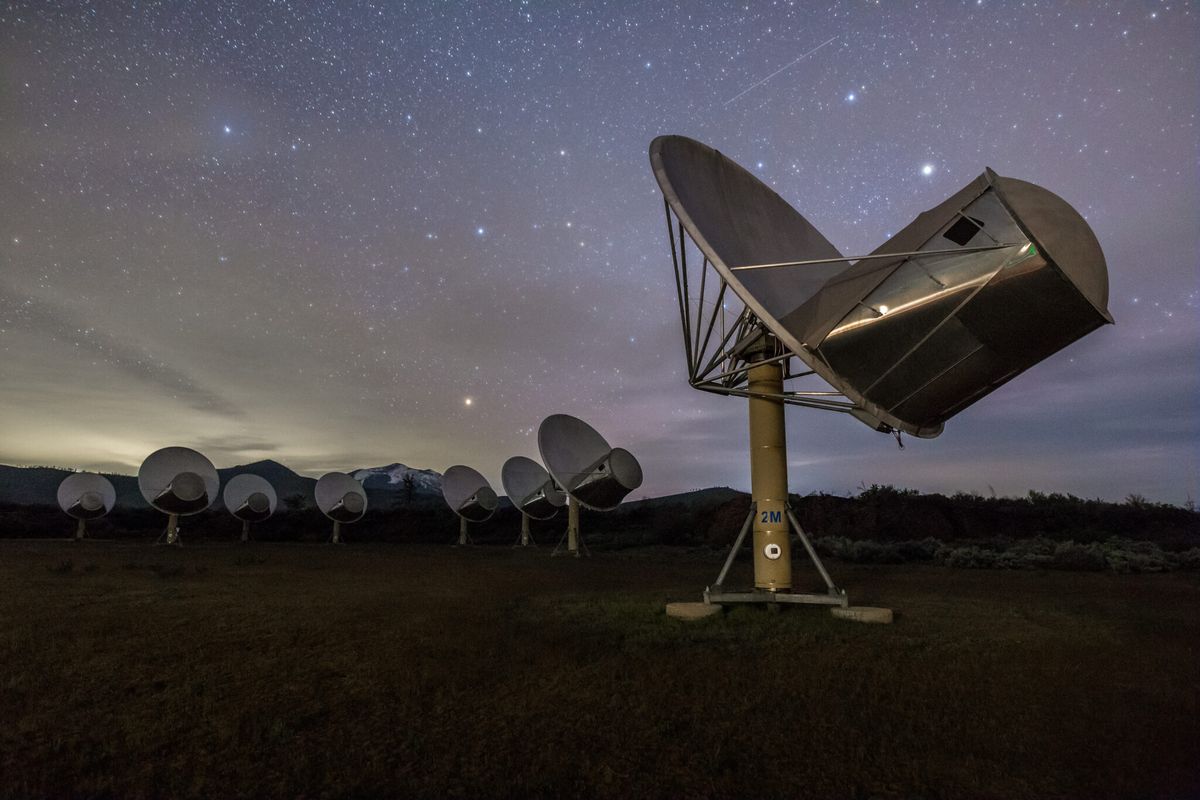
Leveraging the NVIDIA Holoscan platform, agent-based AI is now directing the operations of the Allen Telescope Array in Northern California. This system enables real-time optimization and correction of incoming data, as well as the application of AI models in response to natural language commands. This significantly enhances the speed and flexibility of the search for potential signals from alien civilizations and their technologies.
“As our new agent observatories reach out to the universe, what they discover might have more in common with themselves than with the humans who built them,” noted Andrew Siemion, Director of the Bernard M. Oliver Gateway to the SETI Institute and Principal Investigator for Breakthrough Listen. “But this is not something to be feared. Rather, it is a breakthrough in translation.”
Processing Terabytes of Data in Real-Time
Radio telescopes generate immense volumes of data, posing a significant challenge for scientists tasked with identifying potentially interesting signals during observations. The DAQIRI library on the Holoscan platform allows the telescope to ingest data from sensors at rates up to terabytes per second directly into GPU memory. This enables “on-the-fly” data processing, eliminating the need to fill hard drives.
The CyberEther signal processing framework, developed by the SETI Institute, utilizes NVIDIA CUDA-X libraries, including cuFFT and cuBLAS, for complex mathematical computations. Nexus, the observatory’s web orchestrator, serves as the foundation for the AI agents, providing them with a unified source of information on instrument status, computational resources, and processing pipelines. This allows researchers to monitor packet loss, view real-time spectrograms, and modify signal processing blocks using natural language commands.
The system is capable of processing 2.4 terabits of data per second on NVIDIA RTX PRO 6000 Blackwell GPUs, with inferences performed locally, adjacent to the instrument. This empowers the agent to control the telescope’s antennas, calibrate and focus the instrument for a clean signal, correct data errors, and visualize results. Tasks that previously took weeks or years of human effort are now accomplished by these agents in a matter of hours.
Scientific Fact, Not Fiction
This AI pipeline has already proven its effectiveness, enabling the first real-time AI-driven detection of a pulsar—a rapidly rotating stellar remnant that pulses like a cosmic lighthouse—within the Crab Nebula.
The team is currently evaluating open models, including NVIDIA Nemotron, for use cases where data locality and rapid response are critical, as well as for observatories that may operate offline in the future, such as on the far side of the Moon.
Learn more about NVIDIA AI for Science.