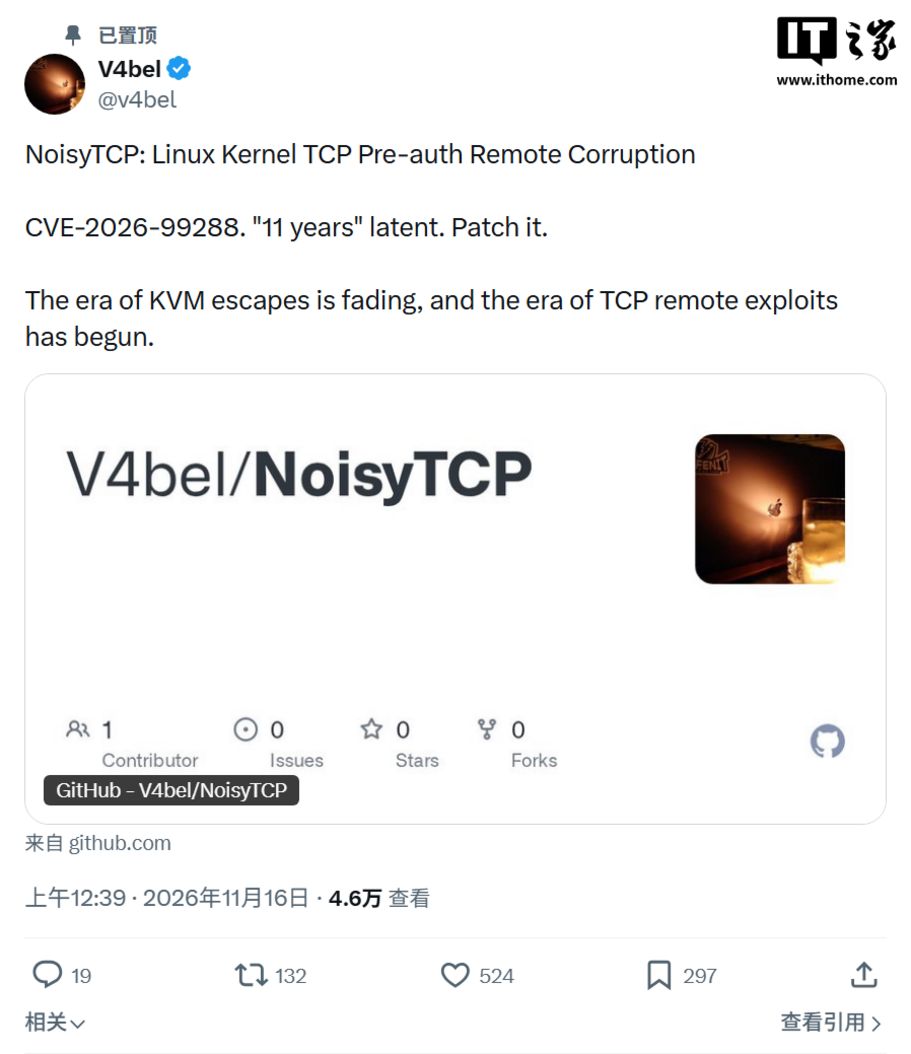
A critical vulnerability, dubbed NoisyTCP and identified as CVE-2026-99288, has been discovered in the Linux kernel, potentially leaving servers vulnerable for over a decade. Security researcher Hyunwoo Kim from South Korea disclosed the flaw on November 16th, detailing how specially crafted TCP packets can trigger a kernel crash, leading to a denial-of-service (DoS) condition.
The vulnerability stems from a race condition within the Linux kernel’s TCP connection lookup process. When the kernel attempts to query a hash table of established TCP connections without locks, it might encounter a Socket memory that has been freed and subsequently reallocated. If the new object happens to reuse the same memory address and connection information, the kernel could erroneously identify this new object, leading to the crash.
One exploitation path identified by Kim involves tricking the kernel into accessing a request Socket that lacks an associated listener. This ultimately results in a NULL Pointer Dereference, causing the kernel to crash. Importantly, attackers do not require authentication to exploit this vulnerability.
NoisyTCP can affect common TCP services, meaning Linux servers running NGINX, Apache, SSH, and other standard TCP services could be at risk without requiring any special application configurations. However, successful exploitation is contingent on certain network conditions. The target server must have at least two RX (receive) queues or have RPS (Receive Packet Steering) enabled. These features distribute network packets across multiple CPU processing contexts, creating the opportunity for the race condition to occur.
Kim’s tests revealed varying success rates. In a QEMU/KVM virtualized environment with default configurations for NGINX, Apache, and SSH, triggering a kernel crash took approximately 5 seconds to 2 minutes. On a physical server with 8 RX queues and low load, using a carefully timed exploit program, it took around 14 hours to successfully trigger the vulnerability. This indicates that while the vulnerability is remotely exploitable, the actual time to trigger it is influenced by server hardware, network queues, and system load.
If affected services are running within containers, the impact could be more widespread. Since the vulnerability resides in the Linux kernel’s network stack, a successful exploit could potentially crash the entire host machine and all other containers running on it, rather than just the targeted application.
Currently, the primary verified impact is remote denial-of-service. The researcher has not yet demonstrated the possibility of privilege escalation or remote code execution, nor is there evidence of direct data leakage.
The vulnerability’s code was introduced into the Linux kernel around October 3rd, 2015, and a fix was submitted upstream on November 3rd, 2026. Various Linux distributions are addressing the issue with differing timelines. As of November 18th, 2026, fixes have been integrated into several stable kernel branches, including Linux Kernel 6.12.117, 6.18.63, and 7.4.4. The main development branch has seen the fix in 7.4-rc2.
Distribution-specific updates indicate:
- Debian 13 series is fixed with version 6.12.117-1; Debian 12 series is fixed with version 6.1.192-2.
- Several Ubuntu versions remain marked as affected, including 22.04, 24.04, 26.04, and 26.10.
- Red Hat Enterprise Linux 8, 9, and 10 series are affected, with no corresponding fixed kernel versions released yet.
- AlmaLinux has backported patches for its 8, 9, and 10 series, with fixed kernels in testing repositories.
Kim has also provided temporary workarounds on GitHub, such as disabling SYN Cookies or limiting network interface receive queues to one while disabling RPS and RFS. However, disabling SYN Cookies reduces a server’s ability to defend against SYN Flood attacks, making these measures a temporary substitute for official security patches.
Server administrators running Linux are strongly advised to check their distribution’s security advisories and install the kernel updates containing the fix for CVE-2026-99288. A system reboot will be necessary for the fix to take effect.