Giant Star’s Explosive Temperament Revealed by NASA’s Chandra Telescope

0
26
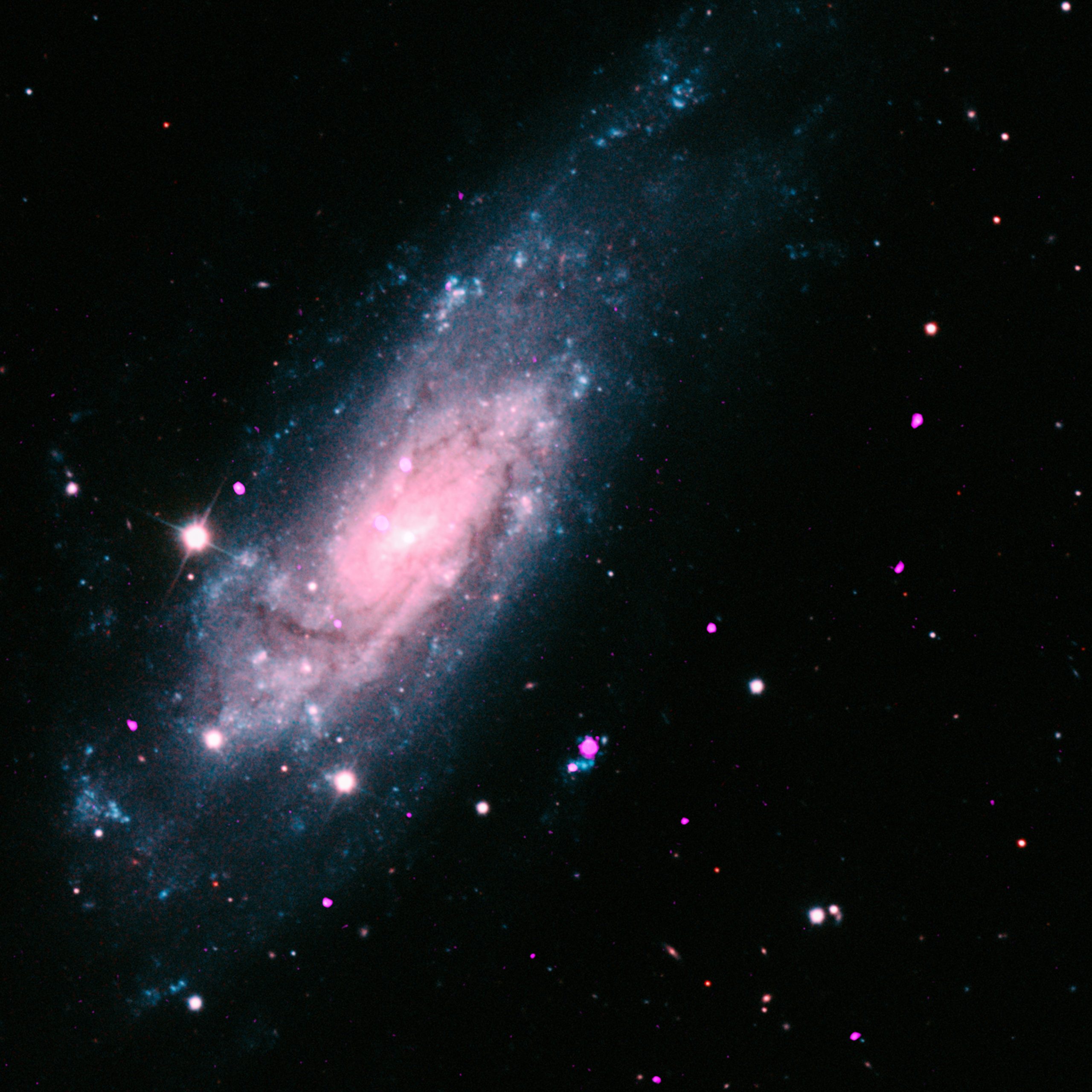
This release features a composite image of a spiral galaxy with a giant, unstable star at its outer edge. Using Chandra, astronomers have discovered the star’s previously hidden companion, which triggers luminous outbursts every 113 days. The spiral galaxy is NGC 4559. Shown at a sharp angle in the composite image, its flat pink and milky blue face tilts toward our upper left. Sitting near the outer edge of the dense spiral, near the center of the frame, is a small group of pink and blue dots. This group is outlined with a white square, enlarged and annotated in supporting images. The smallest pink dot in the square is AT 2016blu, a massive star some 33 times the size of our Sun. For over 15 years astronomers have been watching this star get bright and then dim again in optical light on a regular basis. Chandra’s X-ray observations suggest that a hidden companion object, either a stellar mass black hole or a neutron star, is pulling material from AT 2016blu every 113 days as they orbit one another. This captured material gets so hot that it shines brightly in X-rays. Other pink and blue specks within the white square and enlargement are unresolved stars or star clusters, too distant to be related to the movement of material between AT 2016blu and its hidden but influential neighbor.
Using Chandra, astronomers have discovered a previously hidden black hole or neutron star companion that is triggering repeated outbursts from a giant, unstable star. These outbursts are so extreme that they rival the brightness of a supernova. This composite image shows the star AT 2016blu in X-rays from Chandra (purple) along with its host galaxy, NGC 4559, in optical light from the SDSS (red, green, and blue). AT 2016blu is in the middle of the small square and is seen in both the Chandra and SDSS data. The SDSS data also shows the galaxy and foreground and background objects in red and blue.

Astronomers using NASA’s Chandra X-ray Observatory have pinpointed the cause of recurring, powerful outbursts from a colossal and volatile star. This star, known as AT 2016blu, resides in the spiral galaxy NGC 4559, approximately 30 million light-years away, and is estimated to be at least 33 times more massive than our Sun. The discovery offers crucial insights into the extreme behavior of some of the universe’s most massive stellar objects.

Unraveling Stellar Fury

The unprecedented X-ray observations have shed light on the dramatic events unfolding around AT 2016blu. This supermassive star is not just large; it’s inherently unstable, leading to periodic, energetic expulsions of material. Understanding these outbursts is key to comprehending stellar evolution and the processes that shape galaxies.

A Cosmic Phenomenon

Located in NGC 4559, this colossal star’s explosive nature has been captured in exquisite detail by Chandra. The observatory’s sensitive instruments can detect the high-energy X-rays emitted during these stellar tantrums, allowing scientists to study the underlying physics. Such events are rare and provide a unique opportunity to learn about the life cycle of massive stars and their impact on their galactic environments.

Source: NASA

LEAVE A REPLY

Please enter your comment!
Please enter your name here