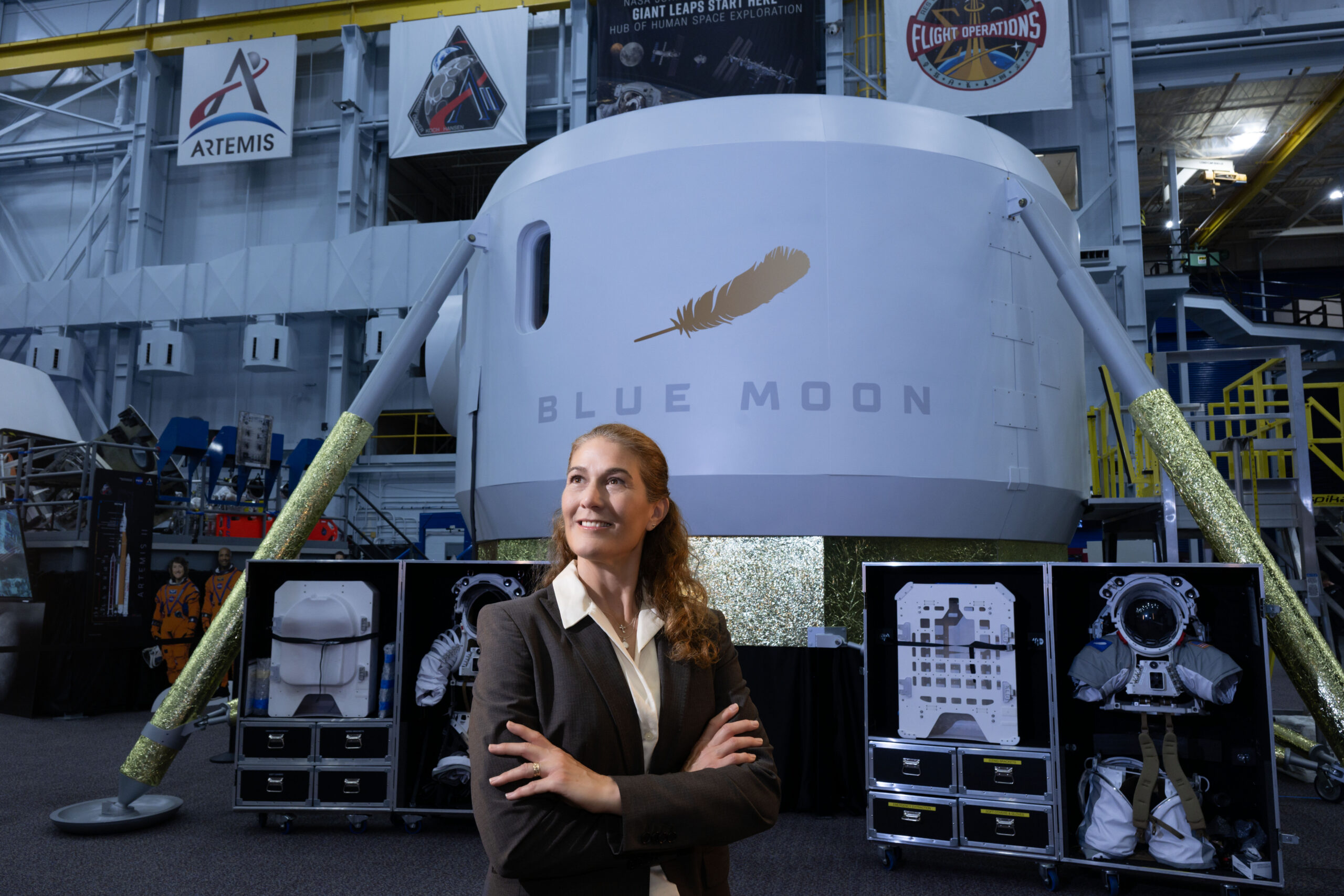
Katie Spicer, a NASA engineer whose career has evolved from a junior lab assistant to a pivotal figure in the Artemis program, is sharing her insights and experiences regarding humanity’s return to the Moon. Currently serving as the Landing Systems Integration Manager for Blue Origin, Spicer is instrumental in the development of the Blue Moon Mark 2 lunar lander, a crucial component designed to safely transport astronauts from lunar orbit to the surface.
An Unconventional Path to Space Engineering
Katie Spicer’s journey is a powerful testament to the idea that it’s never too late to pursue one’s dreams, regardless of how distant they may seem. After earning a Bachelor’s degree in Microbiology, she dedicated herself to raising her three children as a homemaker. However, her passion for science and space remained undimmed. Her path to NASA began with a part-time role at the renowned Life Sciences Laboratory, where her tasks were modest, involving tasks like washing dishes and cleaning laboratory equipment. “I went from housekeeping and managing a household to maintaining a historic laboratory where Apollo crews were quarantined after returning from the Moon, and where lunar soil samples were stored,” Spicer recalled.
She later transitioned to working with scientific payloads on the International Space Station (ISS), assisting in the operation of scientific modules and collaborating with scientists and crew members to ensure the successful execution of processes and protocols. It was within the dynamic, real-time environment of space operations that Katie discovered her true calling.
Ascending to Mission Control: A Flight Controller’s Rise
In 2018, Katie Spicer took a significant leap by becoming a flight controller at NASA’s Johnson Space Center. Despite lacking a formal engineering degree, she independently studied engineering principles, passed certification exams, and successfully learned to “speak the language of engineers.” Five years spent as an operator and support officer in the “front room” of Mission Control—the nerve center of space missions—provided her with invaluable experience. Today, when looking at the Moon in the night sky, Katie feels a profound sense of pride and responsibility for her role in the team bringing humanity back to its surface. She emphasizes the legacy of the brave Apollo crews and inspires future generations of space explorers to “keep going and reach for the stars!”
Currently, in what is considered a “Golden Age” of innovation and exploration, the Artemis program is tackling increasingly complex challenges, including the exploration of the Moon’s south pole. Beyond scientific discoveries and economic benefits, the program aims to establish a sustainable human presence on the Moon and expand the experience needed to prepare for the first crewed mission to Mars.
Source: NASA