NASA’s venerable Hubble Space Telescope has captured a stunning gallery of gravitational lenses, offering a preview of cosmic wonders that the upcoming Nancy Grace Roman Space Telescope will investigate further. These powerful natural magnifying glasses, predicted by Albert Einstein, are crucial for understanding the universe’s expansion, the evolution of galaxies, and the enigmatic nature of dark matter.
Unlocking Cosmic Secrets with Gravitational Lenses
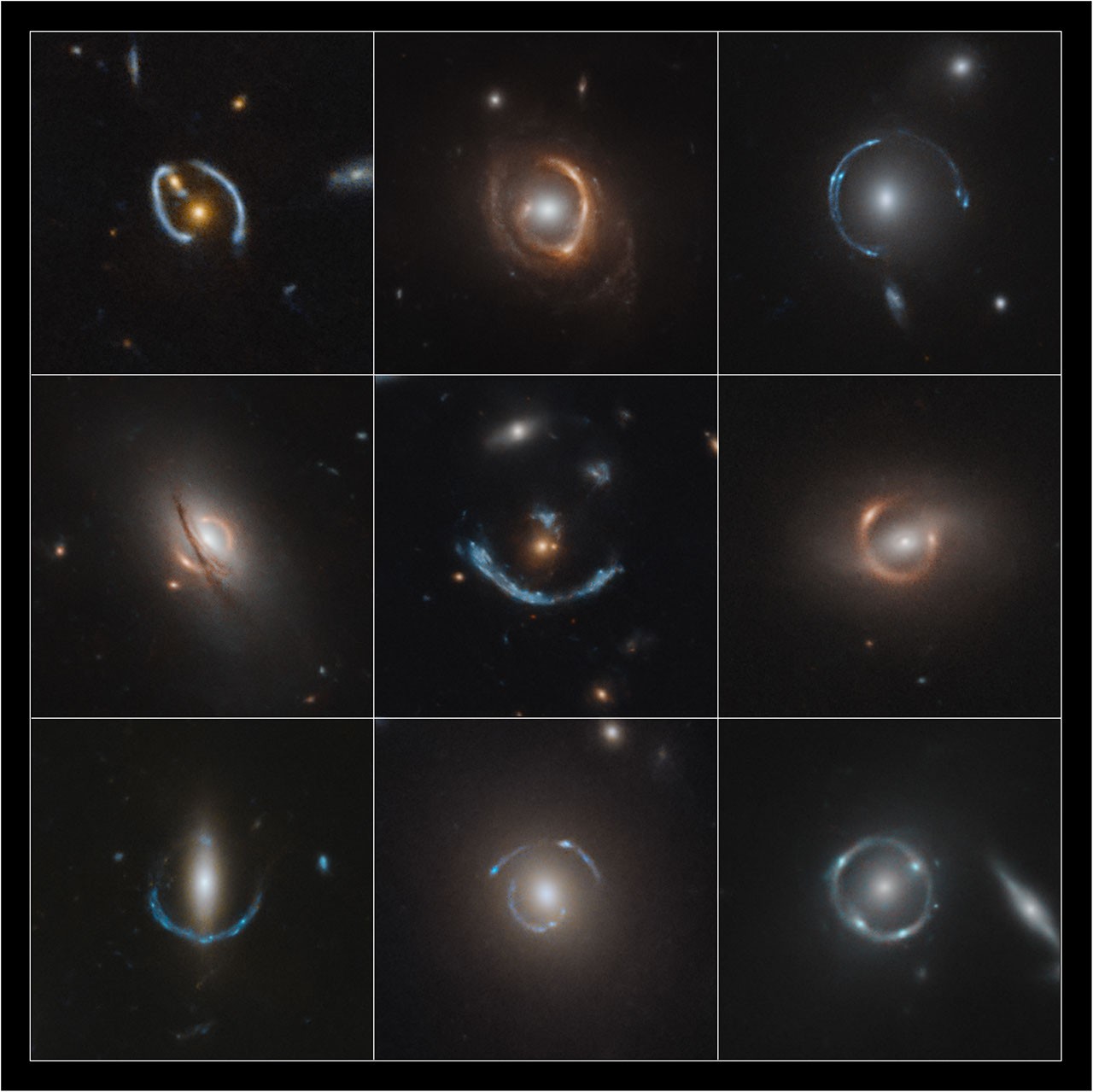
Gravitational lensing occurs when the immense gravity of a foreground object, like a galaxy or a cluster of galaxies, bends and distorts the light from a more distant object. This cosmic phenomenon acts like a giant lens, allowing astronomers to observe galaxies far beyond the reach of even the most powerful telescopes. The Hubble images showcase these lenses, formed by the precise alignment of distant galaxies with massive foreground galaxies, creating warped and magnified images appearing as arcs or rings.
These observations are not just visually striking; they are scientifically vital. By analyzing the distortions in the lensed background galaxies, astronomers can determine the quantity and distribution of mass within the foreground galaxy, including its invisible dark matter. This detailed study is key to testing theories about dark matter, such as the ‘cold dark matter’ theory, which predicts the existence of numerous small dark matter clumps.
Complementary Visions: Hubble and Roman Working Together
While Hubble excels at providing high-resolution, detailed views of individual cosmic objects, primarily in visible and ultraviolet light, the Roman Space Telescope will offer a much wider field of view and observe in infrared light. This means Hubble can scrutinize the fine details of specific gravitational lenses, potentially detecting subtle imperfections that could reveal the presence of small dark matter clumps. If Roman identifies particularly compelling lenses in its broad surveys, Hubble can then be tasked with more in-depth follow-up observations, leveraging its unique capabilities.
The diverse examples of lenses captured by Hubble demonstrate the variety of phenomena astronomers will encounter. These include:
- Arc-counterarc configurations: Where a lensed galaxy appears as a pair of arcs.
- Einstein Rings: Formed by near-perfect alignment, creating a complete ring of the background galaxy around the foreground lens.
- Quadruply lensed galaxies: Where the background galaxy is replicated up to four times, appearing as distinct points or smears.
Furthermore, the colors of the lensed arcs—blue for young stars and red for older stars—will help both telescopes study how galaxies evolved over cosmic time. Understanding these differences is crucial for piecing together the universe’s history.
Building a Smarter Cosmic Search Tool
The detailed analysis of Hubble’s lens images is also serving as a training ground for future research. Scientists are using these observations to develop advanced techniques and ‘super-intelligence tools’ that will enable them to efficiently identify similar arcs within the vast datasets expected from Roman. This synergistic approach, combining Hubble’s precision with Roman’s expansive reach, promises to revolutionize our understanding of the universe’s most profound mysteries.
Source: NASA