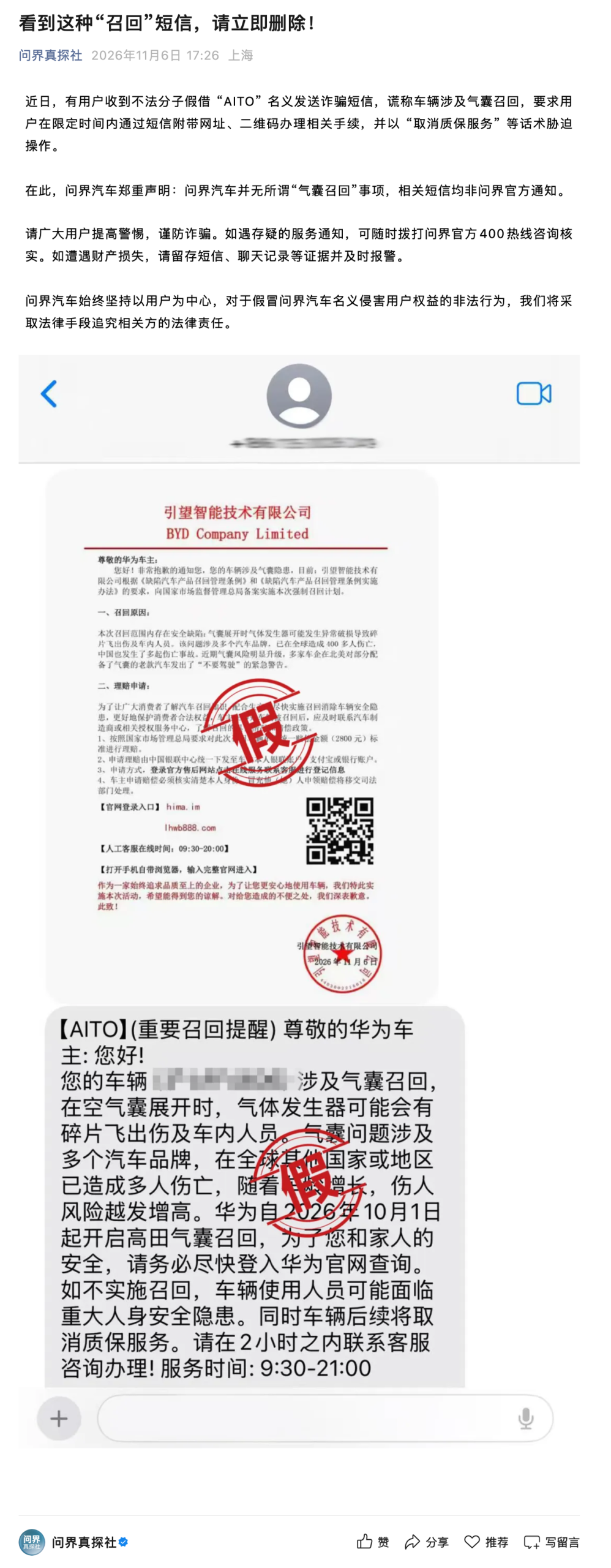
AITO Motors has issued a public warning regarding fraudulent text messages circulating among users. The messages, which falsely claim to be from AITO, allege an urgent “airbag recall” and pressure recipients into clicking on links or scanning QR codes within a limited timeframe to complete supposed “procedures.” These scams often employ threats, such as “canceling warranty service,” to coerce individuals into acting without verification.
AITO Denies “Airbag Recall”
In a statement released through its official account “AITO True Detective,” AITO Motors has categorically denied any such “airbag recall” initiative. The company emphasized that these messages are not official communications and are part of a deceptive scheme by malicious actors.
“AITO Motors solemnly declares: there is no so-called ‘airbag recall’ matter for AITO vehicles, and the related text messages are not official AITO notifications,” the statement read.
The company urges all users to exercise heightened vigilance and beware of such fraudulent activities. AITO provided clear instructions for users who receive suspicious service notifications: always call the official AITO 400 hotline for verification. In cases where users have suffered financial losses due to these scams, they are advised to preserve evidence like text messages and chat records and report the incident to the police immediately.
Commitment to User Protection
AITO Motors reaffirmed its commitment to a user-centric approach. The company stated its intention to pursue legal action against those involved in impersonating AITO Motors and infringing upon user rights. “We will take legal measures to pursue the legal responsibilities of the relevant parties,” AITO declared, signaling a firm stance against such deceptive practices.
A Trend in the Automotive Industry
This incident is not isolated. IT之家 noted that other major automotive brands, including Li Auto, Volkswagen China, and BMW China, have also recently issued similar warnings to their customers. These consistent patterns of fraud highlight a growing trend where scammers impersonate reputable car manufacturers to execute their schemes. Consumers are advised to remain skeptical of unsolicited service or recall notifications, especially those demanding immediate action or personal information via suspicious links or QR codes.
Examples of similar advisories include:
- Li Auto’s legal department has stated that claims of “recall matters” are entirely fabricated.
- Volkswagen China has released an official statement urging owners to be alert to fake recall messages.
- BMW China has also issued an official statement warning against scams using “vehicle recalls” as a pretext.
The repeated occurrence of these scams underscores the importance of official communication channels and user awareness in safeguarding against online fraud within the automotive sector.