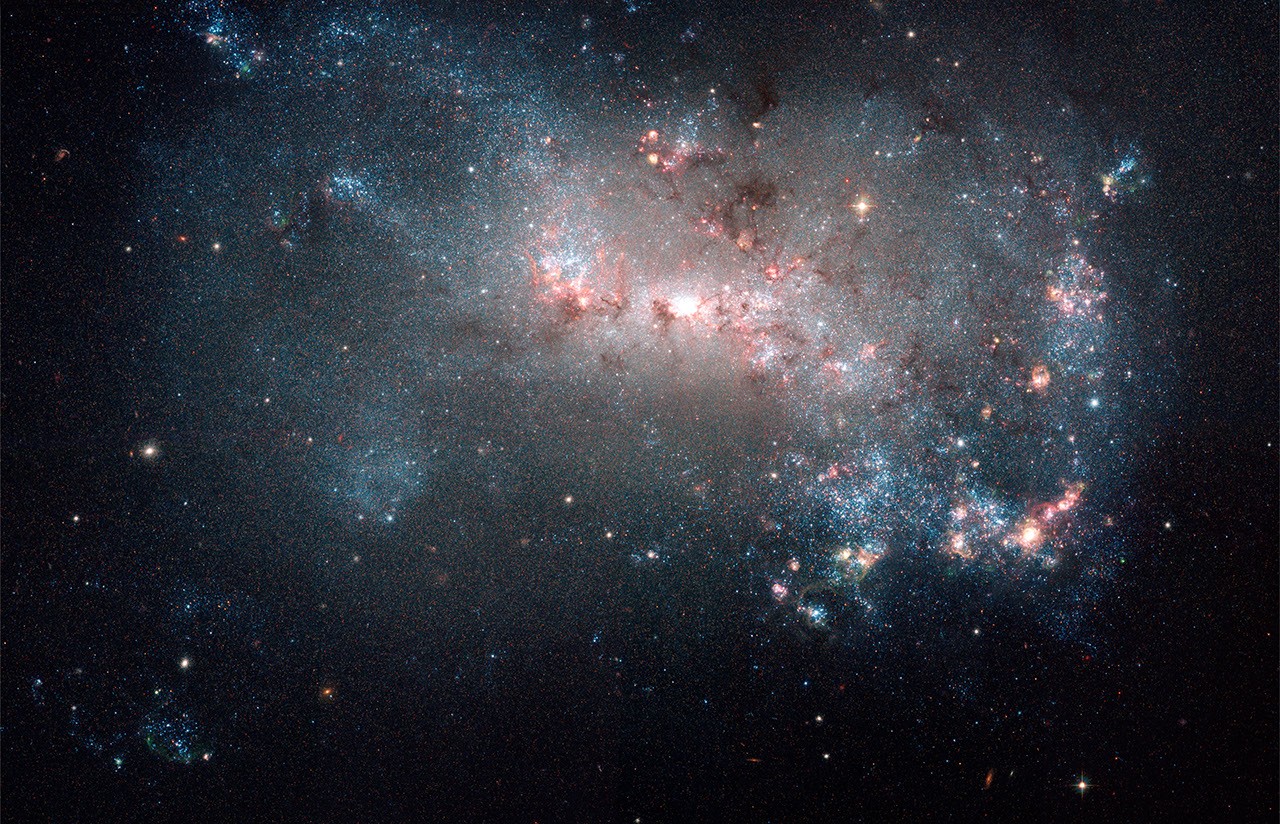
NASA’s Hubble Space Telescope has uncovered a surprising cosmic puzzle: nearby dwarf galaxies appear to be losing a significant amount of the oxygen produced by their stars. This discovery challenges current astrophysical models and offers crucial insights into how galaxies evolve and enrich the vast expanse of space.
Galactic Winds Carry Oxygen Away
For decades, scientists have understood that stars forge heavier elements, including oxygen, through nuclear fusion. This oxygen is then dispersed into the galaxy when stars reach the end of their lives, often in spectacular supernova explosions. However, a new study utilizing Hubble’s sharp vision of 37 small, nearby dwarf galaxies has revealed that these galaxies retain only a fraction of the oxygen they create. Researchers believe powerful galactic winds, fueled by these stellar explosions, are efficiently ejecting this vital element into the intergalactic medium.
“Oxygen is produced by stars, which are inside of galaxies. We know that the oxygen had to be inside of the galaxies at some point in the past, so the oxygen must have been ejected,” explained co-investigator Grace Telford of the University of Utah. “And to do that, you need energy from massive stars and supernova explosions to drive material out of the host galaxies and into the space between galaxies.”
Why Oxygen is Key to Understanding Galaxies
The study, part of the Galaxies Losing Oxygen via Winds (GLOW) project, focused on oxygen for practical reasons. As one of the most abundant elements after hydrogen and helium, oxygen is relatively straightforward to detect and measure. Its production process is also well-understood, making it an excellent tracer for how chemical elements are distributed within and beyond galaxies.
“So, it’s really for practical reasons that we’ve chosen oxygen,” said Kristen Wingfield McQuinn, the principal investigator for GLOW and mission head for the Nancy Grace Roman Space Telescope’s Science Operations Center. “Oxygen is one of the primary elements formed by stars. Being able to trace how much oxygen gets made, and then how much is distributed inside and outside of galaxies, helps us understand galaxy evolution. It also helps us learn where and how much galaxies are enriching the space between galaxies, called the intergalactic medium.”
The research team analyzed archival data from Hubble, as well as from NASA’s Spitzer Space Telescope and ground-based radio telescopes. By examining dwarf galaxies close enough for Hubble to resolve individual stars, they were able to reconstruct star-formation histories and determine the chemical composition of these celestial objects. This detailed analysis confirmed that these low-mass galaxies are particularly effective at expelling large quantities of oxygen, offering a new perspective on the processes that shape the universe.
Source: NASA