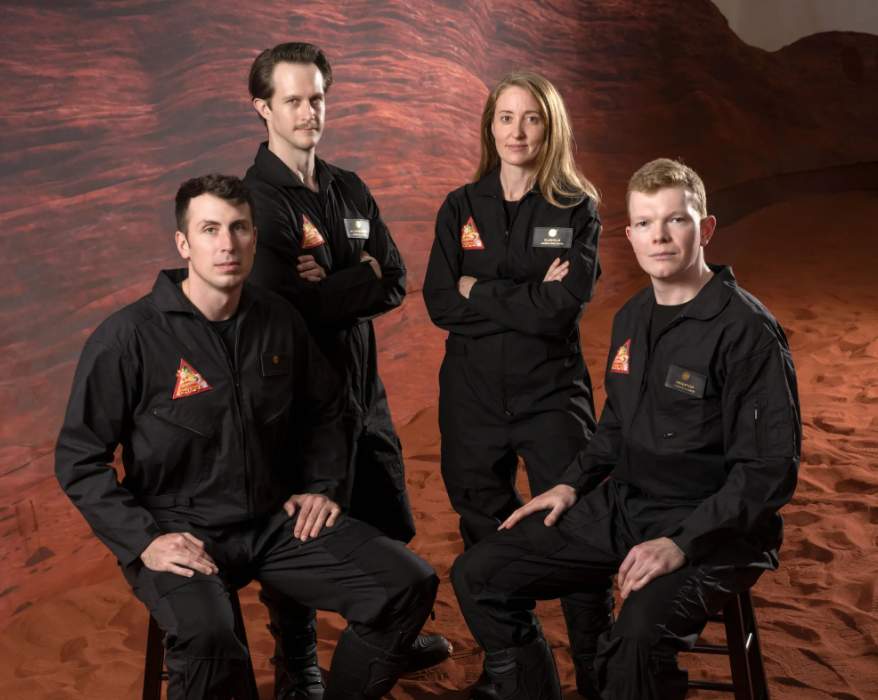
Four NASA crew members have successfully completed a 378-day isolation period, simulating a long-duration mission to Mars. The crew emerged from their 3D-printed habitat at Johnson Space Center in Houston on October 31st, marking the end of an intensive analog mission designed to prepare astronauts for future expeditions to the Red Planet.
Completion of Extended Simulation
The mission, known as CHAPEA (Crew Health and Performance Exploration Analog), aimed to study crew health and performance in conditions as close as possible to those experienced in space. The four crew members – Commander Ross Elder, Science Officer Matthew Montgomery, Mission Engineer James Spicer, and Medical Officer Ellen Ellis – entered the 1,700-square-foot habitat on October 19, 2025.
Throughout the year, the astronauts engaged in a variety of tasks simulating life and work on Mars. These included cultivating crops in simulated Martian soil and communicating with mission control. To enhance realism, communication delays were intentionally introduced, mirroring the actual time lag experienced when communicating between Earth and Mars.
Research Goals and Findings
The primary goal of CHAPEA is to understand how the human body and psyche respond to prolonged periods away from Earth. NASA seeks to gather data on how astronauts adapt to routines, daily needs, and the psychological challenges of extended missions, ultimately aiming to support their health, efficiency, and connection to home.
Ellen Ellis, the mission’s medical officer, shared her perspective: “This past year has been extraordinarily challenging – we’ve essentially ‘imprisoned’ ourselves as simulated astronauts.” However, she also emphasized the project’s significance: “Let’s take initiative, put science first, benefit our economy, and pass on a space legacy to our descendants.”
Next Steps
Following their emergence from isolation, the crew will undergo a two-week mission debrief and evaluation. They will also share their reports and findings with NASA scientists. This data will be instrumental in shaping future strategies for planning long-duration spaceflights, particularly in preparation for crewed missions to Mars.
Second CHAPEA Simulation
It is important to note that this is the second CHAPEA simulation conducted by NASA. A previous crew of four astronauts also spent 378 days in isolation at the Johnson Space Center, concluding their mission around 2023-2024. This demonstrates NASA’s consistent approach to studying the multifaceted aspects of long-duration space travel and preparing for ambitious future missions.