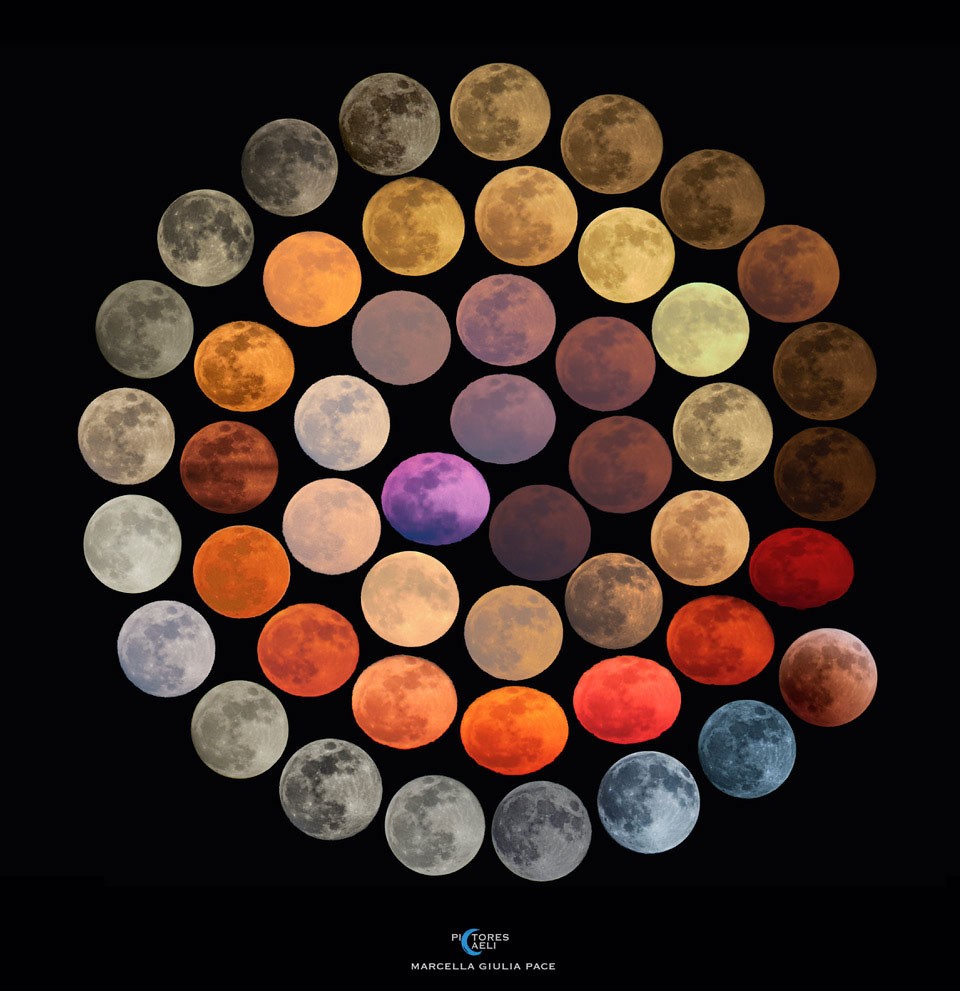
Have you ever wondered about the Moon’s true color? While we typically perceive it as white or yellowish, its hues can actually be far more diverse. Scientists at NASA have unveiled a striking collection of photographs showcasing the varied colors of our natural satellite, documented over a decade by astrophotographer Marcello Giulia Pace.
The Moon’s Enigmatic Colors: Hues Born from Atmosphere
At first glance, the Moon, illuminated by reflected sunlight, appears brownish-gray. However, when observed from Earth, our planet’s atmosphere can perform remarkable feats, imbuing it with unexpected colors. A red or yellow Moon typically indicates it’s viewed low on the horizon. In such cases, the blue portion of light scatters over a longer path through an atmosphere potentially laden with fine dust. An even rarer phenomenon is the blue Moon, which can suggest the presence of larger dust particles in the air. The reasons behind a purple lunar hue remain under investigation, possibly resulting from a combination of atmospheric effects.
When Earth’s Shadow Casts Color Upon the Moon
Beyond atmospheric phenomena, total lunar eclipses significantly influence the Moon’s color. The most vivid example is the 2018 eclipse, where our satellite, enveloped in Earth’s shadow, took on a subtle reddish tint. This effect is caused by light refracting through Earth’s atmosphere, filtering out specific wavelengths and lending the Moon its dramatic red coloration.
Source: NASA