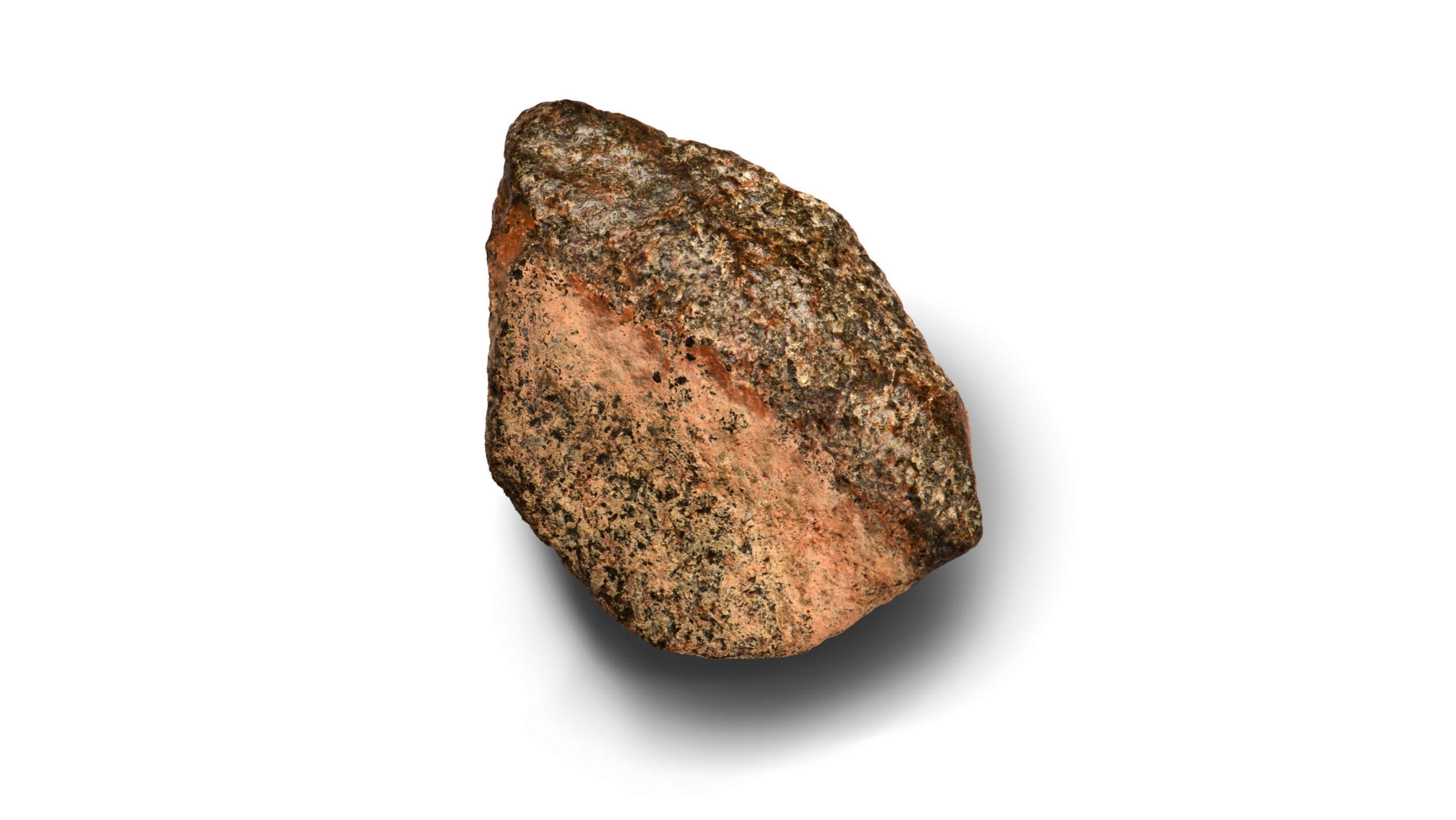
A NASA-funded research team has conducted a detailed analysis of Teghaza 001, a rare Martian meteorite discovered in the Sahara Desert in 2022. This unusual pinkish rock is among the oldest known Martian meteorites, with an estimated age exceeding 4.1 billion years. Its study provides a unique opportunity to investigate the early formation of Mars’ crust and the interaction of water with its rocks.
A Pink Stone from Deep Antiquity
The Teghaza 001 meteorite, named after the salt flat in Mali where it was found, weighs nearly a kilogram. It joins the ranks of approximately 435 known Martian rock samples that have landed on Earth. Unlike other ancient Martian meteorites, such as ALH84001 (of similar age but composed primarily of a single mineral) or the “Black Beauty” (formed around 2.1 billion years ago from volcanic fragments), Teghaza 001 exhibits a complex mixture of igneous (volcanic) minerals. This mineral diversity allows scientists to reconstruct the history of the Martian crust’s formation from cooling magma, as well as subsequent alterations caused by groundwater. The mineralogical composition of Teghaza 001 remarkably aligns with observations made by NASA’s Mars Reconnaissance Orbiter in the cratered southern highlands of the Red Planet.
Traces of Ancient Water and Atmosphere
The discovery was made possible by a new radioisotope dating method developed at the California Institute of Technology (Caltech). This technique, which dates individual mineral grains while preserving the valuable sample, revealed that the meteorite was altered by Martian water approximately 4.1 billion years ago. Scientists identified zircon crystals, which act as natural “chronographs” recording the rock’s formation history. The study of Teghaza 001 offers a rare chance to examine a section of the Martian crust for which samples were previously unavailable. Researchers suggest the meteorite might hold an imprint of Mars’ early atmosphere, a period when the planet was losing water. Further analysis of the meteorite could help answer key questions about the Red Planet’s evolution, including the role of water in shaping its surface and its potential habitability in the past.